
When it matters: Contributions by December 31. Conversions should follow as soon as the money lands.
Does this fit you?
- Your plan document explicitly allows after-tax contributions and either in-service withdrawals or in-plan Roth conversions. Both features, not one.
- You are already contributing the full ordinary deferral, with money left over that would otherwise sit in a taxable account.
- You have a long horizon — the benefit is entirely in what happens to the money later, not in this year's tax.
What it could be worth
Nothing this year. After-tax contributions go in with dollars that have already been taxed, so there is no deduction and the current-year bill does not move.
What changes is the treatment of future growth. Once the after-tax amount is moved to the Roth side, qualified withdrawals in retirement are not taxed again — which is the difference between that money growing inside a retirement plan and growing in a brokerage account where dividends and gains are taxed along the way.
The size of that difference depends on how much goes in, how long it grows, and what rates look like decades from now. Nobody knows the third one.
| 2026 ordinary employee deferral limit | $24,500 |
|---|---|
| 2026 overall limit on everything added to the account | $72,000 |
| Employer contribution, in this illustration | $10,000 |
| After-tax room left, in this illustration | $37,500 |
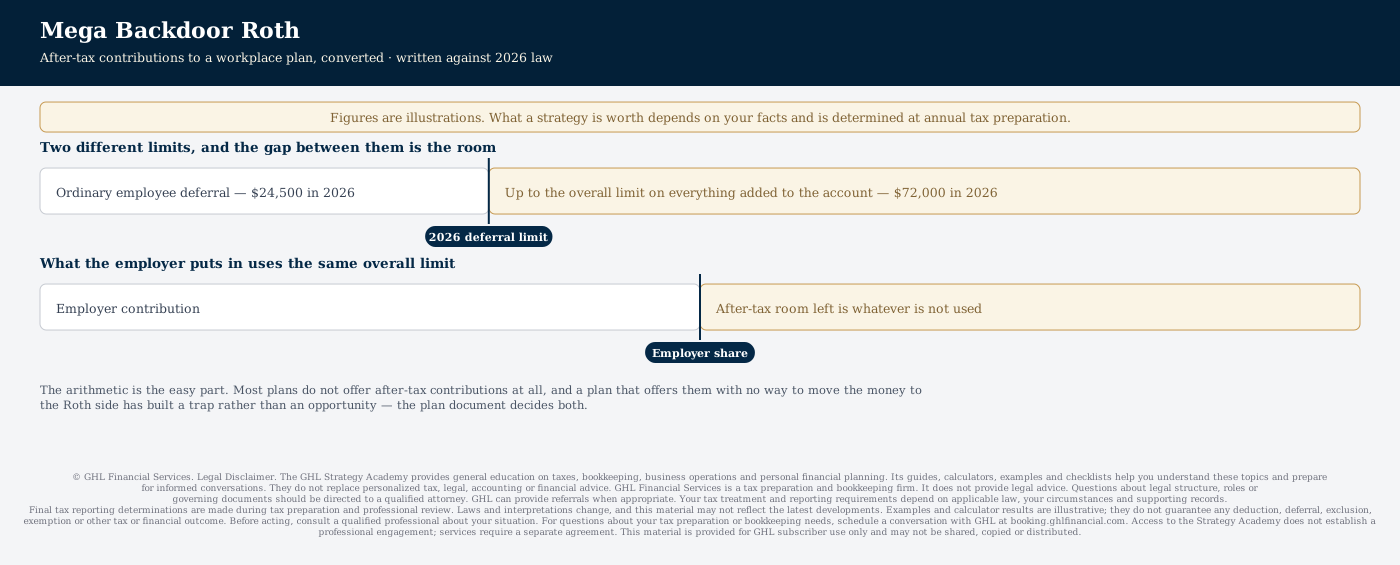
2026 limits. The overall limit counts the employee deferral, the employer contribution and the after-tax amount together, so the room left is whatever the first two do not use. Catch-up contributions from age 50 sit outside the overall limit and are not shown. Most plans do not offer the after-tax feature at all, in which case the room is nil regardless of the arithmetic.
How it works
The ordinary deferral limit and the overall limit on additions to the account are two different numbers. The gap between them is the room this uses.
After-tax contributions are a third category, separate from pre-tax and Roth deferrals. A plan has to offer them specifically; most do not.
The dollars then have to be able to move to the Roth side, either as an in-plan conversion or as an in-service withdrawal rolled to a Roth IRA. A plan that allows after-tax contributions but no way out has created a trap rather than an opportunity.
Earnings on the after-tax amount before it moves are taxable when it moves. The longer the gap, the more of the conversion is taxable, which is why plans that convert automatically each pay period are treated differently from those that do it annually.
The plan may also have to pass a non-discrimination test on after-tax contributions, which can force a refund of part of what was put in.
A self-employed person with a solo plan can adopt these provisions, but the plan document has to say so — it is not a default.
What you would do
- Ask your employer's benefits contact, or read the summary plan description, for two things by name: after-tax contributions, and in-service withdrawals or in-plan Roth conversions.
- If both are there, find out how often the conversion can happen. Every pay period is very different from once a year.
- Confirm the employer contribution you expect for the year before working out the room — it uses the same limit.
- Keep the year-end statement showing the after-tax balance, and the form reporting each conversion.
- Bring it to GHL before the first contribution rather than at filing. The reporting is where this goes wrong.
Allow one to two months. Some of it depends on other people.
Worksheets to use
- Workplace plan feature and conversion record (XLSX). A record of what the plan document actually allows, who confirmed it and when, and a line for every after-tax contribution and each conversion. Fill in the feature block once, from the plan document rather than from memory of a conversation. Then add a line each time money goes in and each time it moves, with the date — the gap between the two is what decides how much of the conversion is taxable.
What GHL needs from you
- The summary plan description, or the pages of it covering after-tax contributions and in-service distributions.
- Your deferrals for the year and the employer contribution.
- The statements showing the after-tax balance and each conversion.
- Any form reporting a distribution or conversion from the plan.
- Whether any part of the contribution was refunded after a plan test.
What usually goes wrong
- Most plans do not offer after-tax contributions. Read the plan document before making any of this a plan.
- Earnings between the contribution and the conversion are taxable when it happens, so a long gap costs money.
- A self-employed person only has this if their own plan document adopts both features — it is not a default.
Common questions
My plan lets me contribute after-tax but says nothing about conversions. Is that enough?
No. Without a way to move the money to the Roth side it is an after-tax balance in a retirement plan, and its growth is taxable when it comes out. That is worse than most alternatives, not better.
Is this the same as a backdoor Roth?
No. That one uses an IRA and is limited to the IRA contribution amount. This uses a workplace plan and the room is much larger — where the plan allows it at all.
I am self-employed. Does this apply?
Only if your solo plan document adopts the after-tax and in-service provisions. Off-the-shelf documents from the large providers often do not, so it is a question to ask before assuming.
Keeping it alive
A position is not finished when it is set up. This is what it needs each year to still be there when it matters.
- Confirm it still applies — circumstances change more often than the law does.
- Keep the record current. Filled in as the year happens it is evidence; assembled in March it is a reconstruction.
- Check the documents still say what they said — an agreement that has drifted from practice is the usual failure.
- Ask GHL what changed for 2027. Figures move every year and rules move most years.