
When it matters: Ongoing, alongside the gifting cycle. Each transfer is appraised at the time.
Does this fit you?
- Your family has an active operating business or real, managed assets — not a portfolio in a wrapper.
- Your family already does systematic gifting and wants a structure around it.
- You are willing to run the entity properly for years: meetings, accounts, separate money, real decisions.
What it could be worth
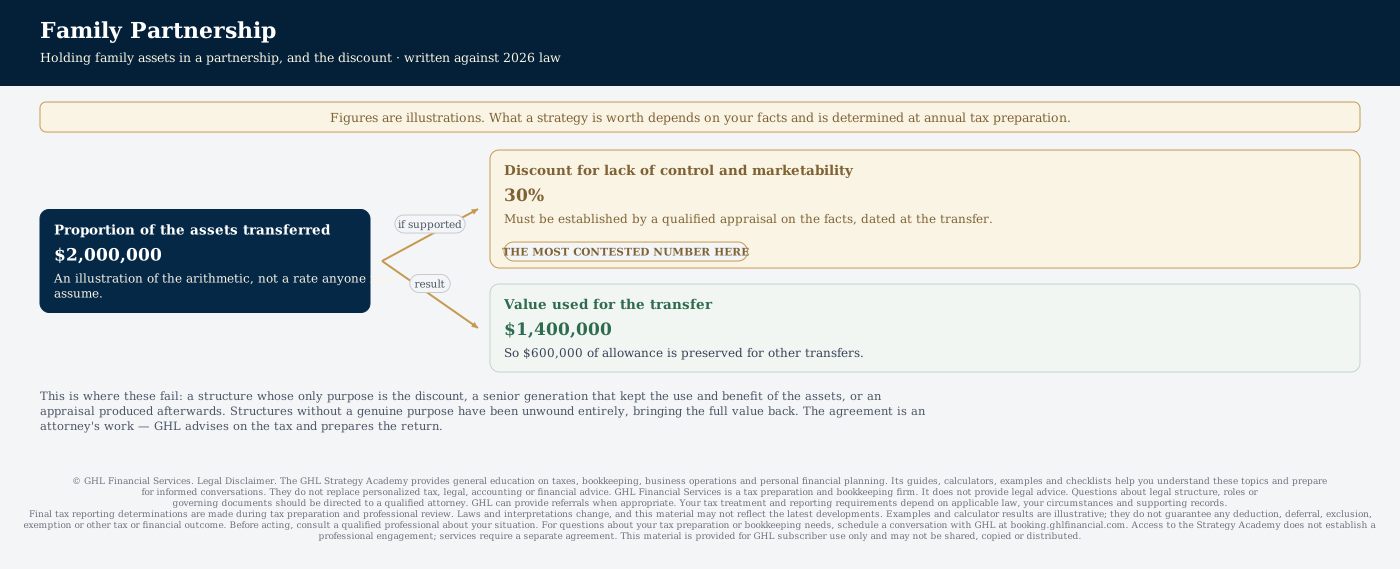
An interest without control, which cannot readily be sold, is generally worth less than the same proportion of the underlying assets. A transfer of that interest is valued accordingly, so more economic value moves for the same amount of allowance used.
That discount is the whole attraction and it is the most contested valuation question in this area. It has to be supported by a qualified appraisal, and the structure has to justify it.
It is not an income tax strategy. It changes what transfers are valued at; it does not reduce income tax on what the assets earn, and it adds a partnership return to the family's filing obligations.
| Underlying value of the proportion transferred | $2,000,000 |
|---|---|
| Combined discount for lack of control and marketability, in this illustration | 30% |
| Value used for the transfer | $1,400,000 |
| Allowance preserved for other transfers | $600,000 |
The discount is not a rate that can be assumed — it must be established by a qualified appraisal on the facts, it is frequently challenged, and structures without a genuine purpose have been unwound entirely, bringing the assets back into the estate. Estate and gift thresholds have been legislated more than once.
How it works
Assets are contributed to a partnership. The senior generation typically retains a general interest and control; limited interests are transferred over time.
Those limited interests lack control and cannot readily be sold, which is why they are valued below a proportionate share of the assets.
The discount has to rest on a qualified appraisal, and the appraisal has to rest on facts — what the partnership actually does, what the agreement actually says, and how it has actually been run.
This is the area where structures fail. Where the senior generation keeps the use and benefit of the assets, or where the partnership has no purpose beyond the discount, it can be disregarded and the full value brought back.
Running it properly means real separation: its own accounts, its own money, documented decisions, distributions that follow the agreement, and personal expenses kept out.
Funding it with an operating business or managed assets is very different from funding it with a securities portfolio. The second has repeatedly had a harder time.
The partnership files its own return and issues statements to the partners each year. That is a permanent addition to the family's compliance.
What you would do
- Start with the attorney. The partnership agreement is the structure, and it is legal work — GHL advises on tax consequences and prepares the returns, and does not draft it.
- Be honest about purpose. If the only reason is the discount, that is the fact pattern that has gone badly for families in litigation.
- Get a qualified appraisal for every transfer, at the time of the transfer. An appraisal produced later is worth much less.
- Run it as a real entity: separate bank accounts, minutes, distributions that follow the agreement, and no personal use of partnership assets.
- Keep a complete record of every transfer and the appraisal behind it. These questions are often examined long after everyone has forgotten the detail.
Allow three to six months. It needs documents, and usually somebody else to draw them.
What GHL needs from you
- The partnership agreement and any amendments.
- The appraisal supporting each transfer, dated at the transfer.
- A record of every transfer: date, interest, recipient.
- The partnership's accounts and bank records.
- Minutes or records of decisions, and evidence that distributions followed the agreement.
What usually goes wrong
- Structures formed shortly before death, or with no business purpose, have been attacked successfully.
- Where the senior generation kept the use or control of the assets, the full value can be pulled back into the estate.
- Large discounts are examined closely, and need a credentialed valuation behind them.
Common questions
Can I put my investment portfolio in one?
It has been done and it has repeatedly fared worse than a structure holding an operating business or actively managed assets. The weaker the purpose beyond the discount, the weaker the position.
What discount can I take?
Whatever a qualified appraisal supports on your facts. A percentage quoted in advance is not a discount; it is an assumption, and this is the area where assumptions are tested hardest.
Can GHL set one up?
No. The agreement is legal work and belongs with an attorney. GHL advises on the tax consequences, prepares the partnership return, and can introduce you to advisors who do this work.
Keeping it alive
A position is not finished when it is set up. This is what it needs each year to still be there when it matters.
- Confirm it still applies — circumstances change more often than the law does.
- Check the documents still say what they said — an agreement that has drifted from practice is the usual failure.
- Ask GHL what changed for 2027. Figures move every year and rules move most years.