
When it matters: Claimed with the return. Both provisions are legislated to end after 2028.
Does this fit you?
- Your hourly employees work beyond forty hours in a week and are paid a premium for it.
- You are in an occupation that is customarily tipped — the list is maintained by Treasury rather than by custom.
- Both fade out as your income rises, so they are worth most to the people they were written for.
What it could be worth
These are deductions taken against income rather than itemized, so they help whether or not somebody itemizes. Both were created together and both are temporary — they apply to tax years 2025 through 2028 and end after that unless they are extended.
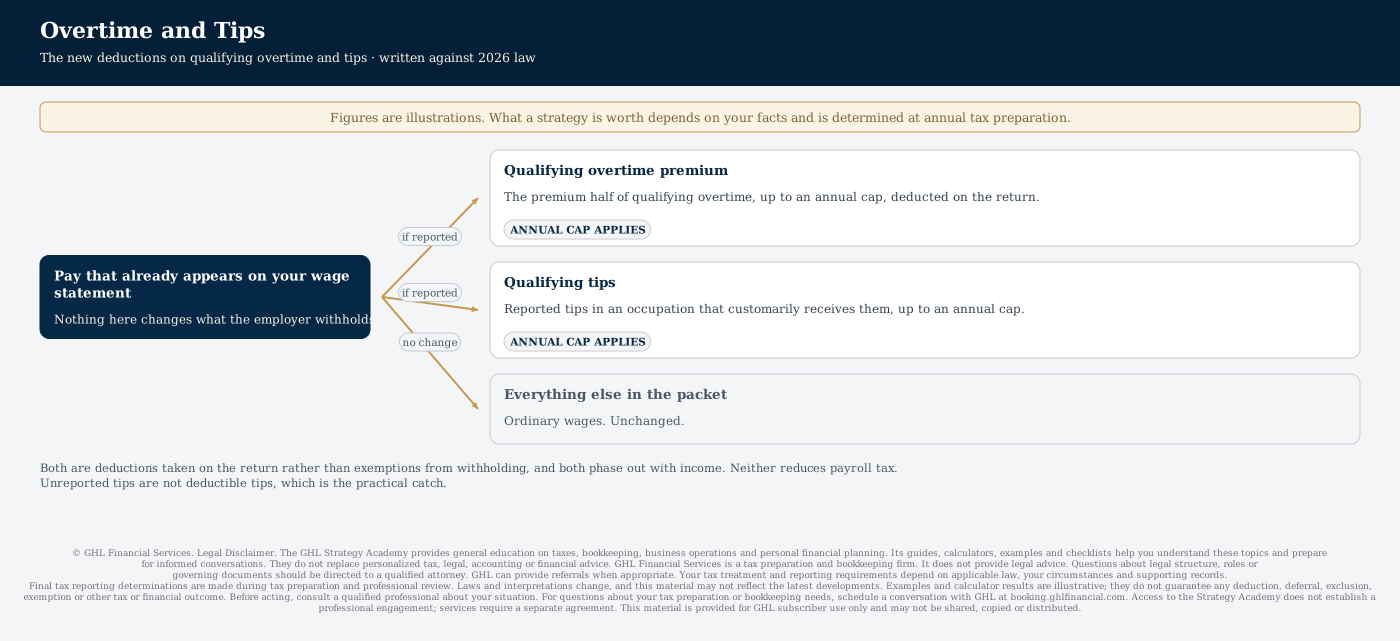
The overtime one is narrower than it sounds, and the misunderstanding is expensive. Only the premium part of overtime pay counts — the extra half-rate above the normal hourly rate, not the whole of the overtime hours and certainly not the whole week's pay.
| Pay for 50 hours at the regular rate | $1,250 |
|---|---|
| Overtime premium — 10 hours at the extra half-rate | $125 |
| Gross pay for the week | $1,375 |
| The part that is deductible | $125 |
| Most overtime that can be deducted in a year (each year through 2028) | $12,500 single / $25,000 joint |
| Most tips that can be deducted in a year (each year through 2028) | $25,000 |
| Reduction begins above (through 2028) | $150,000 single / $300,000 joint MAGI |
One week, a regular rate of $25, and overtime the employer is required to pay a premium on. The deductible figure is the premium alone — not $187.50, and not the week's gross. The annual maximums and the income threshold are set in the statute for 2025 through 2028 and are not indexed for inflation (IRC §224 and §225, as added by P.L. 119-21 §70201 and §70202).
How it works
Overtime: the deduction covers the premium portion of overtime that is required to be paid at a higher rate, which is the extra half above the regular rate. Overtime paid voluntarily, or at a flat rate with no premium, does not produce the same figure.
Tips: voluntary tips count where the occupation is one Treasury has designated, and both cash and card tips qualify as long as they are reported. A mandatory service charge — the automatic gratuity added to a large table — is not a tip; it is wages, and it does not qualify.
Tips received in an occupation that is not on the list do not qualify, however voluntary they were.
Both phase out as income rises, at a level that most people doing this work are comfortably below.
Both rely on the figures being reported properly, which means the payroll side has to identify them. If a payslip does not separate the premium, that is a conversation with the employer rather than something to estimate later.
What you would do
- Keep every payslip for the year, not just the year-end summary.
- Check the W-2 separates the amounts these deductions rely on, and raise it with the employer early in the year if it does not.
- Report tips properly through the year — an unreported tip cannot be deducted.
- Tell GHL if you work in more than one job; the phase-out looks at total income.
What GHL needs from you
- The W-2, including the boxes reporting overtime premium and tips.
- Payslips for the year where the W-2 does not separate the figures.
- Records of tips reported, particularly for self-employed work.
- Total income from all sources, for the phase-out.
What usually goes wrong
- It is the premium half of qualifying overtime, not the whole of the overtime pay. That is the most common misreading.
- Both phase out with income and reach nil well before the top bracket.
- Unreported tips are not deductible tips.
- Both are scheduled to end after 2028, so nothing beyond that year should be planned around them.
Common questions
My overtime was $187.50 for the week. Is that the deduction?
No. The deductible part is the premium — the extra half-rate above your regular rate for those hours — which in that example is $125.
Does the automatic gratuity on a large table count as a tip?
Generally no. A mandatory service charge is treated as wages rather than a tip, and does not qualify.
How long do these last?
They apply to tax years 2025 through 2028 as enacted, and end after that unless extended. Do not build a long-term plan on them.