
When it matters: Counted from the date the return was filed, or its due date if later. A return filed early is treated as filed on the due date, so the clock does not start sooner for being prompt.
Does this fit you?
- Everybody, once a year, when the filing cabinet fills up.
- You own property or a business interest, where the basis records outlive everything else.
- You are about to sell something you have owned a long time.
What it could be worth
Nothing directly. What it prevents is a deduction or a basis you genuinely had being disallowed because the paper is gone — which is the most avoidable tax cost there is.
The largest single case is basis. A property sold without improvement records is taxed on a gain computed from the purchase price alone, and the difference can be a very large number.
The second is a retirement account with non-deductible contributions in it. Without the records, money that was already taxed once gets taxed again on the way out.
| Ordinary returns and their backup | at least three years from filing |
|---|---|
| If income was substantially understated | six years |
| A return never filed, or fraud | no expiry |
| Property purchase and improvement records | as long as you own it, then the usual period |
| Business interest basis schedule | for the life of the interest |
| Non-deductible retirement contributions | until the account is emptied |
| Employment tax records | a longer period of their own |
The general period runs from the filing date or the due date, whichever is later. The extensions described apply on their own terms and some run alongside each other. State periods can be longer than the federal one, so where a state return was filed its own rule applies as well.
How it works
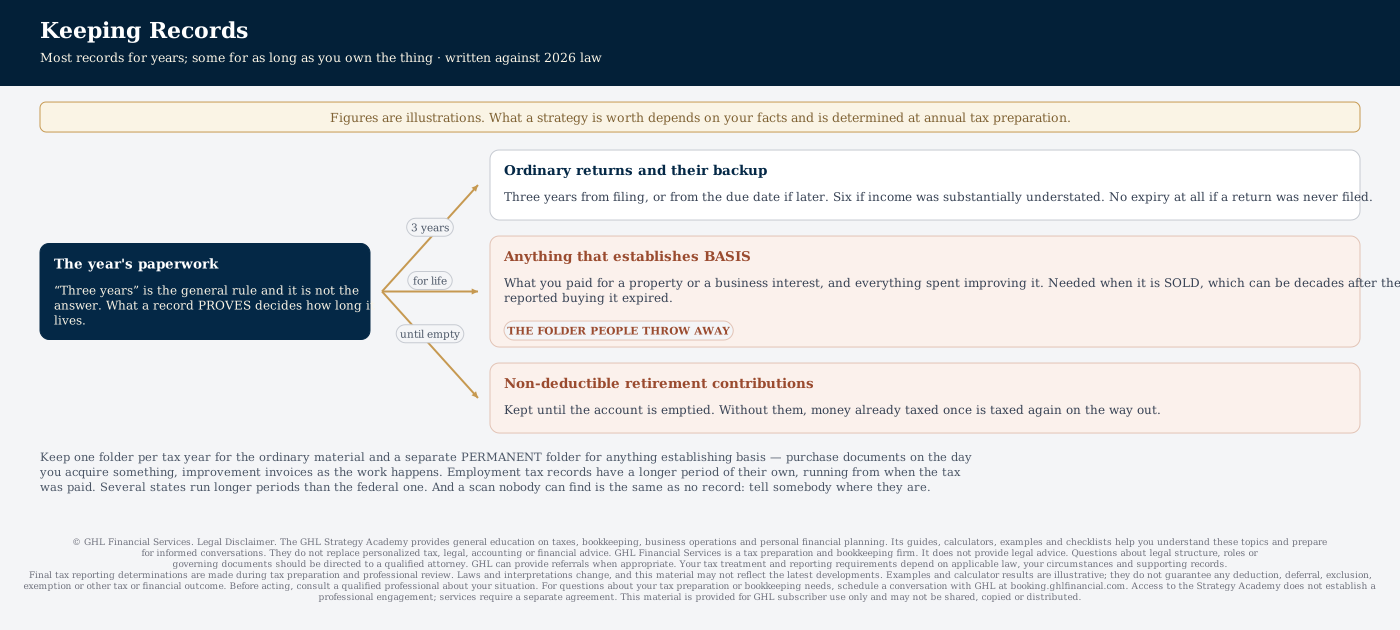
The general period during which a return can be examined is three years from filing, or from the due date if that is later.
Substantially understating income extends that to six years.
A return that was never filed, or one involving fraud, has no expiry.
A claim for a refund has its own period, which is why supporting records matter even when nothing is in dispute.
Records that establish BASIS are different in kind: they are needed when the asset is sold, so they stay live for as long as the asset is held plus the usual period afterwards.
Where a gain is deferred by exchanging one asset for another, the old records carry forward with the basis.
Employment tax records have a separate, longer period running from when the tax was paid.
States set their own periods, and several are longer than the federal one.
What you would do
- Keep one folder per tax year for the ordinary material, and a SEPARATE permanent folder for anything that establishes basis.
- Put the purchase documents for every property and every business interest in the permanent folder on the day you acquire it.
- Add every improvement invoice to the permanent folder as it happens. That is the register that gets lost.
- Keep the record of any non-deductible retirement contribution permanently, not for three years.
- Scan, and keep the scans somewhere a second person could find them. Tell somebody where.
- Before throwing anything away, ask whether it establishes basis. If it does, keep it.
Usually a week or two — mostly things you can start yourself.
Worksheets to use
- Property improvement register (XLSX). Every improvement made after purchase, with what it was and what it cost — the permanent record that decides the gain when the property is sold. Add to it as work happens and keep it with the purchase documents rather than in the year's folder. It outlives every other record connected with the property, which is exactly why it is the one most often thrown away.
- Record retention schedule (XLSX). What to keep, how long to keep it, and where yours actually is. Fill in the location column — it is what makes the sheet useful — and date the review. Keep one copy of anything marked permanently away from your own home or office.
What GHL needs from you
- Purchase documents for property and business interests.
- The improvement register for each property.
- Records of any non-deductible retirement contributions.
- Returns for any year still within its period.
- Where the permanent records are kept, and who else can reach them.
What usually goes wrong
- Three years is the general period, not the answer. Substantially understating income extends it to six, and a return never filed has no expiry at all.
- Basis records are the ones people throw away. What you paid for a property, and everything spent improving it, is needed when it is SOLD — which can be forty years later, long after the return that reported the purchase has expired.
- The same is true for a business interest. A basis schedule is a running balance and the oldest year matters as much as the newest.
- Records for a retirement account that ever received a non-deductible contribution have to be kept until the account is emptied, or the untaxed portion cannot be proved and is taxed again.
- Property records restart when the property is exchanged rather than sold. A deferred gain carries the old basis forward, so the old documents stay live.
- Employment tax records have their own period, which is longer than the usual one and runs from when the tax was paid rather than when the return was filed.
- Digital copies are generally fine, but a folder nobody can find is the same as no folder. Where it is kept matters as much as that it was kept.
Common questions
Can I shred everything after three years?
Not everything. Three years covers the ordinary material. Anything that establishes basis — what you paid, what you spent improving it — is needed when the asset is sold, which may be decades later, so it belongs in a permanent folder instead.
Are scans good enough?
Generally yes. The practical failure is not the format but the filing: a scan nobody can locate is the same as no record. Keep them somewhere findable and tell somebody else where they are.
What about the state?
Where a state return was filed, keep the records for the longer of the two.
Read next
Keeping it alive
A position is not finished when it is set up. This is what it needs each year to still be there when it matters.
- Confirm it still applies — circumstances change more often than the law does.
- Keep the record current. Filled in as the year happens it is evidence; assembled in March it is a reconstruction.
- Put the date in the calendar. This one closes at the year end and cannot be added at tax preparation.
- Ask GHL what changed for 2027. Figures move every year and rules move most years.