
When it matters: Recomputed every year in order. Basis is a running balance, so a year that was never computed has to be reconstructed before the current one can be.
Does this fit you?
- You are a shareholder in an S corporation or a partner in a partnership.
- Your business has made losses, or you have taken distributions beyond the profits.
- You are about to sell or wind up an interest in a business.
What it could be worth
Basis does not save tax by itself. It decides whether a loss you have already suffered is deductible this year or in some later one, and whether money you have already taken out is taxed.
The difference is timing, and it can be years. A loss suspended for want of basis sits waiting; putting capital in before year end can release it.
It also decides the gain when the interest is sold, which is usually the largest single number in an owner's tax life. A basis schedule kept from the start is worth more at that moment than anything else in the file.
| Basis at the start of 2026 | $50,000 |
|---|---|
| Plus your share of income | + $30,000 — applied first |
| Less distributions taken | − $60,000 — applied second |
| Basis before losses | $20,000 |
| Your share of the loss | $35,000 — only $20,000 is usable now |
| Suspended to a later year | $15,000, waiting for basis |
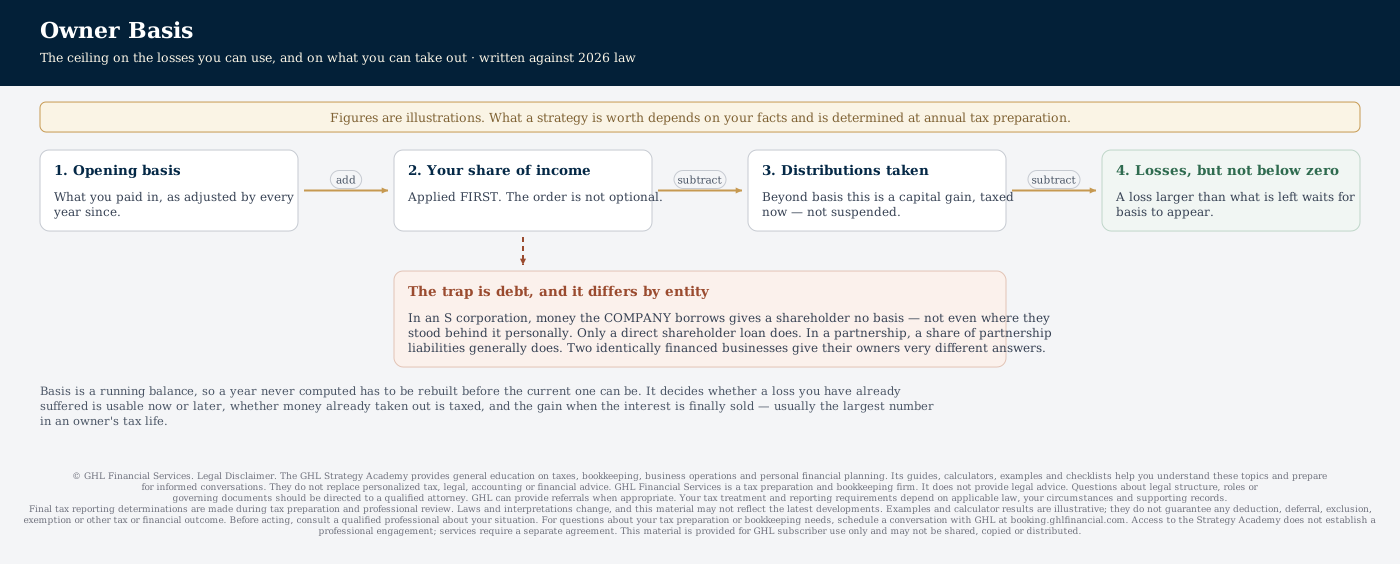
Income is applied before distributions, and distributions before losses. A distribution beyond basis is generally a capital gain. In an S corporation only direct shareholder loans create debt basis; entity-level borrowing does not. In a partnership a share of partnership liabilities generally does.
How it works
Basis starts at what you paid in — cash, property at its carried-over value, or what you paid a previous owner.
Each year it increases by your share of income and by anything further you contribute.
It decreases by distributions taken, then by your share of losses and deductions, in that order.
It cannot go below zero. A loss that would take it below zero suspends and carries forward.
A distribution beyond basis does not suspend — it is a gain, taxed now.
In an S corporation you have stock basis and, separately, debt basis from money you personally lent the company. Losses use stock basis first, then debt basis; later income restores debt basis before stock.
In a partnership, your share of the partnership's liabilities is generally included in basis, which is why partners often have basis where an identically financed S-corporation shareholder has none.
Suspended losses are released in any later year in which basis appears.
What you would do
- Keep a basis schedule from the first year, one row per year. Reconstructing it later is the expensive version of this.
- Record every contribution and every distribution as it happens, with dates and amounts.
- Keep loan documents for anything you lend the business, with a note and a rate. A transfer with no paperwork may not create debt basis.
- If losses are coming and basis is thin, speak to GHL BEFORE year end — putting capital in afterwards does not release that year's loss.
- Do not stand behind a company loan expecting basis from it. If basis is the point, borrow personally and lend it on.
Worksheets to use
- Owner basis schedule (XLSX). One row per year: opening basis, income, contributions, distributions, losses used, losses suspended, and the closing balance — with stock and loan basis kept apart. Start it in year one and add a row every year. It is a running balance, so a missing year has to be rebuilt before the current one can be computed, and it is the first thing asked for when the business is sold.
What GHL needs from you
- Your basis schedule, or everything needed to rebuild it.
- Contributions and distributions for the year, with dates.
- Loans you have made to the business, and the documents.
- The entity's annual statements of your share of income and loss.
- Any change in ownership percentage during the year.
What usually goes wrong
- A loss larger than your basis is not lost, but it is not usable this year either. It suspends and waits for basis to appear.
- A distribution larger than your basis is a taxable gain. Owners take money out of a profitable-looking company and find they have created a capital gain with it.
- The order matters: income increases basis first, then distributions reduce it, and only then do losses. Getting the order wrong changes the answer.
- In an S corporation, money the company borrows does NOT give you basis. Only what you lend it personally does. In a partnership, a share of partnership debt generally does. This is the single largest difference between the two, and it is routinely assumed to work the same way.
- Standing behind a company's bank loan as surety gives an S-corporation shareholder no basis. Borrowing personally and lending the money on does.
- Basis has to be tracked by the owner. The company's return does not compute it for you, and nobody reconstructs twenty years of it easily.
Common questions
The company borrowed from the bank. Does that give me basis?
In an S corporation, no — not even where you stood behind it personally. In a partnership, a share of the partnership's debt generally does. That difference decides whether a loss is usable, and it surprises people every year.
I took out more than the profit. What happens?
Up to your basis it is generally not taxed and reduces basis. It is worth checking before taking the money rather than after.
I have never kept a basis schedule. How bad is that?
Workable but expensive. It is rebuilt from the entity returns, the contribution and distribution history and the loan documents. The time to do it is before a sale, not during one.
Read next
Keeping it alive
A position is not finished when it is set up. This is what it needs each year to still be there when it matters.
- Confirm it still applies — circumstances change more often than the law does.
- Keep the record current. Filled in as the year happens it is evidence; assembled in March it is a reconstruction.
- Ask GHL what changed for 2027. Figures move every year and rules move most years.