
When it matters: State and municipal returns are filed separately and can have different rules about who has to file. A municipality generally wants a return even in a year with nothing owing.
Does this fit you?
- You live in Ohio, particularly if you work in a different municipality from the one you live in.
- You own an Ohio business, because of the business income deduction.
- You started working from home and have not revisited your municipal position since.
What it could be worth
The business income deduction is the largest single item for an owner: the first $250,000 of business income is removed before any state rate applies, and what remains is taxed at a flat 3%.
At the personal level, the untaxed first slice means a modest income pays a much lower effective rate than the top rate suggests.
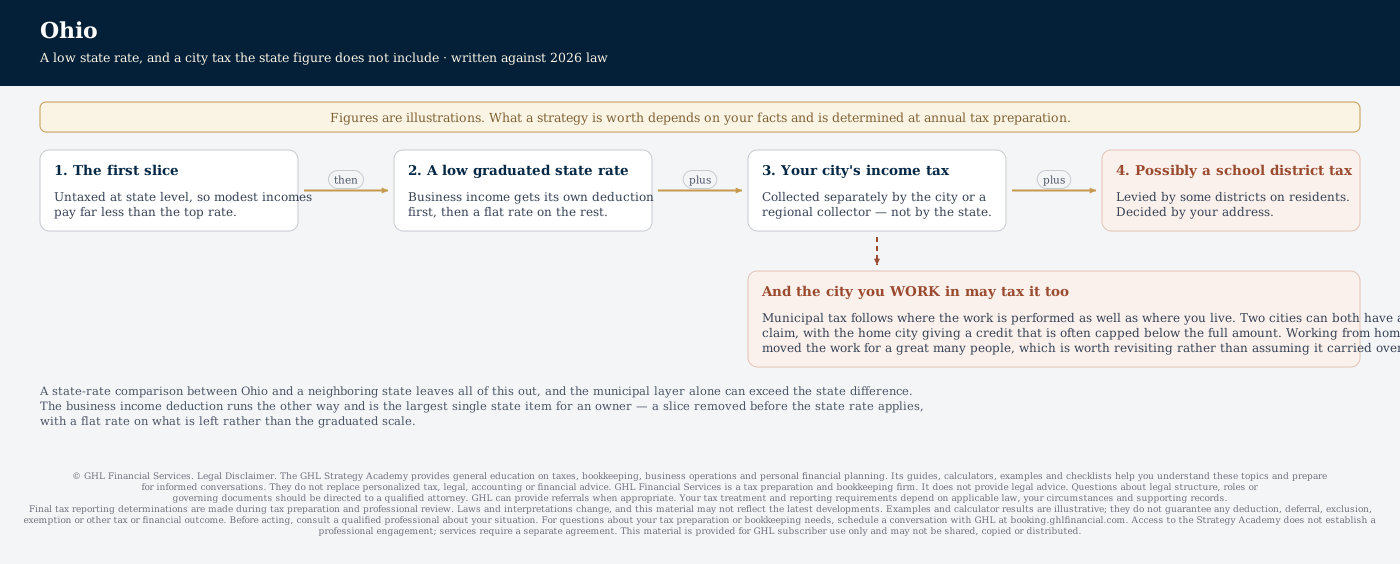
Against that, the municipal tax is the item most often left out of a comparison and it can be worth more than the state difference between Ohio and a neighboring state.
| First slice of income | no state tax at all |
|---|---|
| Above it | a flat 2.75% (2026), plus a $332 base amount |
| Business income | first $250,000 deducted, then a flat 3% |
| Your city | its own income tax, collected separately |
| The city you work in | may tax it too, with a partial credit |
| Your school district | some levy an income tax as well |
The state figures are the engine's 2026 model (Ohio Revised Code 5747.02 as amended by HB 96) and cover the STATE tax only, business income deduction included. Municipal and school district taxes are not modeled and vary by address; those are described here rather than computed.
How it works
For 2026 Ohio taxes no nonbusiness income up to $26,050, then a flat 2.75% on the excess plus a $332 base amount — the graduated brackets are gone (Ohio Revised Code 5747.02, as amended by HB 96).
Business income is taxed separately: the first $250,000 is deducted and the rest is taxed at a flat 3%.
Separately, most Ohio municipalities levy an income tax, administered by the city or by a regional collector rather than by the state.
Municipal tax generally applies where the work is performed as well as where the taxpayer lives. Where both apply, the home city usually gives a credit for what the work city took, often capped below the full amount.
Some school districts levy their own income tax on residents, at a rate set locally.
Ohio has no state estate tax.
What you would do
- Tell GHL which municipality you live in AND which you work in, by name. The two together decide the municipal bill.
- Say whether you moved to working from home, and from when. It changes which city has the work.
- Check whether your school district levies a tax. It is decided by your address and is easy to miss entirely.
- If you have business income, make sure the state deduction is applied — it is the largest single item for an owner.
- Keep municipal filings even in a year with nothing owing. Most cities want the return regardless.
What GHL needs from you
- Your home municipality and school district.
- Where work was physically performed, and for which months.
- Business income separately from wages.
- Municipal tax already withheld, and by whom.
- Any move during the year, with dates.
What usually goes wrong
- The state rate is not the whole bill. Most Ohio cities levy their own income tax, collected separately, and the state figure in any comparison excludes it entirely.
- Municipal tax follows where you WORK as well as where you live. Working in one city and living in another can mean two municipalities with a credit between them, and the credit is often less than the full amount.
- Some school districts levy an income tax of their own on top of both. Whether yours does is a fact about your address, not your employer.
- Working from home changed the municipal answer for a great many people, because the city with the office no longer has the work. That is worth revisiting rather than assuming.
- Ohio gives business income a deduction of its own — the first $250,000 ($125,000 married filing separately) — and taxes the rest at a flat 3% rather than with nonbusiness income. It is a substantial benefit for an owner, and a comparison built on wages alone leaves it out.
- The first slice of income is untaxed at state level, so effective rates at modest incomes are much lower than the headline.
Common questions
Why is my Ohio bill higher than the rate suggests?
The state rate is only one layer. Most people also pay a municipal income tax, and some a school district tax on top. Neither appears in a state-rate comparison, and together they can exceed the state figure itself.
I work from home now. Does that change anything?
It can change which municipality has the right to tax the work, which is a real difference where the two rates differ. It is worth raising rather than assuming the arrangement carried over.