
When it matters: Each state sets its own dates, and many do not fall on December 31. Some take the election early in the tax year itself; others take it on the entity's original return after the year ends, with a payment due during the year. The state tax guide for the entity's state has its dates.
Does this fit you?
- You own an S corporation or a partnership — not a sole proprietorship filing on Schedule C, which has no entity to make the election.
- You are in a state with an income tax and a pass-through entity tax regime; around three-quarters of states have one, each with its own rules.
- Your state tax on the business income is large enough that the itemized cap is biting.
What it could be worth
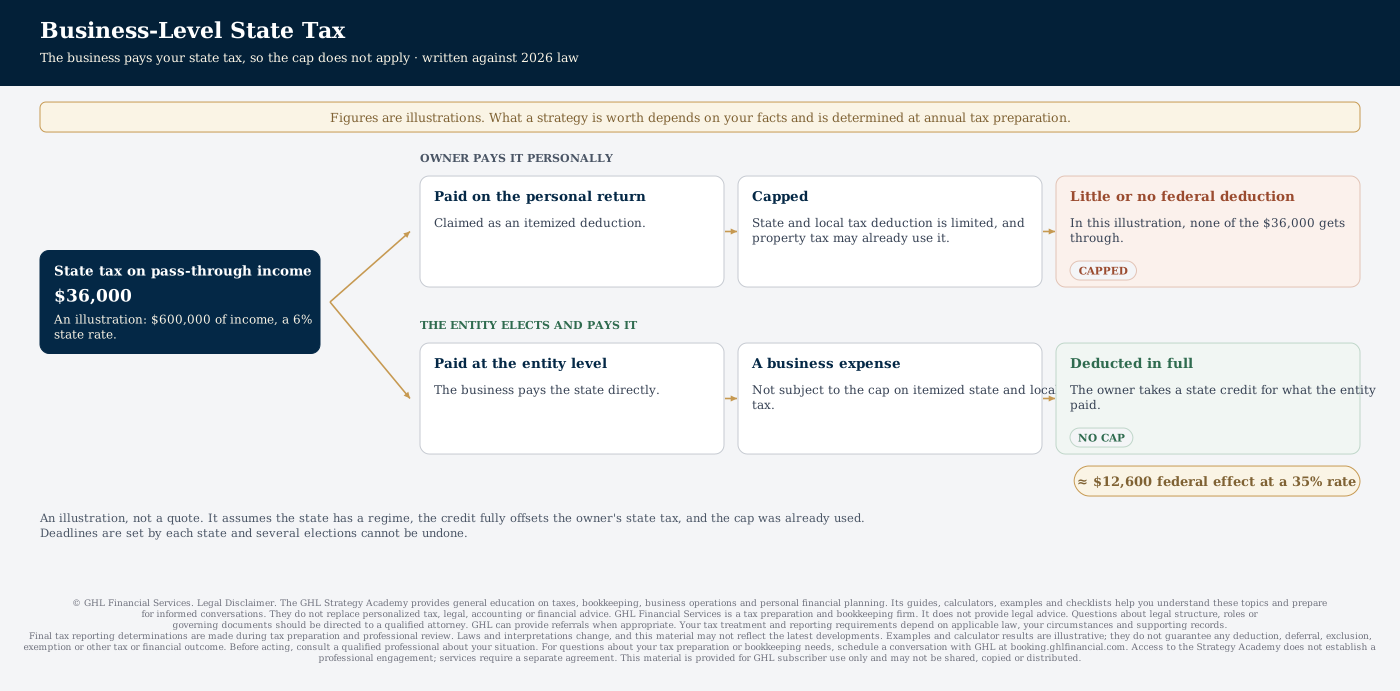
State and local tax claimed as an itemized deduction is capped. State tax paid by a business on its own income is a business expense, and business expenses are not subject to that cap.
The election moves the payment from the first category to the second. The state is paid much the same amount either way — the owner takes a credit for what the entity paid — but the federal deduction is no longer limited.
Whether that is worth anything depends on how much state tax the business income carries, and whether the owner was already over the cap from property tax alone. In a low-tax state, or for an owner well under the cap, it changes nothing.
| State tax on the business income | $36,000 |
|---|---|
| 2026 itemized cap on state and local tax | $40,400, reduced above $505,000 of income |
| Cap left after property and other state taxes, in this illustration | nothing |
| Deduction if the entity pays instead, at the business level | $36,000 |
| Federal effect at a 35% marginal rate | ≈ $12,600 |
2026 federal figures. The illustration assumes the couple's other state and local taxes already use the cap, that their state has a pass-through entity tax, that the credit fully offsets their personal state tax, and a 35% marginal rate. The cap phases down by 30 cents on the dollar above $505,000 of income and does not fall below $10,000. Every one of those assumptions is a fact about a particular return.
How it works
The entity elects, at the state level, to pay tax on its own income. The election is made with the state, not on the federal return.
The entity pays that tax and deducts it federally as a business expense, which reduces the income that flows through to the owners.
The owner claims a credit on the state return for what the entity paid, so the same income is not taxed twice by the state.
Each state sets its own election deadline, its own estimated-payment schedule, and its own rule on whether the election binds for future years. Several are irrevocable once made.
An owner with income in more than one state may have an election available in some and not others, and the credit rules between states of residence and source vary.
This is an entity-level decision that affects every owner, not just the one asking about it.
What you would do
- Tell GHL which states the business earns income in, and where each owner lives — that pair decides whether there is anything here at all.
- Raise it early in the year. Several states require the election, or an estimated payment, well before the return is filed.
- Record what the entity paid and when, by state. The credit on the personal return depends on it.
- Tell your fellow owners. The election is made by the entity and lands on all of their returns.
- Expect the answer to change if you move state, or if the business starts earning in a new one.
Allow one to two months. Some of it depends on other people.
Worksheets to use
- State tax election and payment record (XLSX). A record, by state and by year, of whether an election was made, when, what the entity paid, and the credit each owner took. Fill in one block per state as the year runs. The payment dates matter as much as the amounts: the entity deducts the state tax for the year the payment is made (IRS Notice 2020-75), and a state can reduce the owners' credit when a required payment is late.
What GHL needs from you
- The entity type and the states it earns income in.
- Each owner's state of residence and ownership percentage.
- Whether an election has been made before, and in which years.
- The entity's state tax payments for the year, with dates.
- Your other state and local taxes, so we can see whether the cap was already used.
What usually goes wrong
- The state's dates are missed because nobody looked them up early. Some states want the election early in the tax year, others on the return, and several want a payment during the year; several elections are irrevocable once made.
- One owner decides for everybody. The election is made by the entity and lands on every owner's return, including owners in states where it does nothing for them.
- The payment is made but not recorded by state and by date. The credit on each personal return depends on that detail, and it is tedious to rebuild from bank statements a year later.
Common questions
I am a sole proprietor. Can I do this?
Not as things stand — there is no entity to make the election. Whether becoming one is worth it is a separate and much larger question, and it is not answered by this alone.
Does the business end up paying more state tax?
In most states the credit is designed to leave the owner roughly where they were. Some have a residual difference, and a few treat the credit less generously than the tax paid. It is part of the calculation rather than an afterthought.
Can I undo it if it turns out not to help?
Sometimes. Several states make the election irrevocable for the year, and a few bind future years too. That is the reason to look at it before the deadline rather than after.
Read next
Keeping it alive
A position is not finished when it is set up. This is what it needs each year to still be there when it matters.
- Confirm it still applies — circumstances change more often than the law does.
- Keep the record current. Filled in as the year happens it is evidence; assembled in March it is a reconstruction.
- Check the documents still say what they said — an agreement that has drifted from practice is the usual failure.
- Ask GHL what changed for 2027. Figures move every year and rules move most years.