
When it matters: A plan set up by the return's due date, including extensions, can usually count for the year that just ended, and it can be funded up to that date. Employee deferrals to a solo 401(k) have their own timing rule, so December 31 is still the safer date for those.
Does this fit you?
- You are self-employed with no employees other than a spouse.
- Your business income is high enough that sheltering some of it is the question.
- You will keep the plan's paperwork — a plan is a commitment, not a one-time job.
What it could be worth
Both vehicles move business income into a retirement account before tax. The difference is how much they hold: a SEP takes an employer contribution only, while a solo 401(k) takes an employee deferral as well, on top of the same employer share.
That extra deferral is usually why the solo plan wins for an owner-operator. Where simplicity matters more than the last few thousand dollars of shelter, a SEP is less to run.
| Solo 401(k) — employee deferral | $24,500; generally $32,500 with the age-50 catch-up. Ages 60–63 have a separate catch-up. |
|---|---|
| Solo 401(k) — employer share, on top | Employer contribution depends on compensation. Self-employed owners use the special earned-income calculation in Publication 560. |
| Solo 401(k) — combined ceiling | $72,000 |
| SEP — employer share only | SEP contributions use the self-employed earned-income calculation; the 2026 dollar ceiling is $72,000. |
| Catch-up at ages 60 to 63 | $11,250 instead of $8,000 at ages 60–63 in 2026 |
2026 limits from the IRS. Self-employed contributions use the special earned-income calculation in Publication 560, accounting for the deduction for one-half of self-employment tax and the contribution itself. A SEP reaches the same ceiling with less paperwork but no deferral, so it suits a year of high profit and no staff.
How it works
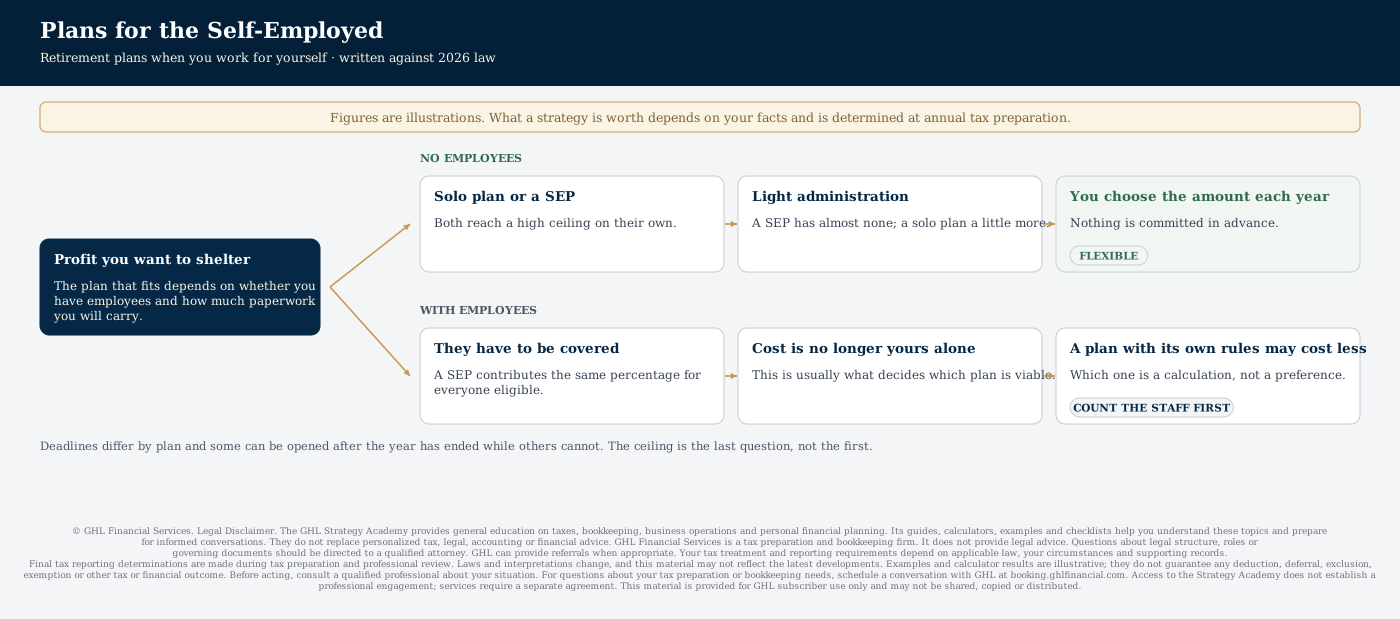
The employee deferral is a slice of compensation; the employer contribution depends on compensation, with a special earned-income calculation for self-employed owners. They stack, up to a combined ceiling.
A solo plan can take the employee half as Roth, which gives a mix of pre-tax and after-tax retirement money — useful when nobody knows what bracket a future year holds.
A spouse on the payroll has their own employee deferral, which is the single largest thing that changes the arithmetic for a couple running a business together.
Hiring an employee other than a spouse changes the plan. A solo plan is defined by having no other employees; once there are, it becomes an ordinary workplace plan with testing requirements attached. Raise a hire before it happens, not at filing.
Deadlines differ between the two, and between establishing a plan and funding it. This is one where the calendar does real work.
What you would do
- Decide with GHL which plan fits before opening either — moving between them later is possible but untidy.
- Open the plan with a provider and keep the plan documents they give you.
- Put a spouse on the payroll properly if the household is going to use both deferrals.
- Tell GHL before hiring anyone, because a solo plan does not survive it unchanged.
- Keep contribution confirmations; the deduction follows what was actually funded, and when.
Allow one to two months. Some of it depends on other people.
What GHL needs from you
- Which plan, with which provider, and the date it was established.
- Contribution confirmations for the year, split between employee and employer where the plan has both.
- Net self-employment earnings and self-employment tax for the business, for the special earned-income calculation.
- Payroll records for a spouse, where a spousal deferral is being made.
What usually goes wrong
- The plan is opened in the spring on the assumption that everything still counts for the year just closed. The employer share usually can; the employee deferral to a solo 401(k) depends on when the plan was set up and when the election was made, and that part is where the spring opening can fall short.
- Somebody is hired and nobody mentions it until filing. A solo plan is defined by having no other employees — once there are, it is a different plan with testing attached, and the discovery usually arrives a year late.
- The employer share is computed on gross receipts rather than on net self-employment earnings. It is a percentage of a figure that is itself reduced, and the two get confused every year.
Common questions
Can I have both a solo 401(k) and a SEP?
Technically possible and rarely useful — the combined ceiling still applies across plans. It usually adds paperwork rather than shelter.
What if I have a job with a 401(k) as well?
The employee deferral limit is yours, not each plan's, so deferrals at work use it up. The employer side of a solo plan is separate. Bring both to tax preparation.
Can I take money out if the business needs it?
A solo 401(k) may allow a loan; a SEP does not. Neither is a working-capital account, and treating one as such creates a different problem.
Read next
Keeping it alive
A position is not finished when it is set up. This is what it needs each year to still be there when it matters.
- Confirm it still applies — circumstances change more often than the law does.
- Check the documents still say what they said — an agreement that has drifted from practice is the usual failure.
- Ask GHL what changed for 2027. Figures move every year and rules move most years.