
When it matters: Wages have to be paid inside the tax year. A payment made in January belongs to the following one, however the work was done.
Does this fit you?
- Your business has work a family member genuinely does, or could do.
- You are in a higher bracket than the family member being paid.
- You are willing to run the payroll properly — job description, hours, a real payment.
What it could be worth
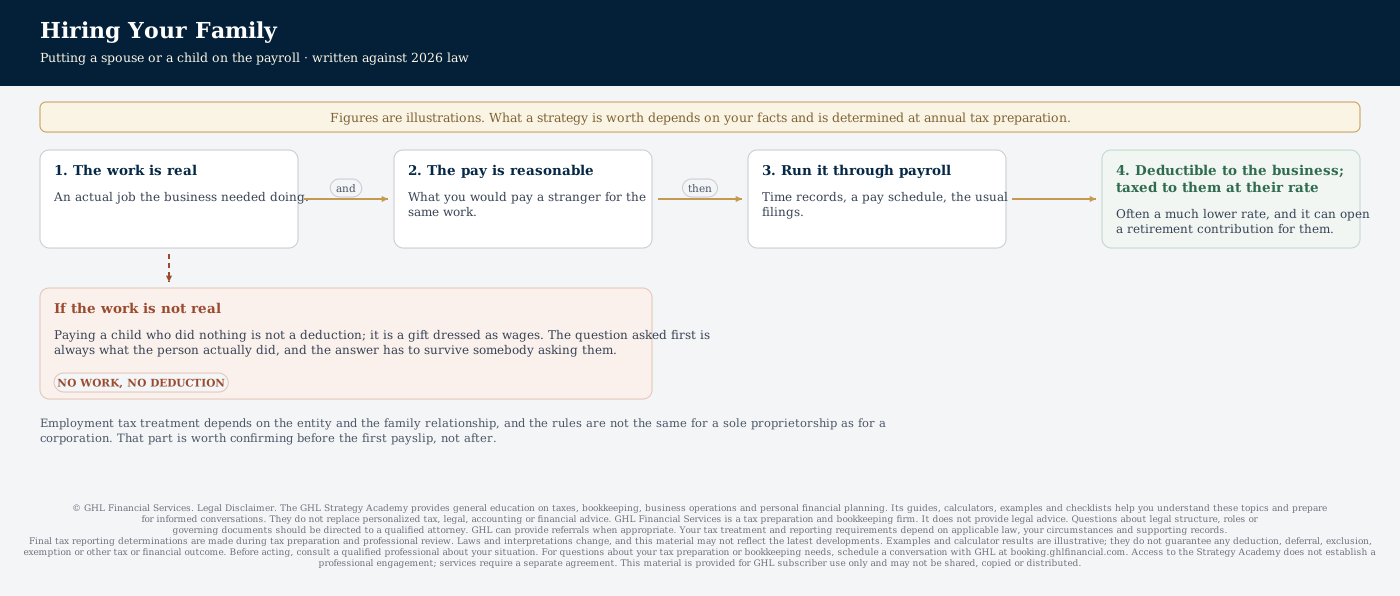
Wages paid for real work are a deduction to the business and income to the person who earned them. Where that person is in a lower bracket, the same dollar is taxed less on the way through, and a child with earned income can fund a Roth IRA that would otherwise have nothing to fund.
The treatment differs by relationship. A child under 18 working for a parent's sole proprietorship or partnership is generally outside FICA; above 18 FICA applies. A spouse is usually close to a wash on brackets — the reason to do it is normally retirement-plan eligibility rather than the rate difference.
| Wage paid for documented work | $16,100 |
|---|---|
| 2026 standard deduction for a single filer | $16,100 |
| Child's federal income tax on that wage | nil on these facts |
| Deduction to a parent at a 37% rate | ≈ $5,957 of tax |
| 2026 IRA contribution the earned income now supports | up to $7,500 |
2026 standard deduction and contribution limit. It assumes a parent at the top rate, a sole proprietorship — the employment-tax treatment of a child differs by entity — and a wage that matches what the work is worth. Each of those changes the answer.
How it works
The wage has to be for work that is real, and the amount has to be what you would pay somebody else to do it. Both halves get tested together — an implausible wage makes the work look unreal.
Pay on paper only is the failure mode. A journal entry with no money moving, or cash with no record, is unwound on examination and takes the deduction with it.
A child can do real work — content, photography, filing, packing orders — and what is plausible depends on their age. Eight-year-olds have appeared in their parents' advertising for as long as advertising has existed; eight-year-olds do not keep the books.
Paying a parent is common where a client is already supporting them. The work still has to be real: bookkeeping, scheduling, answering the phone.
What you would do
- Write down the job before the first payment: what the work is, and what an outside hire would be paid for it.
- Keep a time record as the work happens — dates and hours, not a total invented in December.
- Pay by transfer or check, on the same schedule as anybody else on the payroll.
- Open the child's Roth IRA if the earned income is going to support one, and keep the contribution inside what was actually earned.
Allow one to two months. Some of it depends on other people.
What GHL needs from you
- The job description and the basis for the wage.
- The time records for the year.
- Payroll filings and the W-2, or the 1099 where that is the right form.
- Proof the money actually moved — bank records, not journal entries.
What usually goes wrong
- A year of work is paid as one figure in December, against a time record written the same week. The record is what makes the wage defensible, and one assembled afterwards rarely does.
- The money goes into a parent's account, or the checks are never banked. A wage that did not reach the person who earned it is hard to describe as a wage.
- A child's Roth is funded for more than the child earned. The contribution is limited by the earned income, and an excess has to come back out with whatever it made.
Common questions
Can my eight-year-old be on the payroll?
If the work is real and the wage is what the work is worth, yes. Be honest about what an eight-year-old can do; that is the part that gets tested.
Does paying my spouse save payroll tax?
Generally no — spouse wages carry FICA. The usual reason to do it is that a wage makes retirement-plan contributions possible.
What if the family member does not cash the checks?
Then the money did not move, and the wage is hard to defend. Pay into their own account.
Read next
Keeping it alive
A position is not finished when it is set up. This is what it needs each year to still be there when it matters.
- Confirm it still applies — circumstances change more often than the law does.
- Put the date in the calendar. This one closes at the year end and cannot be added at tax preparation.
- Ask GHL what changed for 2027. Figures move every year and rules move most years.