
When it matters: Claimed with the return. The access test is applied month by month across the year.
Does this fit you?
- You are a sole proprietor, a single-member LLC owner, a partner, or an S-Corp shareholder holding more than 2%.
- You pay your own premiums rather than being offered subsidized coverage.
- Your coverage is for yourself, a spouse or dependents, and tied to the self-employed activity.
What it could be worth
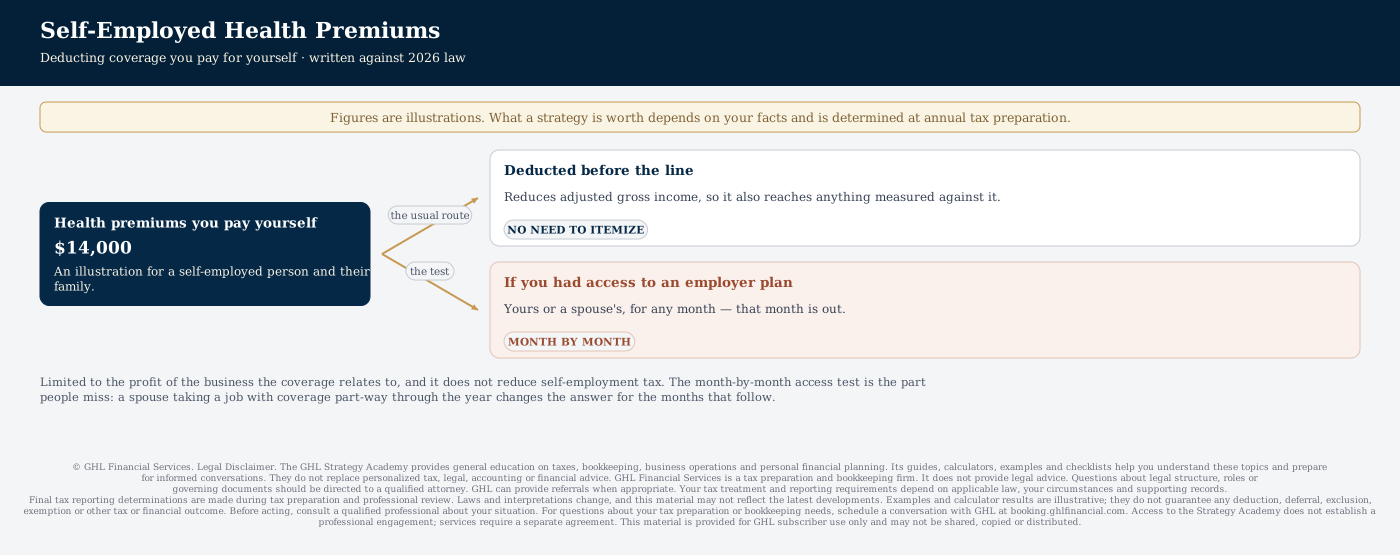
Premiums for health, dental, vision and qualifying long-term care coverage can be deducted directly against income, without itemizing. It reduces adjusted gross income, which matters beyond the tax on those dollars because so many other thresholds are measured from it.
Two limits apply. The deduction cannot exceed net self-employment income from the business the coverage is tied to, and it is not available for any month you could have joined a subsidized plan through an employer — yours or a spouse's.
| Premiums paid for the year | $15,000 |
|---|---|
| Federal tax effect | ≈ $3,600 |
| Capped at | net self-employment income from that business |
A 24% bracket, federal only, positive net self-employment income for the full amount, and no eligibility for subsidized employer coverage in any month. State treatment is additional and varies.
How it works
The deduction is taken against income rather than as an itemized deduction, so it helps whether or not you itemize.
It is measured per business. The premium has to be tied to a specific self-employed activity, and that activity has to have net income — a loss year zeroes it out.
Eligibility for subsidized employer coverage disqualifies the months it was available, even if you declined it. A spouse taking a new job mid-year changes the answer from that month.
For an S-Corp shareholder above 2% there is a reporting sequence that trips people up: the corporation pays the premium and includes it in Box 1 of the W-2, and the deduction is then taken on the personal return. Miss the W-2 step and the deduction is hard to support.
What you would do
- Keep the premium statements showing what was paid and when, by month.
- Tell GHL about any month either spouse was eligible for employer coverage.
- If the business is an S-Corp, make sure the corporation pays the premium and that it reaches the W-2 correctly — check this before the W-2 is filed, not after.
- Raise a loss year early; the cap follows net income, not what was paid.
Worksheets to use
- Owner health insurance record (XLSX). Premiums paid for an owner's coverage, and whether they were put through payroll in time to count. Check the last line in November, while there is still a payroll left to fix it. A premium the company paid and never reported does not reach the owner's return.
What GHL needs from you
- Premium statements for health, dental, vision and long-term care, by month.
- Net self-employment income for the business the coverage is tied to.
- Confirmation of any employer coverage available to you or a spouse, and the months it was available.
- For an S-Corp: the W-2 showing the premium included in Box 1.
What usually goes wrong
- It is limited to the net profit of the business the coverage relates to. A loss year zeroes it.
- Access to any employer plan — yours or a spouse's — disqualifies the months it was available, even if you did not take it.
- For a 2% shareholder of an S corporation the premium has to be paid by the company and reported on the W-2, or the deduction is not available.
Common questions
My spouse's employer offers a plan I did not take. Does that matter?
Yes. Eligibility is what counts, not enrollment, for the months the cover was available.
Can I deduct more than the business earned?
No. Net income from that business is the ceiling, and the excess is not carried forward as this deduction.
Does long-term care insurance count?
Qualifying long-term care premiums do, subject to an age-based limit on how much counts each year.
Read next
Keeping it alive
A position is not finished when it is set up. This is what it needs each year to still be there when it matters.
- Confirm it still applies — circumstances change more often than the law does.
- Keep the record current. Filled in as the year happens it is evidence; assembled in March it is a reconstruction.
- Ask GHL what changed for 2027. Figures move every year and rules move most years.