
When it matters: Structured at closing. Treatment applies automatically unless elected out by the filing deadline.
Does this fit you?
- You are selling property and are willing to be paid over time rather than at once.
- Your gain in a single year would push you through a higher rate or into surtaxes.
- You are selling to family, where financing the buyer is often already the intention.
What it could be worth
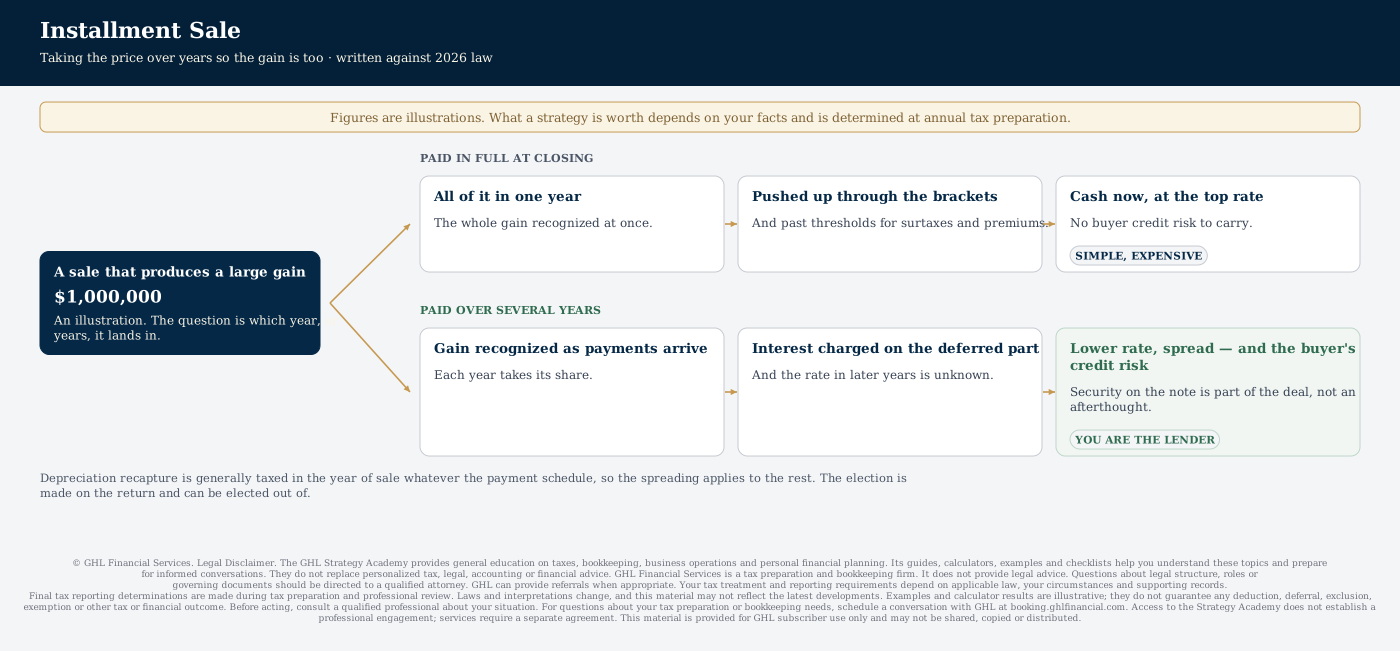
The gain is reported as payments are received rather than all at once. Each payment carries a slice of gain, a slice of return of what the property cost, and interest — the proportion fixed at the start by the arithmetic of the deal.
What it is worth is the difference between the rate a single large year would have attracted and the rates the spread years attract. Where a one-year sale would push into the top rate or into the investment surtax, spreading it can keep several years below both.
| Reported at once | the whole gain in the year of sale |
|---|---|
| Spread over ten years | roughly a tenth of the gain each year |
| Effect of staying in a lower band | commonly 5–10% of the gain |
| On this gain, that is | $50,000 – $100,000 |
A non-dealer property, a buyer's note over ten years, and rates that stay where the spreading puts them. Interest on the note is separate income each year, and the buyer's ability to pay is a risk the seller now carries.
How it works
The seller holds a note from the buyer. Each payment splits into a return of what the property cost, the gain, and interest — the split set by a ratio worked out at the start.
It is reported each year on its own form for as long as payments continue, so the paperwork lasts as long as the note does.
Interest has to be charged at a proper rate. A note at no interest, or at a token rate, is recharacterized, which changes the arithmetic and can surprise family sellers in particular.
The seller becomes the lender. If the buyer stops paying, that is a problem with its own tax treatment on top of the commercial one.
Some property is outside this — property held for sale in a business is treated differently, and depreciation previously taken is generally reported in the year of sale rather than spread.
What you would do
- Raise it with GHL before agreeing terms; the structure decides the tax treatment, and it is written into the contract.
- Have the note drawn up by an attorney, with a proper interest rate.
- Keep the amortization schedule and record every payment received, split as the schedule shows.
- Tell GHL if the buyer pays early or refinances — a lump sum changes which year the remaining gain lands in.
Allow one to two months. Some of it depends on other people.
What GHL needs from you
- The sale contract and the note.
- The amortization schedule.
- Payments received in the year, with dates.
- The property's cost and improvement history, and depreciation taken.
What usually goes wrong
- Inventory and property held for sale do not qualify, so this is not available to somebody flipping property.
- Selling, gifting or forgiving the note brings all the remaining deferred gain into that year at once.
- The note has to carry a proper rate of interest, or interest is imputed anyway.
- Depreciation recapture is generally taxed in the year of sale whatever the payment schedule.
Common questions
What if the buyer pays the whole balance early?
The remaining gain is generally reported in that year, which can undo the spreading. Tell GHL before agreeing to an early payoff.
Does all of the gain spread?
No. Depreciation previously taken is generally reported in the year of sale rather than spread across the note.
Read next
Keeping it alive
A position is not finished when it is set up. This is what it needs each year to still be there when it matters.
- Confirm it still applies — circumstances change more often than the law does.
- Check the documents still say what they said — an agreement that has drifted from practice is the usual failure.
- Ask GHL what changed for 2027. Figures move every year and rules move most years.