
Does this fit you?
- You own real estate held for investment or business use — not a home you live in.
- You are replacing it with other investment or business real estate, which is a wide category.
- You can plan the sale in advance: several of the requirements cannot be met retrospectively.
What it could be worth
Where the requirements are met, the gain on the property sold is not reported now. It carries into the replacement property instead, reducing its basis, so the reporting is deferred rather than removed.
What that is worth depends on the gain, the rate that would have applied, and how long the deferral lasts. It is not a saving in the ordinary sense — it is a timing difference, and the eventual reporting is a real event that should be planned for rather than forgotten.
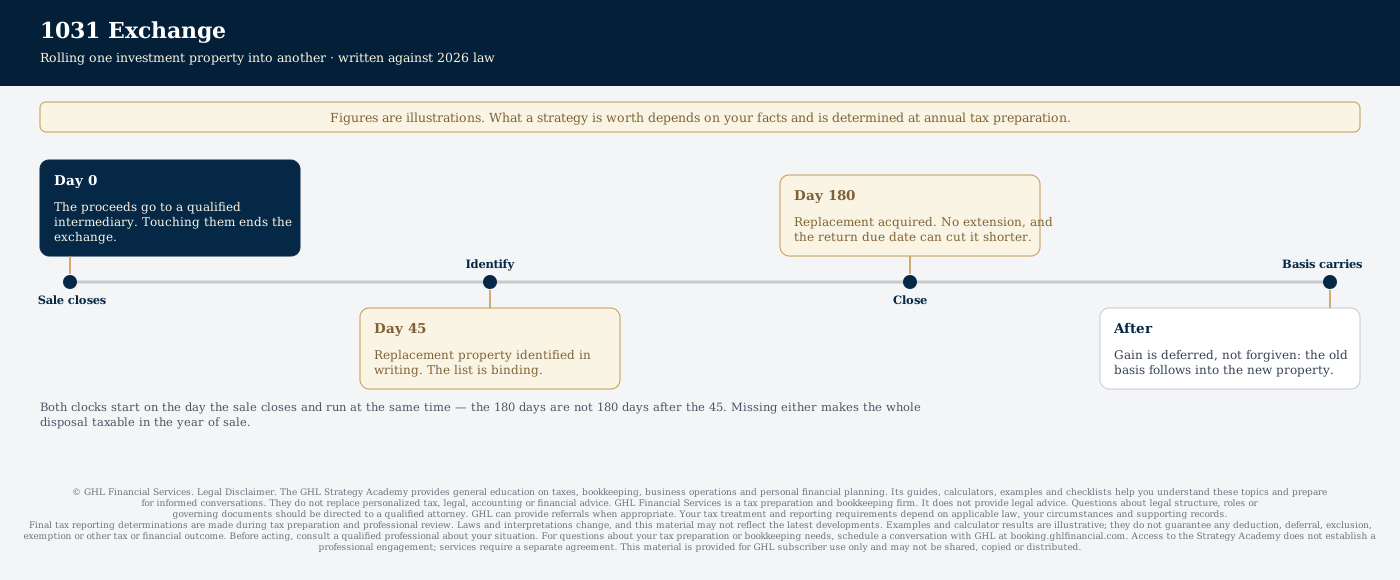
| Days to identify the replacement property | 45 |
|---|---|
| Days to close on it | 180 |
| Both counted from | the day the first property sells |
| Proceeds must go to | a qualified intermediary, not to you |
Both periods run from the closing of the sale and are not extended for weekends, holidays or a deal falling through. The 180 days includes the 45, rather than following it.
How it works
The proceeds cannot pass through your hands. They go to a qualified intermediary engaged before the sale closes — arranging one afterwards is too late, and this is the single most common way an intended exchange fails.
Real estate held for investment or business is like-kind to other real estate held for investment or business, which is broader than people expect: a rental house for a commercial unit, or for land.
To defer the whole gain, all the proceeds have to be reinvested and the debt on the replacement has to be at least what was paid off. Taking cash out, or ending up with less debt, produces an amount that is reported now.
Paying down a loan during the process is a common accidental version of that, and it surprises people because it feels like prudence rather than a distribution.
A home you live in is outside this entirely. There is a separate rule for a principal residence, with its own conditions.
What you would do
- Talk to GHL and engage a qualified intermediary before the sale closes, not after.
- Line up candidate replacements before you sell — 45 days is shorter than it sounds in a slow market.
- Keep every closing statement, for both properties.
- Tell GHL about any debt being repaid or cash being taken out at either closing.
- Record the carried-over basis; it matters for every year of depreciation that follows and again at the eventual sale.
Allow one to two months. Some of it depends on other people.
What GHL needs from you
- Closing statements for the property sold and the property bought.
- The intermediary's agreement and their accounting of the funds.
- Identification of the replacement, with its date.
- Debt figures on both sides, and any cash received.
What usually goes wrong
- The sale closes and the intermediary is engaged afterwards. Once the proceeds have touched the seller's hands there is nothing left to fix, and this is the most common way an intended exchange fails.
- A loan is paid down along the way. It feels like prudence and it produces an amount reported now — the debt on the replacement has to be at least what was paid off.
- Forty-five days is treated as a search window rather than a deadline. Candidates are lined up before the sale, because in a slow market the identification period runs out well before anything suitable appears.
Common questions
Can I exchange the house I live in?
No. A principal residence is outside these rules; there is a separate provision for a home, with its own conditions. Ask which applies before listing.
What if I cannot find a replacement in time?
Then the sale is reported as an ordinary sale. The clocks do not extend, which is why candidates are lined up before selling rather than after.
Does the deferred gain ever go away?
Treat it as postponed rather than canceled, and tell GHL it is there.
Read next
Keeping it alive
A position is not finished when it is set up. This is what it needs each year to still be there when it matters.
- Confirm it still applies — circumstances change more often than the law does.
- Check the documents still say what they said — an agreement that has drifted from practice is the usual failure.
- Ask GHL what changed for 2027. Figures move every year and rules move most years.