
When it matters: Elections at open enrollment, usually with mid-year changes allowed.
Does this fit you?
- You work for a public school, a university, a public hospital, a church or a non-profit.
- You have long service at the same qualifying employer — fifteen years or more is the test for the extra catch-up.
- You also have a plan under section 457 at the same employer, because the two run on separate limits.
What it could be worth
A deferral reduces taxable pay in the year it is made, in the same way a 401(k) deferral does. The money and its growth are taxed when they come out.
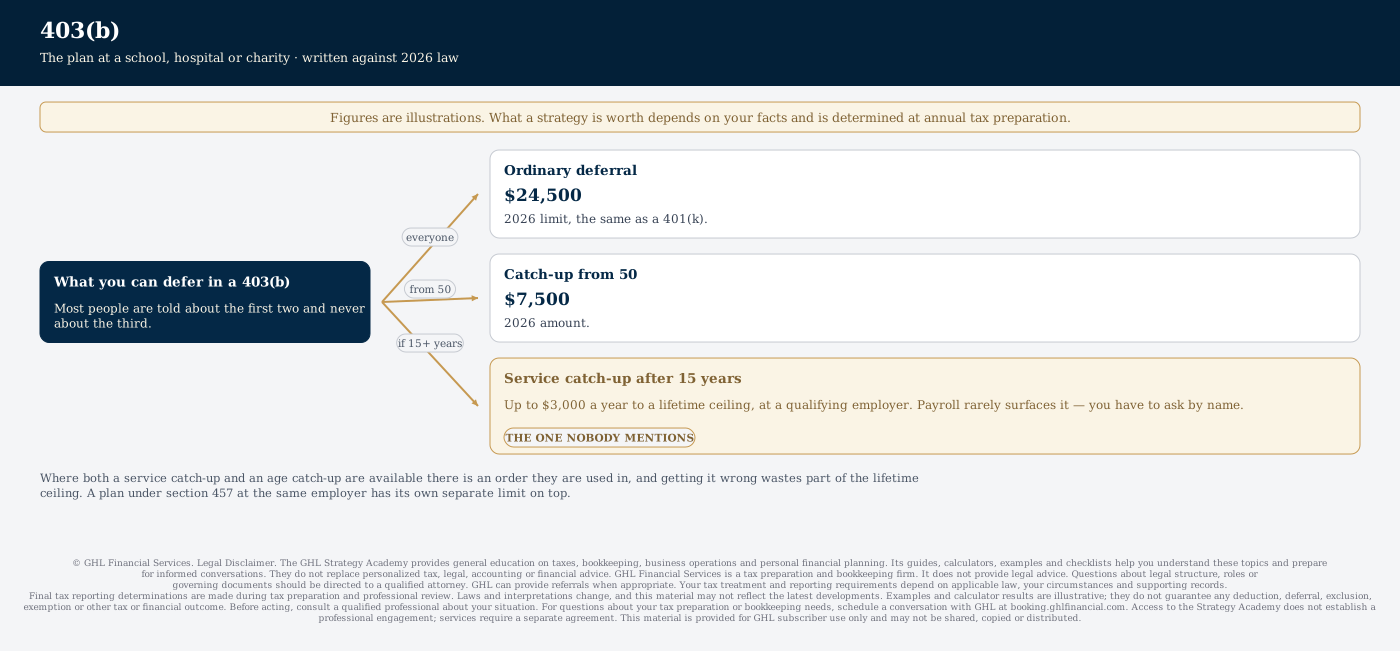
The part that goes unclaimed is the service catch-up. Fifteen years at the same qualifying employer can open a further amount each year, subject to a lifetime total, and payroll systems rarely surface it — the employee has to ask.
How much either is worth depends entirely on the marginal rate this year against the rate when the money is drawn. For somebody who expects a lower rate in retirement the deferral is doing real work; for somebody who expects a higher one, the Roth side of the same plan may be the better place.
| 2026 ordinary employee deferral limit | $24,500 |
|---|---|
| 2026 catch-up from age 50 | $8,000 |
| Service catch-up, where fifteen years of service qualifies | up to $3,000 a year, to a lifetime ceiling of $15,000 |
2026 limits for the ordinary deferral and the age-50 catch-up. The service catch-up is a long-standing provision of the plan type rather than an inflation-adjusted figure, and what is left of the lifetime ceiling depends on what was used in earlier years — which is a calculation from your own records, not from this table.
How it works
Deferrals come out of pay before income tax, through payroll, and are shown on the year's wage statement.
The ordinary limit and the age-50 catch-up work the same way they do in a 401(k).
The service catch-up is particular to this plan type. It needs fifteen years of service with the same qualifying employer, and the amount available depends on what was deferred in all the earlier years.
Where both a service catch-up and an age-50 catch-up are available, there is an order in which they are used, and getting it wrong can waste part of the lifetime ceiling.
A plan under section 457 at the same employer has its own separate limit, so the two can be used in the same year.
Many of these plans also offer a Roth side. That is a different decision from how much to put in, and it turns on which rate is higher — now, or when the money comes out.
What you would do
- Ask the benefits office, by name, whether the fifteen-year service catch-up is available to you and how much of the lifetime ceiling is left.
- Ask whether there is also a plan under section 457. If so, the limits are separate and both can be used.
- Keep your wage statements — the deferral is reported there and it is the evidence of what was used each year.
- Review the amount at open enrollment, and again if your pay changes mid-year.
- Bring the plan description to GHL if the service catch-up is on the table. The ordering rules are the part that goes wrong.
Allow one to two months. Some of it depends on other people.
What GHL needs from you
- The plan description, or the pages covering catch-up contributions.
- Your wage statements showing deferrals, for this year and earlier ones if the service catch-up is in play.
- Your years of service with the employer.
- Whether a plan under section 457 is also available and used.
- Whether the plan has a Roth side and whether any of the deferral went there.
What usually goes wrong
- The service catch-up has a lifetime ceiling, and what you have already used counts against it. Check before relying on it.
- Some of these plans are annuity wrappers with high charges. Look at the investment menu before making a large deferral.
- Confirm whether you are contributing to the pre-tax or the Roth side; they do different things to this year's bill.
Common questions
Payroll has never mentioned a service catch-up. Does that mean I do not have one?
No. It means nobody has checked. The calculation depends on your full deferral history, which the payroll system often does not hold, so it usually has to be asked for directly.
Can I use this and a plan under section 457 in the same year?
Where the employer offers both, yes — they run on separate limits. That is unusual among retirement plans and is the main reason to ask whether a 457 exists.
Should I use the Roth side instead?
That turns on whether your rate now is higher or lower than the rate when you draw the money. It is worth working through with your own figures rather than by rule of thumb.
Read next
Keeping it alive
A position is not finished when it is set up. This is what it needs each year to still be there when it matters.
- Confirm it still applies — circumstances change more often than the law does.
- Check the documents still say what they said — an agreement that has drifted from practice is the usual failure.
- Ask GHL what changed for 2027. Figures move every year and rules move most years.