
When it matters: Most plans require the election before the first pay of the year.
Does this fit you?
- You work for a state or local government, a public school, or a qualifying tax-exempt employer.
- You are already contributing the full amount to a 401(k) or a 403(b) and have more you could put away.
- You are within a few years of the plan's normal retirement age, where a special catch-up may be available.
What it could be worth
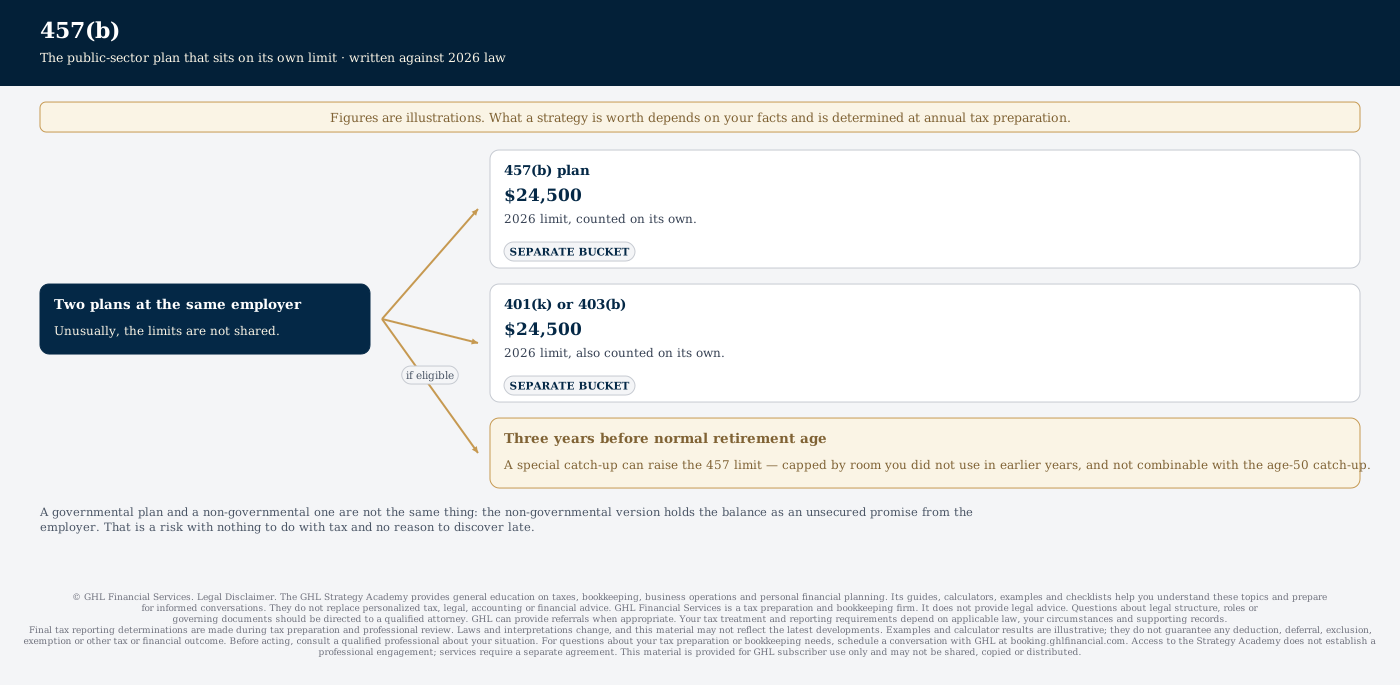
A deferral reduces taxable pay this year, and the limit is not shared with a 401(k) or a 403(b). Somebody with both can use both in full.
In the three years before the plan's normal retirement age, a special catch-up can raise the limit substantially — but only to the extent of amounts that could have been deferred in earlier years and were not.
Whether either is worth doing depends on the rate now against the rate when the money is drawn, and on whether the cash flow supports deferring twice.
| 2026 deferral limit for this plan | $24,500 |
|---|---|
| 2026 limit for a 401(k) or 403(b), separately | $24,500 |
| Special catch-up, in the three years before normal retirement age | up to twice the ordinary limit, capped by unused room from earlier years |
2026 limits. The two plan limits are separate, which is what makes both usable. The special catch-up is not a flat doubling — it is limited by how much could have been deferred in earlier years and was not, which is a calculation from your own deferral history.
How it works
The deferral comes out of pay through payroll and is reported on the year's wage statement.
The limit for this plan is counted separately from a 401(k) or 403(b), so both can be used in the same year.
In the three years before the plan's normal retirement age, a special catch-up may apply. It cannot be used in the same year as the age-50 catch-up, so one has to be chosen.
A governmental plan and a non-governmental one are not the same thing. The governmental version does not carry the early-withdrawal penalty other plans do; the non-governmental version holds the money as an unsecured promise from the employer, which is a risk that has nothing to do with tax.
Distributions are fully taxable when received, so the year they are taken in matters — particularly for somebody who leaves and takes a large amount at once.
Most plans require the election before the first paycheque of the year; a mid-year election usually applies only to the months that follow.
What you would do
- Ask whether your plan is a governmental one. The answer changes both the withdrawal rules and the risk.
- Confirm your plan's normal retirement age — that is the date the special catch-up counts back from, and it is not always the age you expect.
- Make the election before the year starts if you can; mid-year elections only reach the remaining months.
- Before you separate from service, plan the withdrawals. Taking the balance in one year is what produces the large bill.
- Keep the wage statements and enrollment forms; they are the evidence of what was deferred.
Allow one to two months. Some of it depends on other people.
What GHL needs from you
- Whether the plan is governmental or not.
- The plan's normal retirement age.
- Your wage statements, and your deferral history if the special catch-up is in play.
- Any other retirement plan you contribute to in the same year.
- The expected date of separation, and how you plan to draw the balance.
What usually goes wrong
- A non-governmental plan holds the balance subject to the employer's creditors, and does not carry the same withdrawal treatment.
- The three-year special catch-up cannot be combined with the age-50 catch-up in the same year. One or the other.
Common questions
Can I really use this and my 403(b) in the same year?
Where the employer offers both, the limits are separate and both can be used in full. It is one of the few places in the code where that is true.
My plan is at a private hospital. Is that the same?
No. A non-governmental plan holds the money as an unsecured promise from the employer, and the withdrawal rules differ. It is worth understanding before deferring a large amount.
Can I use the special catch-up and the age-50 catch-up together?
No, one or the other in a given year. Which produces more depends on your unused room from earlier years.
Read next
Keeping it alive
A position is not finished when it is set up. This is what it needs each year to still be there when it matters.
- Confirm it still applies — circumstances change more often than the law does.
- Check the documents still say what they said — an agreement that has drifted from practice is the usual failure.
- Ask GHL what changed for 2027. Figures move every year and rules move most years.