
When it matters: Nothing to elect. The decisions it informs — when to buy, how to finance, what to draw — are made during the year.
Does this fit you?
- You have looked at a profitable year and an empty account.
- You are about to buy equipment, take on finance, or increase your draws.
- You read the profit and loss and nothing else.
What it could be worth
Nothing on the return. What it prevents is the most ordinary business failure there is — running out of money while trading profitably.
It also changes decisions. Buying equipment outright in December for the deduction is a different proposition once the cash side is visible, and so is drawing to the level of the profit figure.
And it makes the tax predictable. Tax follows profit, so a business that understands the gap knows what is coming and can set it aside rather than meeting it in April.
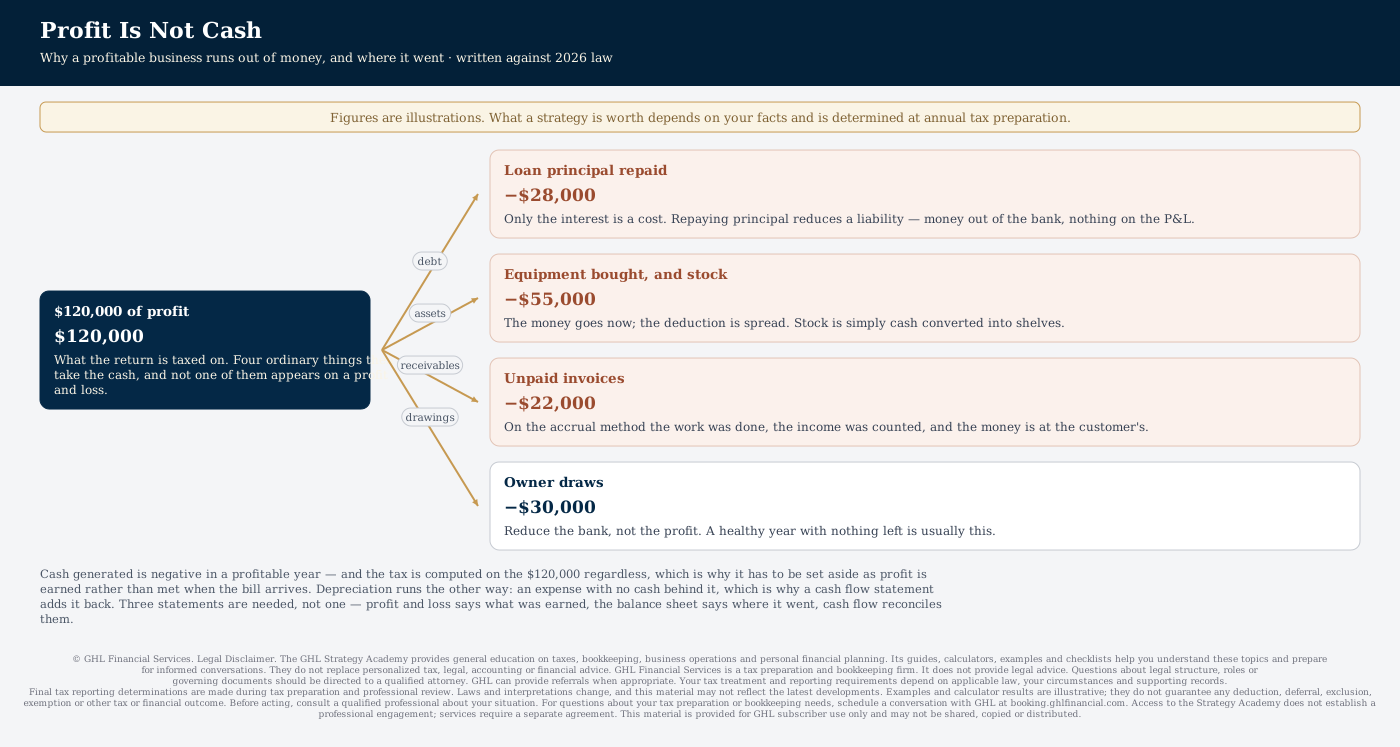
| Profit for the year | $120,000 — what the return is taxed on |
|---|---|
| Less loan principal repaid | −$28,000 — not an expense, and not on the P&L |
| Less equipment bought | −$40,000 out now; the deduction is spread |
| Less increase in unpaid invoices | −$22,000 — earned, counted, not received |
| Less increase in stock | −$15,000 — cash converted into shelves |
| Less owner draws | −$30,000 — reduces the bank, not the profit |
| Cash actually generated | negative, in a profitable year — and the tax is still due |
An illustration on the accrual method; on cash basis the receivables line largely disappears and the others do not. Depreciation runs the other way — an expense with no cash attached — which is why a cash flow statement adds it back. The arithmetic here is ordinary accounting rather than a tax rule.
How it works
The profit and loss measures what was earned and spent. It is what the tax is computed from.
The balance sheet measures what the business holds and owes at a moment — stock, receivables, equipment, debt.
Cash flow reconciles the two: profit, adjusted for everything that moved money without touching the profit and loss, and everything that touched it without moving money.
Loan principal, equipment purchases, stock and owner draws all move cash and never appear as expenses.
Receivables are income counted before the money arrives, on the accrual method.
Depreciation is the reverse — an expense with no cash behind it — which is why it is added back.
Tax is computed on the profit regardless of any of this, which is why the gap has to be planned for rather than discovered.
What you would do
- Read all three statements, not just the profit and loss. Ask GHL for a cash flow if you are not getting one.
- Before buying equipment, ask what it does to cash this year as well as what it does to the deduction.
- Watch receivables. A growing business is usually lending money to its customers without deciding to.
- Set the tax aside as profit is earned rather than when the bill arrives.
- Size draws against cash generated, not against profit.
- If stock is growing faster than sales, that is the year's cash sitting on a shelf.
Usually a week or two — mostly things you can start yourself.
What GHL needs from you
- Profit and loss, balance sheet and cash flow for the year.
- Loan statements showing the split between principal and interest.
- Asset purchases, with dates.
- Receivables and stock at the start and end of the year.
- Owner draws taken.
What usually goes wrong
- A loan repayment is not an expense. The interest is; the principal is money leaving the bank that never appears on a profit and loss, and it is the commonest reason a profitable business is short.
- Buying equipment is not an expense either, at least not all at once. The money goes now and the deduction is spread — or the reverse, where it is expensed in full and the cash went years ago on finance.
- Unpaid invoices are already profit on the accrual method. The work was done, the income was counted, and the money is somewhere else.
- Stock is cash you have converted into shelves. It is on the balance sheet, not the profit and loss, and it can absorb an entire year's profit without appearing anywhere in it.
- Owner draws are not an expense. They reduce the bank and not the profit, so a business can show a healthy year and have nothing left because it was all taken out.
- Tax is paid on the profit, not on the cash. That is the one that bites hardest: a year with everything reinvested produces a bill and no money set aside for it.
- So three statements are needed, not one. Profit and loss says what was earned; the balance sheet says where it went; cash flow reconciles the two.
Common questions
We made $120,000 and there is nothing in the bank. Where did it go?
Usually four places, none of which is on the profit and loss: loan principal, equipment, unpaid invoices and stock — plus whatever was drawn out. The balance sheet shows all of them, which is why reading the profit and loss alone leaves the question unanswerable.
Why is loan repayment not an expense?
Because only the interest is a cost of borrowing. Repaying principal returns money you were already given — it reduces a liability rather than creating an expense, so it leaves the bank without touching the profit.
Should I buy equipment in December for the deduction?
Sometimes, and the cash side belongs in the decision. A large purchase made for a deduction takes the money now and gives the deduction back over time or in one go depending on the election — and the tax on the rest of the year's profit is still due either way.
Read next
Keeping it alive
A position is not finished when it is set up. This is what it needs each year to still be there when it matters.
- Confirm it still applies — circumstances change more often than the law does.
- Put the date in the calendar. This one closes at the year end and cannot be added at tax preparation.
- Ask GHL what changed for 2027. Figures move every year and rules move most years.