
When it matters: Decided when the money moves, not at filing. A transfer recorded as one thing in January and reclassified in March is the version that fails.
Does this fit you?
- You own an S corporation, partnership or LLC and move money between the business and yourself.
- Your bookkeeper has an 'owner draw' account that everything goes into.
- You are lending money to your own business, or borrowing from it.
What it could be worth
The difference between paying yourself well and paying yourself badly is real money. Salary carries payroll tax that a distribution does not, and a reimbursement under an accountable plan is deductible to the business and untaxed to you — the most efficient of the four where it genuinely applies.
Against that, too little salary in an S corporation is the position most often challenged, and the cost of losing that argument is the payroll tax plus penalties on several years at once.
The larger saving is usually avoidance of a mess: four transaction types recorded as one is what turns a two-hour year end into a reconstruction.
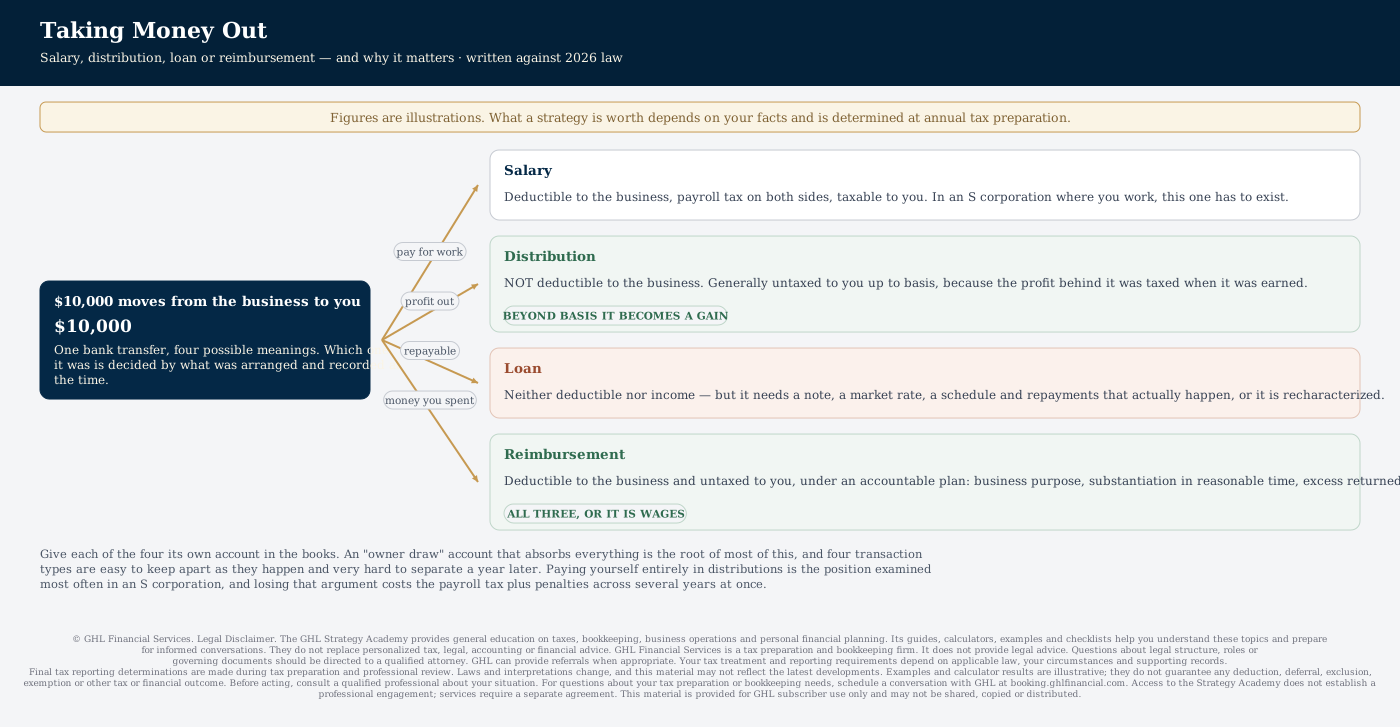
| Salary | deductible to the business · payroll tax both sides · taxable to you |
|---|---|
| Distribution | NOT deductible · no payroll tax · generally untaxed to you, up to basis |
| Loan to you | not deductible, not income — repayable, and it needs a note and a rate |
| Reimbursement | deductible · no payroll tax · untaxed to you — under an accountable plan |
| What decides which | what was arranged and recorded when the money moved |
| Beyond basis | a distribution stops being untaxed and becomes a gain |
The general treatment for an S corporation; a partnership uses different words for the same ideas and a partner's guaranteed payment behaves much like salary. A C corporation is different again — a distribution there is a dividend and is taxable. Reimbursements are only untaxed under a plan that requires substantiation and the return of anything unspent.
How it works
Salary is pay for work. It is deductible to the business, carries payroll tax on both sides, and is taxable to you. In an S corporation an owner who works in the business is expected to have one.
A distribution is a payment of profit already allocated to you. It is not deductible to the business and generally not taxable to you, because it was taxed when it was earned.
A distribution beyond your basis is taxable as a gain, which is the exception worth knowing.
A loan is money you are expected to give back. It is neither deductible nor income, and it needs the apparatus of a loan to be one: a note, a market rate, a schedule, and repayments that actually happen.
A reimbursement repays you for something you bought for the business. Under an accountable plan it is deductible to the business and untaxed to you.
An accountable plan requires a business purpose, substantiation within a reasonable time, and the return of any excess. Without all three, payments under it are wages.
Each of these has to be recorded as what it is when it happens. The bookkeeping is the evidence.
What you would do
- Give each of the four its own account in the books. An 'owner draw' account that absorbs everything is the root of most of this.
- Run salary through payroll on a schedule, not as a year-end entry. An amount booked in December and never paid through payroll is not salary.
- Paper every loan properly before the money moves — note, rate, schedule — and then actually make the repayments.
- Put an accountable plan in place before the first reimbursement, not after.
- Ask GHL for your basis before taking a large distribution in a year the business lost money.
- Reconcile monthly. Four transaction types are easy to keep apart as they happen and very hard to separate a year later.
Allow one to two months. Some of it depends on other people.
Worksheets to use
- Expense reimbursement report (XLSX). Each business expense paid personally, with date, amount, business purpose and the receipt reference — the substantiation an accountable plan requires. Complete it within a reasonable time of the spend, not at the year end. Late substantiation is what turns a reimbursement into wages.
- Owner basis schedule (XLSX). The running balance of what you have in the business, which decides whether a distribution is untaxed or a gain. Check it before taking a large distribution, particularly in a year the business made a loss.
- Payroll and owner distribution tracker (XLSX). What the owner was actually paid as wages, what was taken as distributions, and whether the agreed salary is being run. Log every distribution as it is taken, including anything the company paid on the owner's behalf. Distributions climbing while wages sit still is the pattern that draws attention.
What GHL needs from you
- Every transfer between you and the business, with dates and what each was.
- Payroll reports for the year.
- Loan notes, and the repayment history.
- The accountable plan document and the expense claims under it.
- Your basis schedule.
What usually goes wrong
- One bank transfer, four possible meanings. Which one it was is decided by what was arranged and recorded at the time — not by what suits the return later.
- Salary is the only one that carries payroll tax, and in an S corporation it is the one that must exist. Paying yourself entirely in distributions is the position examined most often.
- A distribution is not a deduction to the business. It moves money that has already been taxed to you; it does not reduce the business's profit.
- A loan needs to look like a loan: a note, a rate, a repayment schedule, and actual repayments. A 'loan' with none of those is usually recharacterized as a distribution or as wages.
- A below-market loan between an owner and a business can be treated as carrying interest anyway, with the interest imputed on both sides.
- A reimbursement is untaxed to you and deductible to the business only under an accountable plan — substantiated, and with anything unspent returned. Without that it is wages.
- Taking a distribution beyond basis creates a gain. That is the one way taking money out produces tax directly, and it surprises people in a good year followed by a bad one.
Common questions
Can I just take distributions and skip payroll?
In an S corporation where you work in the business, no — that is the position examined most often, and losing the argument costs the payroll tax plus penalties across several years at once. A reasonable salary has to exist; what is above it can be distributed.
I lent the business money. Does the paperwork really matter?
It decides whether it is a loan at all. Without a note, a rate and actual repayments it is generally treated as a contribution or a distribution instead — which changes your basis, and in an S corporation whether you get debt basis for losses.
Read next
Keeping it alive
A position is not finished when it is set up. This is what it needs each year to still be there when it matters.
- Confirm it still applies — circumstances change more often than the law does.
- Keep the record current. Filled in as the year happens it is evidence; assembled in March it is a reconstruction.
- Put the date in the calendar. This one closes at the year end and cannot be added at tax preparation.
- Ask GHL what changed for 2027. Figures move every year and rules move most years.