
When it matters: The SBA's guidance: open the account as soon as the business starts accepting or spending money, once it has its EIN.
Does this fit you?
- You are starting a business and have not opened its bank account yet.
- Your business and personal money share an account.
- Your books are brought up to date once a year.
What it could be worth
This guide quotes the SBA, whose guidance is about running a business. It is not a tax rule, and nothing in it changes what the business owes.
What it is worth is books a return can be prepared from. IRS.gov's recordkeeping page says good records help prepare financial statements and the return, show where income came from, and support the items on the return.
How it works
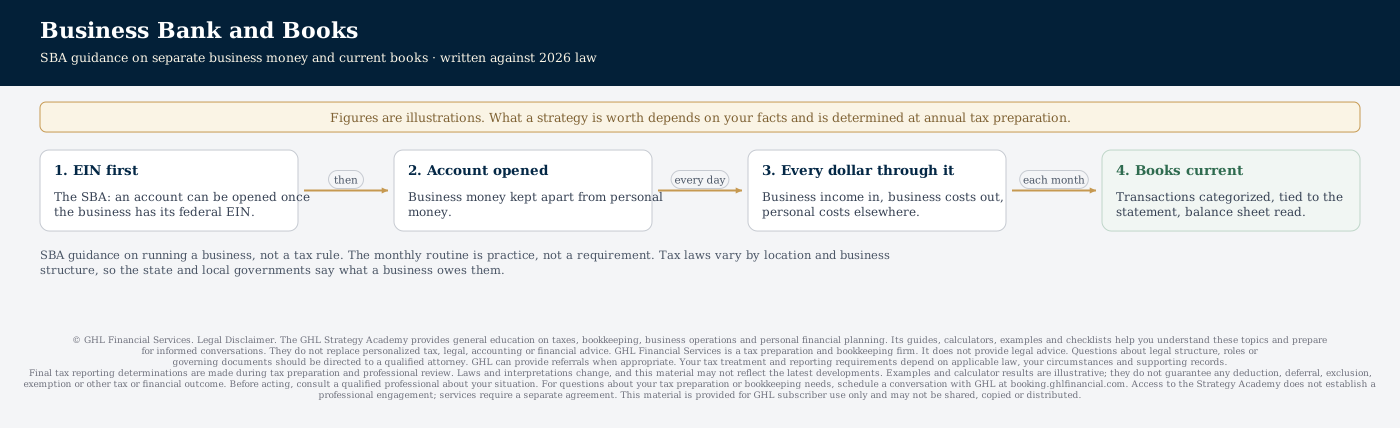
When to open it. The SBA's guidance: “As soon as you start accepting or spending money as your business, you should open a business bank account.” And: “You can open a business bank account once you've gotten your federal EIN.” Getting the EIN has its own guide.
Why separate. The SBA: “Business banking offers limited personal liability protection by keeping your business funds separate from your personal funds.” How much protection a particular structure gives is a legal question for an attorney.
Bookkeeping. The SBA: “Make sure you maintain proper bookkeeping and have a basic knowledge of business finances.” And on the balance sheet: “The balance sheet is the foundation of managing your finances. It operates as a snapshot of your business financials.”
A monthly habit that keeps the books current: every business dollar through the business account, each transaction categorized, the books tied to the bank statement, and the profit and loss and balance sheet read. That is practice, not a rule; the Cash or Accrual and Profit Is Not Cash guides take it further.
The tax year. The SBA: “If you don't have special accounting needs for your business, choose a calendar tax year.” Whether a business has such needs is a question for a qualified tax professional.
State and local. The SBA: “Tax laws vary by location and business structure, so you'll need to check with state and local governments to know your business' tax obligations.”
Sources
What you would do
- Open the business account once the business has its EIN, if it needs one.
- Run business income and costs through it, and keep personal ones off it.
- Pick bookkeeping software or a simple spreadsheet, and set a monthly time to bring it up to date.
- Each month, tie the books to the bank statement and read the balance sheet.
- Keep receipts and statements in one place, on paper or digitally.
Usually a week or two — mostly things you can start yourself.
What GHL needs from you
- Year-end statements for every business account.
- The year's books: the profit and loss and the balance sheet.
- A note of any personal costs paid from the business account, or business costs paid personally.
- All of it sent through the Secure Client Portal, not by email.
What usually goes wrong
- Mixing personal and business money in one account, then sorting it out at tax time.
- Books brought up to date once a year, from statements, after the details are forgotten.
- Opening the account under the owner's own name and number when the business has its own EIN.
- Reading the SBA's guidance as a tax rule. It is guidance on running a business.
Common questions
Does the IRS require a separate business account?
This guide quotes the SBA, whose guidance is about running the business. It does not state an IRS requirement for a separate account.
Do I need an EIN to open one?
The SBA's guidance says you can open a business bank account once you've gotten your federal EIN. A bank may set its own requirements.
Calendar year or another tax year?
The SBA's guidance is to choose a calendar tax year if the business has no special accounting needs. Whether it does is a question for a qualified tax professional.
Read next
Keeping it alive
A position is not finished when it is set up. This is what it needs each year to still be there when it matters.
- Confirm it still applies — circumstances change more often than the law does.
- Put the date in the calendar. This one closes at the year end and cannot be added at tax preparation.
- Ask GHL what changed for 2027. Figures move every year and rules move most years.