
When it matters: Answered when the money is spent. A cost recorded correctly at the time needs no argument later; one reclassified in March is the version that gets looked at.
Does this fit you?
- You are about to buy something and are unsure whose money should pay for it.
- You are looking at a card statement with personal items on it.
- You have been told 'put it through the business' and want to know what that actually means.
What it could be worth
A legitimate business cost run through personal money is a deduction nobody claims. That is the quiet loss, and over a year it adds up to more than most single strategies in this library.
The opposite costs more when it is found: personal spending run through the business is disallowed, and in an S corporation it can become wages with payroll tax attached.
The largest practical saving is the time. A card statement coded as it happens takes minutes a month; the same statement reconstructed in March takes days and produces a worse answer.
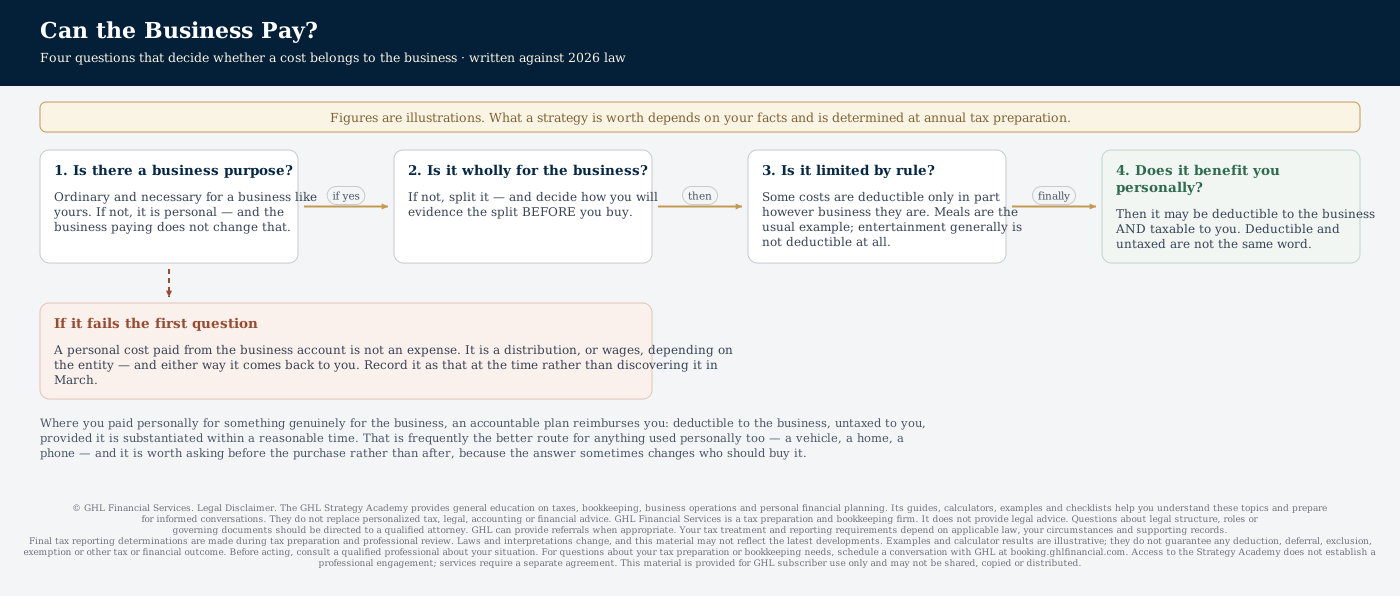
| 1. Is there a business purpose? | if not, it is personal — and the business paying does not change that |
|---|---|
| 2. Is it wholly for the business? | if not, split it, and evidence the split |
| 3. Is it limited by rule? | some costs are deductible only in part however business they are |
| 4. Does it benefit you personally? | then it may be deductible to the business AND taxable to you |
| If it fails question 1 | record it as a distribution or as wages, not as an expense |
| If you paid it yourself | reimburse under an accountable plan rather than absorbing it |
The general order. A cost has to be ordinary and necessary for the business to be deductible at all; personal costs are not, regardless of which account paid. Particular categories carry their own limits and substantiation rules, and some benefits provided to an owner are taxable to them even where the business deducts them.
How it works
Start with purpose. A cost is deductible where it is ordinary and necessary for the business — something a business like yours would normally incur, for a business reason.
If there is no business purpose, it is personal. Paying for it from the business account does not create one; it creates a distribution or wages instead.
If the purpose is partly business and partly personal, the business share is deductible. That share has to be supported by a record rather than an estimate.
Some categories are limited by rule whatever their purpose — meals are deductible only in part, and entertainment is generally not deductible at all.
Substantiation requirements are stricter for some things than others. Travel, vehicles and meals each need more than a receipt.
Where something benefits you personally, ask a second question: is it taxable to you? A benefit can be deductible to the business and still income in your hands.
Where you paid personally for something genuinely for the business, an accountable plan reimburses you — deductible to the business, untaxed to you, provided it is substantiated.
What you would do
- Stop using one card for both. A separate business card removes most of this problem before it starts.
- Code transactions monthly, not annually. The business purpose is obvious in the week it happened and invisible a year later.
- For anything mixed, decide how you will evidence the split before you buy it — a log, a usage record, a floor plan.
- Put an accountable plan in place so personal payments for business costs can be reimbursed properly.
- When you are unsure, ask before buying rather than after. The answer sometimes changes what to buy or who should buy it.
- Keep personal spending out of the business account entirely. Where it happens, record it as a distribution at the time.
Usually a week or two — mostly things you can start yourself.
Worksheets to use
- Expense reimbursement report (XLSX). Each business cost paid personally, with date, amount, business purpose and receipt reference. This is how a cost you paid for reaches the business deduction without becoming wages. Submit it within a reasonable time of the spend rather than at the year end.
- Business travel and meals log (XLSX). Each trip with its days split between business and personal, and each meal with the people who were at it. Open a trip line before you go. For meals, write the names and the business relationship at the table — that detail is never recoverable afterwards.
What GHL needs from you
- Bank and card statements for the business, coded.
- The business purpose for anything unusual or large.
- Usage records for anything mixed — vehicle, home, equipment.
- The accountable plan and the claims under it.
- Anything personal that went through the business, identified.
What usually goes wrong
- 'The business paid for it' is not the test. A business can pay for anything; whether it is DEDUCTIBLE is a separate question, and whether it is taxable to you is a third.
- A purely personal cost paid by the business is not a deduction. It is a distribution, or wages, depending on the entity — either way it comes back to you.
- Mixed use is the common case and the one that needs a record. A laptop, a car, a phone — the business share is deductible and the personal share is not, and the split has to be evidenced rather than asserted.
- Some costs are deductible only in part by rule rather than by use, whatever the business purpose. Meals are the usual example.
- Entertainment is generally not deductible at all, which still surprises people who remember when it was.
- Some things are best handled as a reimbursement to you rather than a direct company purchase — particularly where the asset is used personally too, and especially with a home or a vehicle.
- A benefit given to you as an owner can be taxable to you even when it is deductible to the business. Deductible and untaxed are not the same word.
Common questions
The business paid for it. Isn't that enough?
No — those are two different questions. A business can pay for anything; whether it is deductible turns on business purpose, and a personal cost paid from the business account is a distribution or wages rather than an expense.
What about something I use half for work?
The business share is deductible and the personal share is not, so the question becomes how you will evidence the split. Decide that before buying — a log started on day one is easy, and a split asserted a year later is the part that gets challenged.
Can the company buy my car?
It can, and that is often not the best answer. Where an asset is used personally too, reimbursing your own use under an accountable plan is frequently simpler and produces a better result.
Read next
Keeping it alive
A position is not finished when it is set up. This is what it needs each year to still be there when it matters.
- Confirm it still applies — circumstances change more often than the law does.
- Keep the record current. Filled in as the year happens it is evidence; assembled in March it is a reconstruction.
- Put the date in the calendar. This one closes at the year end and cannot be added at tax preparation.
- Ask GHL what changed for 2027. Figures move every year and rules move most years.