
When it matters: Established on the return for the loss year. A loss not computed and recorded then is a loss nobody can find later.
Does this fit you?
- Your business has had a genuinely bad year, particularly after a large first-year deduction on equipment.
- You are carrying a loss forward and are about to have a profitable year.
- You took a large accelerated deduction and created a loss on purpose.
What it could be worth
It stops a loss being wasted. Income and expenses fall in calendar years, and a business that loses money in one year and makes it in the next would otherwise be taxed as though the first year had not happened.
The carryforward is indefinite for losses from 2018 onwards, so there is no clock running out.
What it does not do is take a later year to nil. Only 80% of that year's income can be covered, so there is always some tax in a profitable year however large the loss.
| Loss carried forward | $500,000 |
|---|---|
| Taxable income in the later year, before the loss | $300,000 |
| Most the loss can cover | 80% — $240,000 |
| Income still taxed that year | $60,000 |
| Loss remaining, carried on | $260,000 |
The 80% limitation applies to losses arising from 2018 onwards; older ones are treated differently. Basis, at-risk and passive-activity limits are applied before this one, so a loss may be restricted long before it reaches this stage. States do not all follow the federal treatment.
How it works
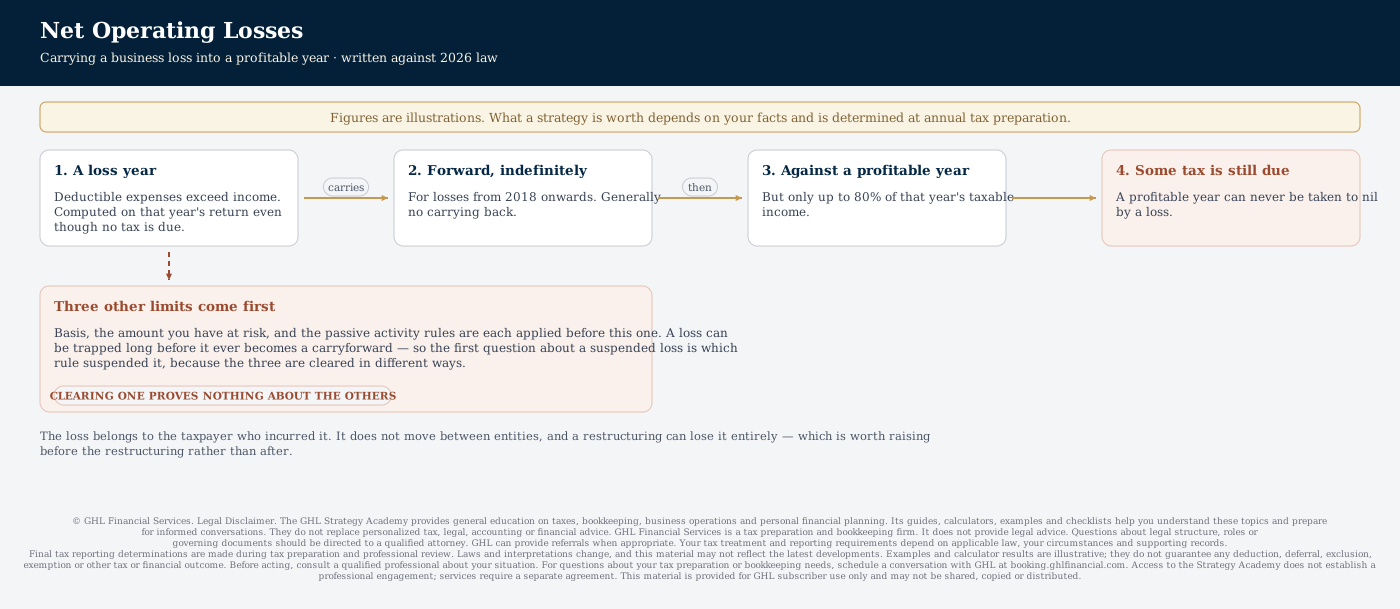
A loss arises when deductible expenses exceed income for the year, computed on the return for that year.
For losses from 2018 onwards it carries forward indefinitely, and generally cannot be carried back.
In a later year it can cover at most 80% of taxable income, so a profitable year always carries some tax.
Other limits apply first: your basis in the business, the amount you have at risk, and the passive activity rules. Each can trap a loss before this stage.
The loss belongs to the taxpayer who incurred it. It does not move between entities, and restructuring can lose it.
States often have their own rules, so the federal answer and the state answer are different numbers.
What you would do
- Make sure the loss is computed and recorded on the return for the year it happened, even though there is no tax to pay.
- Keep a running schedule of what is carried, from which year, and how much has been used.
- Tell GHL before a restructuring or a sale — losses are among the things most easily lost in one.
- Ask which limit is actually binding before assuming a loss is available: basis and at-risk come first.
- Expect to pay some tax in the year you return to profit. Budget for it.
What GHL needs from you
- The return for the loss year, with the computation.
- A schedule of losses carried, by year of origin.
- Your basis in the business, and what you have at risk.
- Details of any restructuring or change of ownership.
- The states the business files in.
What usually goes wrong
- A loss arising from 2018 onwards can only offset 80% of a later year's income. It cannot take a profitable year to nil, so tax is due in a year the owner expected to pay none.
- Carrying back to an earlier year is generally no longer available for these, so the loss waits for profit rather than producing a refund now.
- The loss belongs to whoever the return belongs to. A loss in one entity does not automatically shelter income in another, and losses can be lost entirely in a restructuring.
- Several other limits sit in front of this one — basis, at-risk, and passive activity — and they apply first. A loss can be trapped long before it ever becomes one of these.
Common questions
Can I get a refund of earlier years' tax?
Generally not for losses from 2018 onwards — the carryback was removed. The loss waits for future profit instead.
Does the loss follow me if I change entity?
Not automatically, and that is one of the more expensive things to discover afterwards.