
When it matters: The asset must be placed in service — ready and available for a specific use — by the last day of the business's tax year: December 31 for a calendar-year business, the last day of its fiscal year for one that is not. Ordering it is not enough.
Does this fit you?
- Your business is buying equipment, machinery, off-the-shelf software, or qualifying improvements.
- You have taxable income from actively conducting a trade or business, including wages — the deduction cannot exceed it, and the excess carries forward instead.
- You have had a high-income year and want the deduction in it rather than spread across the next five.
What it could be worth
Ordinarily the cost of equipment is deducted across its useful life. This provision lets a business deduct the whole cost in the tax year the asset is placed in service, up to an annual dollar limit — $2,560,000 for tax years beginning in 2026 — reduced dollar for dollar by the amount qualifying purchases placed in service that year exceed $4,090,000.
It is a question of timing rather than total. The same cost is deducted either way; what changes is when, which matters most when this year's bracket is higher than next year's is likely to be.
| Deducted in the year placed in service | $50,000 |
|---|---|
| Federal effect at a 24% rate | ≈ $12,000 |
| Dollar limit, tax years beginning in 2026 | $2,560,000 |
| Reduced dollar for dollar once property placed in service in the year passes | $4,090,000 |
Tax years beginning in 2026, from the What's New section of IRS Publication 946 (2025); the limits are indexed and change each year. Assumes the equipment is placed in service before the business's tax year ends, is used more than 50% for business, and that the business and its owner each have at least $50,000 of taxable income from the active conduct of a trade or business to absorb the deduction. Federal treatment only — several states do not follow it.
How it works
Placed in service is the trigger, not ordered and not paid for: the date the asset is ready and available for a specific use. A machine sitting on a supplier's floor on the last day of the tax year — December 31 for a calendar-year business — does not count for that year, however early the purchase order went in.
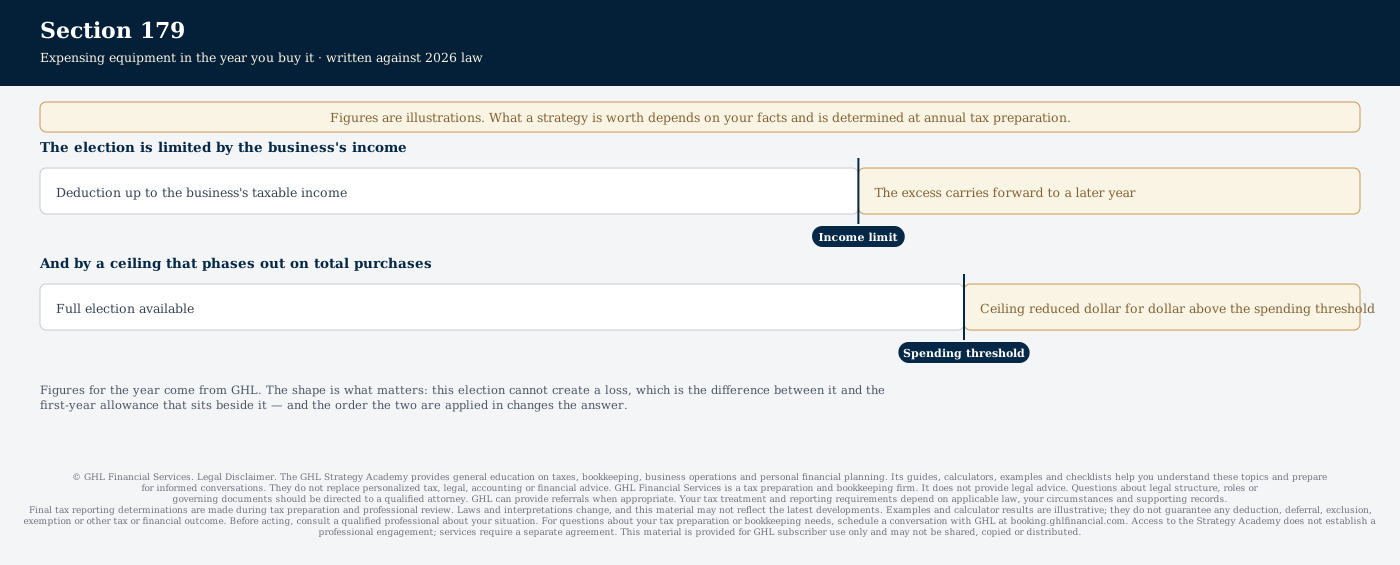
Two limits apply before the income limit. The dollar limit is $2,560,000 for tax years beginning in 2026, and it shrinks dollar for dollar by the amount the cost of qualifying property placed in service in the year exceeds $4,090,000.
The deduction cannot exceed taxable income from the active conduct of any trade or business — which for an individual counts all of their active businesses together, and wages from a job. Where it would, the excess carries forward to a later year rather than creating a loss.
In a partnership or S corporation, the limits apply twice: once to the business, and again to each partner or shareholder, whose share joins any other 179 deductions they have and is tested against their own business income.
It coordinates with bonus depreciation: this election first, bonus on what is left, ordinary depreciation on the remainder. The order is not a preference, it is how the calculation runs.
If business use falls to 50% or less in any year of the asset's recovery period, part of the deduction is recaptured: the 179 deduction taken, less the depreciation that would have been allowed without it, is ordinary income in that year, reported on Form 4797. That is not a penalty — it is the other end of having taken the deduction early. Selling the asset is handled separately, under the depreciation recapture rules for section 1245 property.
Vehicles have their own rules, and business use has to stay above half. See the vehicle document.
Sources
What you would do
- Tell GHL what you are planning to buy before the end of the year, not after.
- Make sure the asset is delivered and ready for use before your business's tax year ends — December 31 if it runs on the calendar year — not merely ordered.
- Keep the invoice, the delivery date, and what the asset is used for.
- Keep a use log for anything that could be used personally — vehicles especially.
- Tell GHL when an asset is sold, taken out of the business, or used less for business; the treatment follows it.
Allow one to two months. Some of it depends on other people.
Worksheets to use
- Equipment placed-in-service log (XLSX). Asset, cost, invoice date and the date it was actually put to use — the two dates that decide which year the deduction belongs to. Add a line when equipment is delivered, not when it is ordered. Check it in December against anything still on order.
What GHL needs from you
- Purchase invoices with dates.
- The date each asset was placed in service, where it differs from the invoice.
- An asset list for the year, with cost and description.
- A business-use log for any asset with personal use.
What usually goes wrong
- A vehicle on the order book and undelivered does not qualify. The trigger is delivery and readiness, not the purchase order.
- Business use of the asset falls to 50% or less in a later year of its recovery period, and part of the deduction comes back as ordinary income in that year.
- The limit is applied once to the business and again to each owner. A partner or S-corp shareholder with 179 deductions from more than one business, or too little active business income of their own, cannot always use what the business passed through.
- Several states do not follow the federal limit, so the federal answer and the state answer are different numbers.
Common questions
I ordered it in December and it arrived in January. Which year?
For a calendar-year business, the year it was placed in service, so the new year. The order date does not move it. A business with a fiscal year asks the same question of its own year end.
We are an S corporation. Does the deduction on the business return settle it?
Not entirely. The limits are applied to the corporation first, and the deduction then passes to each shareholder, where it is added to any other 179 deductions they have and tested again against their own dollar limit and their own taxable income from active trades or businesses. The worked example in Publication 946 has a partner carrying forward the part his own business income could not absorb; which limit stopped an amount decides what happens to it, and that is settled on the return.
Does my state follow the federal limit?
Not always. Several states set their own, which is why a state figure is confirmed before the federal saving is relied on.
Read next
Keeping it alive
A position is not finished when it is set up. This is what it needs each year to still be there when it matters.
- Confirm it still applies — circumstances change more often than the law does.
- Keep the record current. Filled in as the year happens it is evidence; assembled in March it is a reconstruction.
- Put the date in the calendar. This one closes at the year end and cannot be added at tax preparation.
- Ask GHL what changed for 2027. Figures move every year and rules move most years.