
When it matters: Tested every year. The amount at risk moves with contributions, withdrawals, profits and losses.
Does this fit you?
- You have invested in something financed largely by borrowing.
- Your share of losses is larger than what you put in.
- You have been told your loss is suspended and not told which rule suspended it.
What it could be worth
Nothing on its own — this is one of the rules that decides whether a loss you already have is usable this year or later.
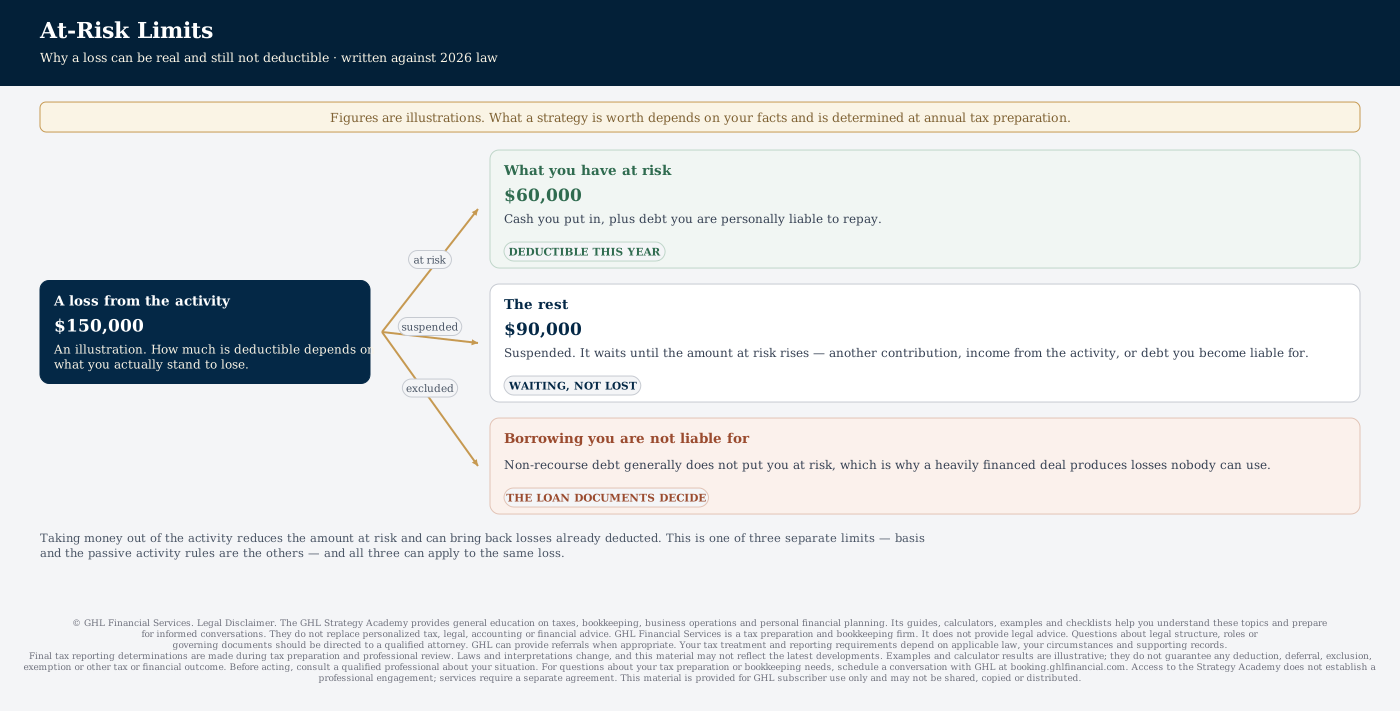
A suspended loss is not lost. It waits, and becomes deductible when the amount at risk rises: another contribution, a profitable year, or taking on debt you are actually liable for.
Knowing which of the three limits is binding is what makes it fixable. Basis, at-risk and passive activity trap losses for different reasons and are cleared in different ways.
| Cash you put in | $40,000 |
|---|---|
| Debt you are personally liable for | $20,000 |
| Amount at risk | $60,000 |
| Loss deductible this year | $60,000 |
| Suspended until the amount at risk rises | $90,000 |
Whether a particular borrowing counts is decided on the loan documents rather than on its label. Basis and the passive activity rules are applied separately and either can restrict the same loss further.
How it works
You are at risk for money you contributed and for debt you are personally liable to repay.
You are generally not at risk for non-recourse debt, or for amounts that somebody else has agreed to make good if the venture fails.
A loss is deductible only up to the amount at risk. The rest is suspended and carried.
The suspended part becomes deductible when the amount at risk rises — a further contribution, income from the activity, or converting the borrowing into something you are liable for.
Taking money out reduces the amount at risk and can recapture losses already taken.
It is computed activity by activity, and it sits alongside basis and the passive activity rules rather than replacing them.
What you would do
- Keep the loan documents. Whether debt is recourse is decided by what they say, not by what the lender calls the product.
- Track contributions and withdrawals by date. The amount at risk moves with both.
- Ask which limit is binding on a suspended loss before trying to fix it — the three are cleared differently.
- Before taking money out of an activity showing losses, ask what it does to the amount at risk.
- Keep the suspended loss schedule. Nobody reconstructs it years later.
What GHL needs from you
- Loan agreements, and anything signed promising to cover the debt.
- Contributions and withdrawals, with dates.
- The statement from the partnership or corporation showing your share.
- Any suspended losses carried from earlier years.
- Whether you participate in the activity, for the separate passive test.
What usually goes wrong
- Non-recourse debt — borrowing you are not personally liable for — generally does not put you at risk, which is why a heavily financed investment can produce a loss you cannot use.
- Taking money out of the activity reduces the amount at risk, and can bring back losses already deducted.
- It is a different limit from basis, and from the passive activity rules, and all three can apply to the same loss. Clearing one proves nothing about the others.
- The amount is per activity, not per taxpayer. Being at risk in one venture does not free a loss in another.
Common questions
Is this the same as basis?
No, though they are often the same number.
Is a suspended loss lost?
No. It waits until the amount at risk rises, and it carries with the activity. Keep the schedule — it is the part people lose.