
When it matters: The plan has to be established by the end of the tax year. Funding follows later, up to the filing deadline including extensions.
Does this fit you?
- You are self-employed or own a small business, usually in your fifties or sixties — the shorter the run to retirement, the larger the required contribution.
- Your income is high and, more importantly, steady. The plan has to be funded every year, including bad ones.
- You have few or no employees, or employees whose inclusion you are willing to fund. They cannot be left out.
- You have already used the other plans available and still have profit you want to shelter.
What it could be worth
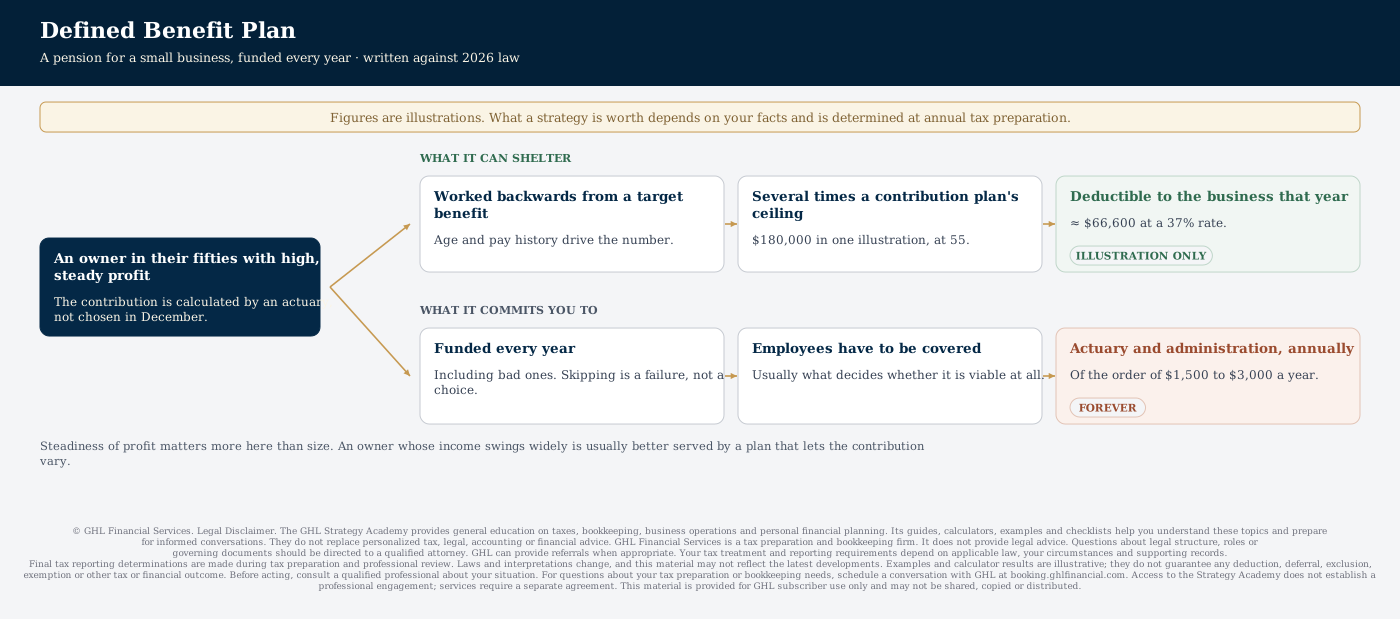
The contribution is a deduction to the business in the year it is made, like any other retirement contribution. What is different is the size: because the figure is worked backwards from a target benefit, an older owner with a short horizon can be required to put in several times what the contribution plans allow.
That size is the point and also the risk. The plan carries a minimum funding requirement. A year the business cannot fund is not a year the contribution is skipped; it is a failure with its own consequences.
There are real costs: an actuary to set it up and to certify it every year. On a large contribution those are small. On a small one they are not, which is roughly where the decision sits.
| Actuarially determined contribution, in this illustration | $180,000 |
|---|---|
| Federal effect at a 37% marginal rate | ≈ $66,600 |
| Typical annual administration and actuarial cost | of the order of $1,500 to $3,000 |
| Years the plan is expected to be funded | every one, until it is frozen or terminated |
An illustration at one age, one income and one target benefit. The actual contribution is calculated by an actuary from the owner's age, pay history and the benefit the plan promises — no table produces it. It assumes no employees; adding employees adds required contributions for them. The deduction is worth the marginal rate in the year it is taken, and the money is taxed when it is drawn.
How it works
The plan promises a benefit at retirement. An actuary calculates what must be contributed each year to fund it, and that calculation is redone annually.
The contribution is largely determined rather than chosen. There is a range, but it is not a number the owner picks in December.
Employees have to be included on the plan's terms. For a business with staff, the cost of covering them is usually what decides whether this is viable.
It can be combined with a contribution plan, which is how the largest totals are reached, subject to limits on the combination.
The assets have to be invested to fund the promised benefit. Returns above or below what was assumed change later contributions — a good year reduces them, a bad year increases them.
Freezing or terminating the plan is possible and is the normal exit, but it is a process with its own rules, not a decision to stop paying.
What you would do
- Look at the last three or four years of profit honestly before anything else. Steadiness matters more here than size.
- Count your employees and understand what covering them would cost. This is the question that usually ends it.
- Get an actuarial illustration before committing — the contribution is a calculation, not an estimate, and it should be seen before the plan exists.
- Plan for the years it will be funded, not just the first one. The first year is always the easy one.
- Bring it to GHL alongside whatever plan you already have, because the two interact and the combination is limited.
Allow three to six months. It needs documents, and usually somebody else to draw them.
What GHL needs from you
- Three or more years of business profit, and what you expect next year.
- Your age, and your pay history from the business.
- A full employee list with ages, pay and service.
- Any existing retirement plan and what has been contributed to it.
- The actuary's report, once there is one, and the annual certification thereafter.
What usually goes wrong
- The plan is set up on the strength of one exceptional year. The contribution is an actuarial calculation repeated annually, and a business whose profit halves still owes it.
- Employees are counted after the plan exists rather than before. Covering staff on the plan's terms is usually the cost that decides whether this was viable at all, and it is cheaper to find out first.
- Stopping is treated as a decision rather than a process. Freezing or terminating is the normal exit and has its own rules; simply not funding a year is not one of them.
Common questions
Can I skip a year if business is bad?
No, and that is the central thing to weigh. Owners whose income swings widely are usually better served by a plan that lets them vary the contribution.
I have four employees. Is this still possible?
Possible, but they have to be covered, and that cost is part of the arithmetic from the start rather than a surprise in year two.
How much can I actually put in?
Only an actuary can say, from your age, pay history and the benefit the plan promises. Any figure quoted before that calculation is a guess.
Read next
Keeping it alive
A position is not finished when it is set up. This is what it needs each year to still be there when it matters.
- Confirm it still applies — circumstances change more often than the law does.
- Check the documents still say what they said — an agreement that has drifted from practice is the usual failure.
- Ask GHL what changed for 2027. Figures move every year and rules move most years.