
When it matters: Form 2553 by the fifteenth day of the third month to count for this tax year. The salary itself has to run through payroll during the year.The salary for a year is paid through that year's payroll and reported on that year's Form W-2, so the last payday of December is the last one that counts. Whether the business is taxed as an S corporation at all is the Form 2553 election, covered in Changing Entity Type.
Does this fit you?
- You own the business and do the work in it yourself.
- Your net business income is high enough to carry the cost of payroll — the conversation usually starts around $80,000.
- You are willing to run real payroll: withholding, quarterly filings, a W-2 at year end.
What it could be worth
Two different taxes fund the same Social Security and Medicare programs. A sole proprietor pays self-employment tax on Schedule SE, figured on net earnings from self-employment, which for most owners is 92.35% of the net profit. An S-Corp owner who works in the business is an employee: the salary carries Social Security and Medicare taxes (FICA), half withheld from the owner's pay and half paid by the corporation through payroll, and distributions are not wages, so neither tax applies to them. The gap between those two bills is what this strategy is about.
How much that difference is worth depends entirely on the profit, the salary that can be justified for the work being done, and how it interacts with the qualified business income deduction, any retirement plan contributions, and state treatment. It is not a fixed percentage, and it is not free — payroll has a real administrative cost that has to be netted against it.
| Sole proprietor — net earnings from self-employment ($200,000 × 92.35%) | $184,700 |
|---|---|
| Social Security part (12.4% of $184,500, the 2026 wage base) | $22,878.00 |
| Medicare part (2.9% of $184,700) | $5,356.30 |
| Sole proprietor — self-employment tax, Schedule SE | $28,234.30 |
| S-Corp with a $90,000 salary — FICA, employee and employer halves (7.65% each) | $13,770.00 |
| Difference in these two taxes alone | $14,464.30 |
Tax year 2026. One owner, single, with no other wages and no other self-employment income; the same $200,000 is the profit before the owner's pay in both columns. Schedule SE arithmetic: 92.35% of net profit, 12.4% on the part up to the $184,500 Social Security wage base, 2.9% on all of it. FICA on the salary: 6.2% plus 1.45% from the owner and the same again from the corporation. The 0.9% Additional Medicare Tax does not arise in either column, because both figures stay under the $200,000 single threshold. Not counted: income tax, the deduction for half of self-employment tax, the corporation's deduction for its share of FICA, the qualified business income deduction, federal and state unemployment tax, state tax, and the cost of running payroll and a second return — together they narrow the gap. The salary is assumed defensible for the work performed. Your figures will differ; the number that matters is the one produced from your own return at annual review.
How it works
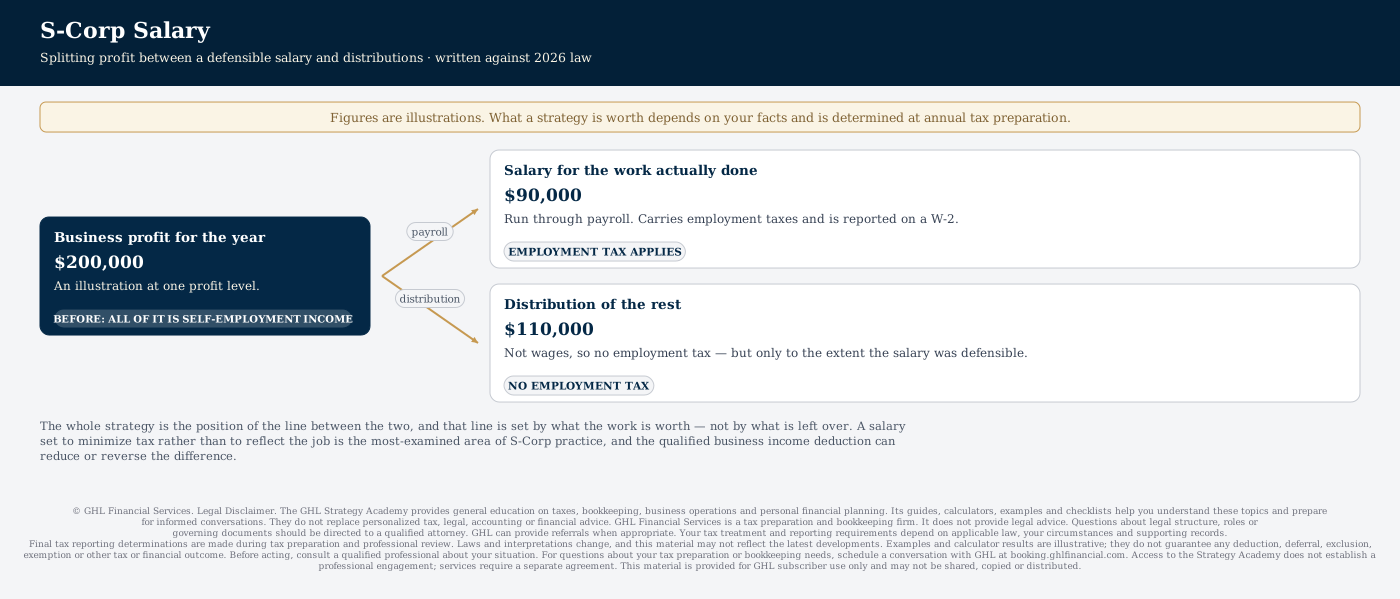
The election changes how the business reports, not what it does. The company files its own return and issues the owner a W-2 for the salary, and the remaining profit passes through on a K-1.
Once the business is an S corporation, the owner's salary is wages: Social Security and Medicare taxes are withheld from it and matched by the corporation, and self-employment tax no longer applies to the owner's share of the business profit. The distribution portion is not wages and carries neither — which is precisely why the salary figure is the part the IRS looks at, and the part that has to be supportable.
A salary set to minimize tax rather than to reflect the work is the most-examined area of S-Corp practice. The reasonable figure is the one you could explain to somebody who had never met you, from comparable pay for comparable work.
Sources
- IRS.gov: Schedule SE (Form 1040), the self-employment tax form (lines 4a, 10 and 11)
- IRS.gov: Instructions for Schedule SE (Form 1040)
- IRS.gov: Self-employment tax (Social Security and Medicare taxes)
- IRS.gov: Topic no. 751, Social Security and Medicare withholding rates (the 2026 wage base)
- IRS.gov: S corporation compensation and medical insurance issues
- IRS.gov: Topic no. 608, Excess Social Security and RRTA tax withheld
What you would do
- Talk to GHL before electing — the election has deadlines, and it is not always the right answer for the year you are in.
- Set up payroll and run it on a schedule, including for yourself.
- Keep the salary decision in writing, with what it was based on.
- Take distributions separately from payroll, and keep the business account out of personal spending.
Allow one to two months. Some of it depends on other people.
Worksheets to use
- Reasonable compensation worksheet (XLSX). Records the role, the comparables it was priced against, and the salary decided — the evidence the figure rests on. Fill it in once a year, before the salary is set — the comparables are gathered first and the decision recorded after. Keep the completed copy with the payroll records for that year.
- Payroll and owner distribution tracker (XLSX). What the owner was actually paid as wages, what was taken as distributions, and whether the agreed salary is being run. Take the salary figure from the reasonable compensation worksheet, then read the last two lines each quarter. A salary agreed in January and never run is worth nothing in December.
What GHL needs from you
- The reasonable-compensation basis for the year — the comparables or analysis the salary was set from.
- Payroll records: quarterly filings and the W-2.
- A distribution record showing amounts and dates, pro-rata across owners where there is more than one.
- The business bank statements, separate from personal.
What usually goes wrong
- The salary is set once, at election, and not revisited. It is a yearly decision — the business grows, the role changes, and a figure that was defensible three years ago becomes the weakest thing on the return.
- Distributions get taken whenever money is needed, straight from the business account, with personal spending alongside. An account that doubles as a personal one undermines more than the salary figure.
- Payroll is run once in December to catch up the year. The salary is meant to move through payroll as the year goes, and a single year-end run invites the question it was supposed to answer.
Common questions
Can the business be an S-Corp without running payroll?
No. An active owner who takes no salary is the pattern examiners look for, and a return filed that way invites the question rather than avoiding it.
I also have a W-2 job. Does that change the arithmetic?
Yes. On Schedule SE, wages from a job count first toward the Social Security wage base, so self-employment earnings above what is left of it carry only the Medicare part. Each employer withholds Social Security on its own payroll up to the base, and somebody with more than one employer whose combined withholding goes over it may claim the excess as a credit on the return. The Medicare portion has no cap, and the 0.9% Additional Medicare Tax applies once combined wages and self-employment earnings pass the threshold for the filing status. Bring the other W-2 to tax preparation.
Is there a percentage that is automatically safe?
No. Percentages of revenue circulate as rules of thumb, but what supports a salary is evidence about the work, not a ratio.
Read next
Keeping it alive
A position is not finished when it is set up. This is what it needs each year to still be there when it matters.
- Confirm it still applies — circumstances change more often than the law does.
- Keep the record current. Filled in as the year happens it is evidence; assembled in March it is a reconstruction.
- Check the documents still say what they said — an agreement that has drifted from practice is the usual failure.
- Ask GHL what changed for 2027. Figures move every year and rules move most years.