
When it matters: A new plan has to be set up by October 1 for that year. The employer route is chosen before the year starts.A SIMPLE IRA has to be set up effective by October 1 to count for the year, unless the business only came into existence after October 1 and sets one up as soon as it can.
Does this fit you?
- You employ a hundred or fewer people who earned at least a set amount in the prior year.
- Your business wants a payroll-deduction retirement plan without the annual testing and filing a 401(k) brings.
- You are willing to contribute for staff — the employer contribution is a condition of the plan, not a choice made each year.
What it could be worth
Employee deferrals reduce the employee's taxable pay. The employer contribution is a deductible business expense.
The real saving compared with a 401(k) is administrative: no annual non-discrimination testing, no plan document to maintain, and a much lighter filing burden. For a business of ten people that is a meaningful cost.
What it gives up is the ceiling. The amount an owner can put away is well below what a 401(k) or a SEP allows, and for an owner whose main goal is their own contribution that difference usually decides the question.
| 2026 employee deferral limit | $17,000 |
|---|---|
| 2026 catch-up from age 50 | $4,000 |
| Employer match, if the matching route is chosen | up to 3% of pay, for those who contribute |
| Employer contribution, if the flat route is chosen | 2% of pay, for everyone eligible |
2026 limits. The two employer routes are alternatives and the choice is made before the year starts and announced to employees. An enhanced catch-up applies at ages 60 to 63 and is not shown. Which route costs less depends entirely on how many employees contribute, which is not known in advance.
How it works
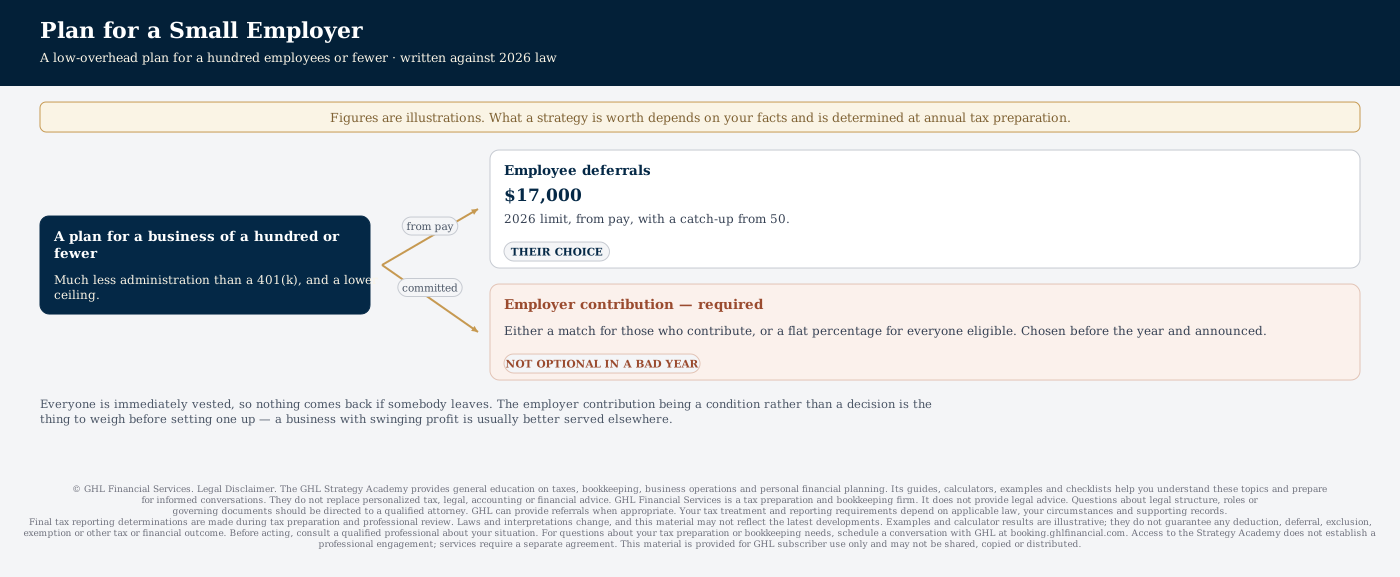
Every eligible employee can defer part of their pay, up to the annual limit, straight from payroll.
The employer must contribute as well, by one of two routes: a match for those who contribute, or a flat percentage for everyone eligible whether they contribute or not.
The route is chosen before the year begins and told to employees, so the cost is committed in advance rather than decided when the numbers are known.
Employees are immediately vested in everything, including the employer contribution. There is no schedule that returns money to the business if somebody leaves.
The plan generally has to be the only retirement plan the employer maintains for the year.
Withdrawals in the first two years carry a heavier early-withdrawal penalty than other plans, which matters for a workforce that may need the money.
What you would do
- Count your employees for the prior year, including part-time, against the eligibility test — this is the first gate.
- Decide the employer route and be ready to announce it before the year starts.
- Set the plan up through a provider and get the payroll deductions running; the deferrals must be deposited promptly, and late deposits are their own problem.
- Keep the notice you gave employees. It is evidence the required disclosure happened.
- Talk to GHL before setting one up if you already have another plan, or if you expect to grow past the employee limit.
Allow one to two months. Some of it depends on other people.
What GHL needs from you
- Employee counts and pay for the prior year.
- Which employer route you chose, and the notice given to employees.
- Deferral and employer contribution totals for the year, by person.
- The dates deferrals were deposited.
- Whether any other retirement plan was maintained in the same year.
What usually goes wrong
- In the first two years of participation, moving money to another kind of plan carries a much heavier penalty.
- This and a 401(k) cannot run in the same year for the same employer. Switching takes a January changeover.
- The employer contribution is required even in a loss year.
Common questions
Can I skip the employer contribution in a bad year?
No. It is a condition of the plan, and it is the main thing to weigh before setting one up. A business that cannot commit to it should look at a plan that does not require it.
We are growing past a hundred employees. What happens?
There is a grace period before the plan has to change, but it is finite. It is worth raising as you approach the limit rather than after crossing it.
Can I have this and a 401(k)?
Generally not in the same year. Moving from one to the other has timing rules of its own, so it is a conversation to have well before January.
Read next
Keeping it alive
A position is not finished when it is set up. This is what it needs each year to still be there when it matters.
- Confirm it still applies — circumstances change more often than the law does.
- Check the documents still say what they said — an agreement that has drifted from practice is the usual failure.
- Ask GHL what changed for 2027. Figures move every year and rules move most years.