
Does this fit you?
- You are bringing a partner, member or shareholder into your business.
- You are making a family member or key person an owner of your business.
- Your business is an LLC, partnership or corporation, or will become one when the owner joins.
What it could be worth
Nothing here lowers a tax bill by itself. It sets out what changes so the first year's returns are filed the right way.
How it works
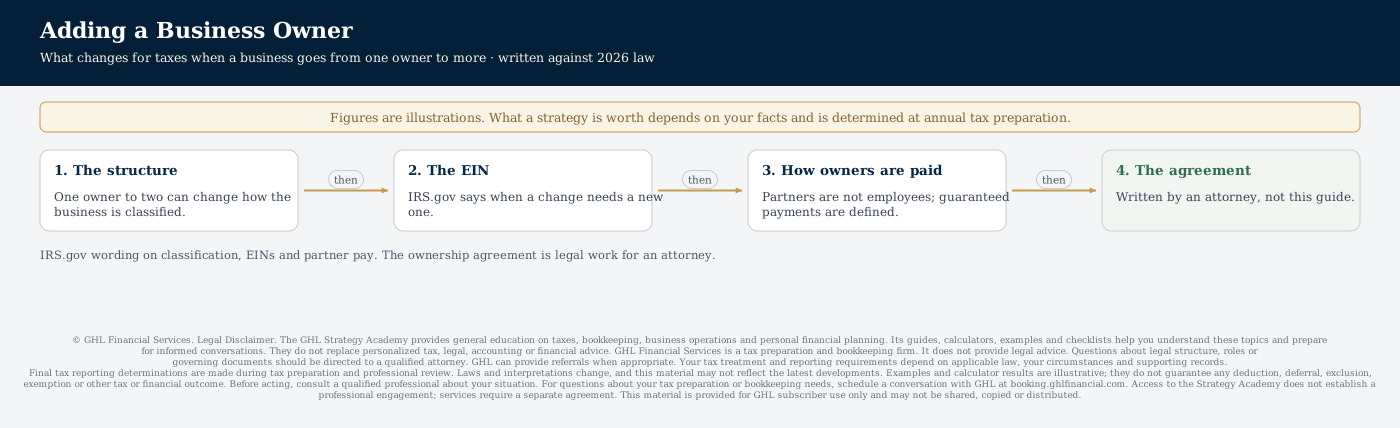
How an LLC is classified. IRS.gov, Limited liability company (LLC): “For income tax purposes, an LLC with only one member is treated as an entity disregarded as separate from its owner, unless it files Form 8832 and elects to be treated as a corporation.” And: “Specifically, a domestic LLC with at least two members is classified as a partnership for federal income tax purposes unless it files Form 8832 and affirmatively elects to be treated as a corporation.”
The partnership's return. IRS.gov, Partnerships: “A partnership must file an annual information return to report the income, deductions, gains, losses, etc., from its operations, but it does not pay income tax.” Each owner then receives a K-1.
The EIN. IRS.gov, Do you need a new EIN?, for a sole proprietor: “Get a new EIN if you:” … “Form a partnership.” For an existing partnership, a new EIN is not needed when you: “Undergo a change in ownership that does not result in the termination of the partnership.”
How partners are paid. IRS.gov, Partnerships: “Partners are not employees and shouldn't be issued a Form W-2.” Publication 541: “Guaranteed payments are those made by a partnership to a partner that are determined without regard to the partnership’s income.”
A corporation adding a shareholder has its own questions, including whether an S election still fits. The S Corporation Election covers that election.
The ownership agreement (who contributes what, who decides, how profits are shared and what happens when an owner leaves) is legal work. An attorney writes it; GHL can introduce one, and then handles the bookkeeping and returns that follow.
Sources
What you would do
- Write down the current structure and the new owner's share and contribution.
- Check the IRS EIN page for whether the change needs a new EIN.
- Talk with an attorney about the ownership agreement before the change.
- Decide with GHL how each owner will be paid, and set it up before the first payment.
- Expect a K-1 for each owner from the business's return.
Allow three to six months. It needs documents, and usually somebody else to draw them.
What GHL needs from you
- The signed ownership agreement, once an attorney has prepared it.
- The date the new owner joined and what they contributed.
- Any new EIN letter, through the Secure Client Portal.
What usually goes wrong
- Adding an owner without a written agreement. What each owner contributes and receives is set there, by an attorney.
- Paying a partner through payroll. IRS.gov says partners are not employees.
- Keeping the old EIN without checking whether the change needs a new one.
Common questions
Can my new partner be paid a salary through payroll?
IRS.gov says partners are not employees and should not be issued a Form W-2. How a partner is paid is worth deciding with GHL before the first payment.
Who writes the agreement between the owners?
An attorney. GHL can introduce one, and then handles the bookkeeping and tax side of what is agreed.
Read next
Keeping it alive
A position is not finished when it is set up. This is what it needs each year to still be there when it matters.
- Confirm it still applies — circumstances change more often than the law does.
- Put the date in the calendar. This one closes at the year end and cannot be added at tax preparation.
- Ask GHL what changed for 2027. Figures move every year and rules move most years.