
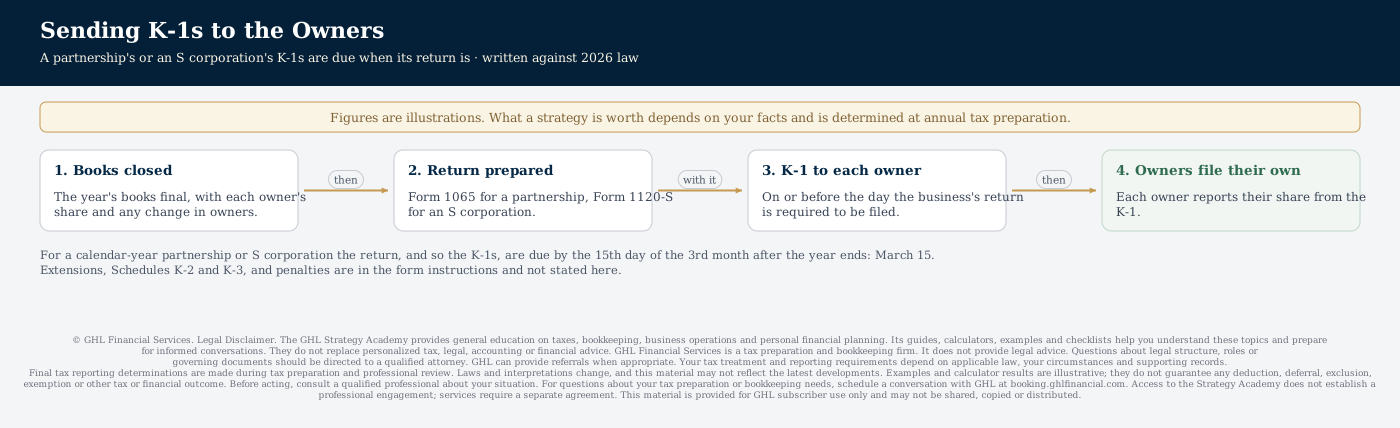
When it matters: On or before the day the business's return is required to be filed: generally the 15th day of the 3rd month after the tax year ends, March 15 for a calendar year.
Does this fit you?
- You own part of a partnership, a multi-member LLC or an S corporation.
- Your business has more than one owner, each waiting on a K-1.
- You are the owner who makes sure the K-1s go out.
What it could be worth
A partnership does not pay income tax itself, and an S corporation passes its income, losses, deductions and credits through to its shareholders. Either way, each owner reports a share on their own return, from the Schedule K-1 the business sends.
So the owners' returns wait on the K-1s. What this is worth is every owner able to file on time, from figures the business finished when it said it would.
How it works
A partnership. The Form 1065 instructions: “Schedule K-1 must be provided to each partner on or before the day on which the partnership return is required to be filed.” Form 1065 is generally due by the 15th day of the 3rd month after the end of the partnership's tax year: March 15 for a calendar year.
An S corporation. The Form 1120-S instructions: “Schedule K-1 must be provided to each shareholder on or before the day on which the corporation's Form 1120-S is required to be filed.”
Publication 509 puts the two side by side. On Form 1120-S: “This form is due on the 15th day of the 3rd month after the end of the corporation's tax year.” And: “Provide each shareholder with a copy of their Schedule K-1 (Form 1120-S) … by the 15th day of the 3rd month after the end of the corporation's tax year.”
A multi-member LLC is treated as a partnership by default, so it sends K-1s on the partnership's date. A single-member LLC is disregarded by default, with no partnership return to send a K-1 from.
Weekends and holidays. Publication 509 moves a due date that falls on a Saturday, Sunday or legal holiday to the next day that is not one.
Reading a K-1 once it arrives is a different subject. Not covered here, because the wording has not been checked against IRS.gov: what an extension of the return does to the K-1 date, Schedules K-2 and K-3, penalties for a late or missing K-1, and sending K-1s electronically.
Sources
What you would do
- Note the business's tax year, and from it the return's due date.
- Set a date to close the year's books that leaves time for the K-1s before then.
- Keep each owner's current mailing address and ownership share, and any change in owners during the year, with the ownership records.
- Record when each K-1 was sent, and how.
- Tell each owner when to expect theirs, since their own returns wait on it.
Allow one to two months. Some of it depends on other people.
What GHL needs from you
- The business's return and every K-1 issued.
- Each owner's ownership share, and any change during the year.
- When and how each K-1 was sent.
- All of it sent through the Secure Client Portal, not by email.
What usually goes wrong
- Treating the K-1s as something to send after the return. Both sets of instructions tie them to the return's own date.
- Leaving off an owner who joined or left during the year.
- Owners who file early finding their K-1 is still to come. Telling them when to expect it avoids a return filed without it.
- Closing the books so late that the K-1s cannot be ready by the return's date.
Common questions
When do the K-1s have to go out?
On or before the day the business's return is required to be filed. For a calendar-year partnership or S corporation, that return is generally due March 15.
Can the K-1s come after the return?
The instructions tie them to the day the return is required to be filed. What an extension of the return does to that day is not covered in this guide; it is in the instructions for each form.
Does my single-member LLC send me a K-1?
By default a single-member LLC is disregarded as separate from its owner for income tax, so there is no partnership return for it to send one from. An LLC that elected corporate or S corporation treatment is a different case.
Read next
Keeping it alive
A position is not finished when it is set up. This is what it needs each year to still be there when it matters.
- Confirm it still applies — circumstances change more often than the law does.
- Put the date in the calendar. This one closes at the year end and cannot be added at tax preparation.
- Ask GHL what changed for 2027. Figures move every year and rules move most years.