
When it matters: Certification is usually due before the plan year starts.
Does this fit you?
- You are servicing student loans and not contributing to the workplace plan, or contributing less than the match would reach.
- You want to make the plan useful to early-career staff who cannot do both.
- You have looked at the match and concluded you cannot afford to reach it.
What it could be worth
Nothing on this year's tax return, directly. What it changes is whether the employer's contribution happens at all.
For somebody who has been forgoing the match, the amount at stake is the match itself — money the employer would have contributed and did not, because the employee's cash was going to a loan instead.
That contribution is not taxed as it goes in and grows inside the plan, so the long-run effect is larger than the figure suggests. How much larger depends on time, which nobody can promise.
| Match available if contributions reach it | $3,200 a year |
|---|---|
| Contributed while servicing loans, in this illustration | nothing |
| Match received in that case | nothing |
| Match received if loan payments are certified and the plan has adopted the feature | up to $3,200, on the same terms as the plan's ordinary match |
An illustration of the mechanism at one salary and one match formula. The match formula, the certification process and whether the feature exists at all are set by the plan. The employee still has to make the loan payments; nothing here reduces them.
How it works
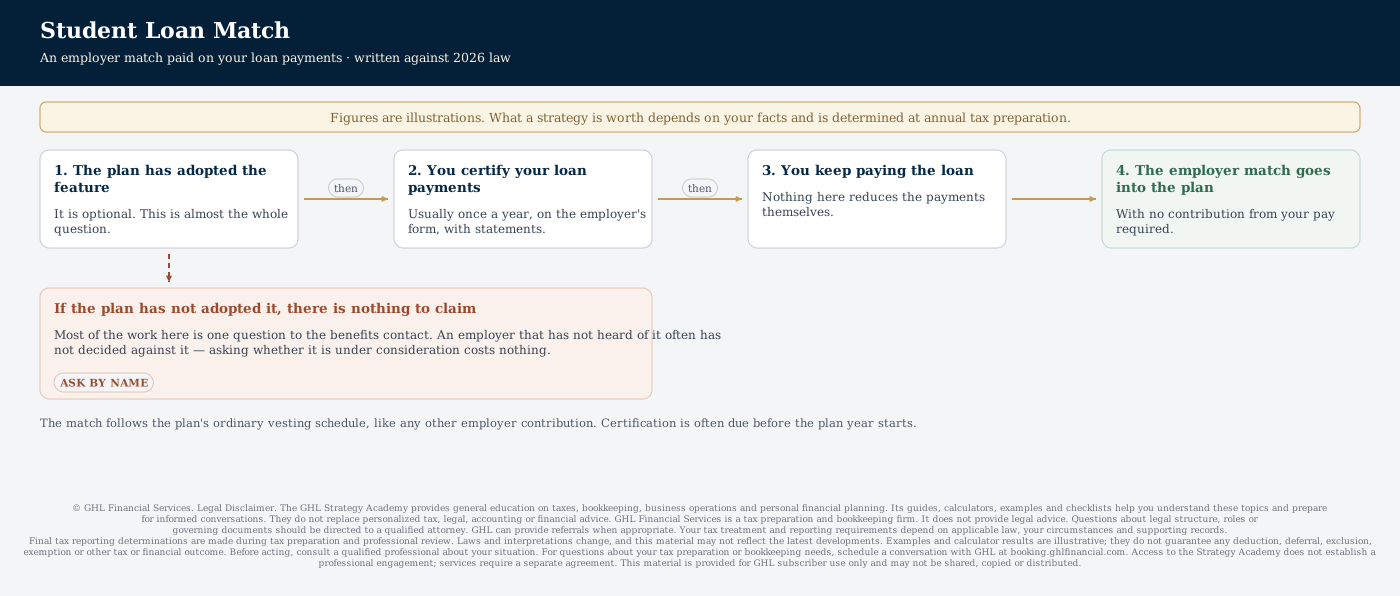
The plan may treat qualifying student loan payments as if they were elective contributions, for the purpose of the match only.
It is optional for the plan. A plan that has not adopted it does not have it, and most of the question is finding out which.
The employee certifies their qualifying payments to the employer, usually once a year and usually on the employer's own form with statements attached.
The match then goes into the plan on the certified payments. No contribution from pay is required to receive it.
The loans have to be qualifying ones for the employee's own education or, in some cases, a dependent's — the plan's rules say which.
The match is a plan contribution like any other and follows the plan's vesting schedule.
What you would do
- Ask your employer's benefits contact whether the plan has adopted the student loan match. This is the whole question; the rest follows.
- If it has, find out when certification is due — several plans require it before the plan year starts.
- Keep your loan statements for the year. They are what the certification rests on.
- Check the vesting schedule so you know what is yours and when.
- If the plan has not adopted it, ask whether it is being considered. An employer that has not heard of it often has not decided against it.
Usually a week or two — mostly things you can start yourself.
What GHL needs from you
- Whether the plan has adopted the feature, and the certification form used.
- Loan statements showing the qualifying payments.
- The match formula and vesting schedule.
- Your wage statement, which shows contributions to the plan.
- Whether you also contributed from pay in the same year.
What usually goes wrong
- The plan has to have adopted it. Many have not, and it cannot be assumed.
- The loans have to be qualifying education loans. A personal loan used for study does not count.
- The match counts against the employer contribution limits, not your own deferral limit.
Common questions
Do I have to contribute from my pay as well?
No. That is the point of the provision — the certified loan payments stand in for a contribution for matching purposes.
Does this reduce my loan balance or my tax?
Neither. The payments are yours to make either way. What changes is that the employer's match happens, into your retirement account, instead of being forgone.
Read next
Keeping it alive
A position is not finished when it is set up. This is what it needs each year to still be there when it matters.
- Confirm it still applies — circumstances change more often than the law does.
- Check the documents still say what they said — an agreement that has drifted from practice is the usual failure.
- Ask GHL what changed for 2027. Figures move every year and rules move most years.