
Does this fit you?
- Your business sells goods or services a state taxes.
- You are unsure of your state's filing schedule.
What it could be worth
Nothing here lowers a tax bill. Keeping collected tax apart means it is there when the return is due.
How it works
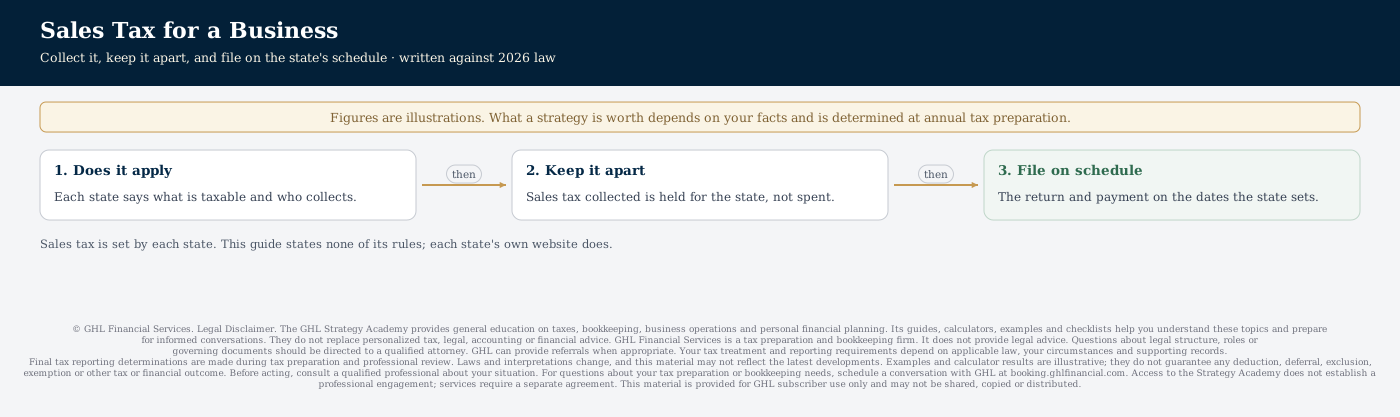
Sales tax is a state matter. Which sales are taxable, who must collect, how to register and how often to file are all set by each state.
Where to find the state's rules. IRS.gov, State government websites: “Visit the state websites below and find information on doing business in the state, taxation, links for employers, and more.” Each state's revenue department explains its own sales tax there.
Tax collected from customers is owed to the state. Keeping it in its own account, or at least tracked apart in the books, means it is not spent before the return is due.
Filing follows the schedule the state sets for the business. Business Year's quarterly stage holds a reminder for it.
Sources
What you would do
- From the IRS page, open your state's revenue department and read its sales tax pages.
- Write down whether your sales are taxable there, and the filing schedule set for the business.
- Keep collected tax apart from the business's own money.
- Put each filing date on the business's calendar.
Allow one to two months. Some of it depends on other people.
What usually goes wrong
- Spending collected sales tax as if it were the business's own money.
- Missing a filing period because no sales were made. A state can expect a return even then; its website says.
- Applying one state's rules to sales into another.
Common questions
Is sales tax a federal tax?
No. It is set by each state, and in some places by local governments, so each state's own website is the source.
Where should the sales tax we collect be kept?
Apart from the business's own money, in its own account or at least tracked apart in the books, so it is there when the return is due.
Read next
Keeping it alive
A position is not finished when it is set up. This is what it needs each year to still be there when it matters.
- Confirm it still applies — circumstances change more often than the law does.
- Put the date in the calendar. This one closes at the year end and cannot be added at tax preparation.
- Ask GHL what changed for 2027. Figures move every year and rules move most years.