
Does this fit you?
- Your business has a bank or card account that is not reconciled every month.
- Your books have fallen behind and need to be brought current.
- You want the year closed cleanly before the return is prepared.
What it could be worth
Nothing here lowers a tax bill by itself. Reconciled books make the return faster to prepare and easier to support.
How it works
Why it matters. IRS.gov, Recordkeeping: “Good records will help you monitor the progress of your business, prepare your financial statements, identify sources of income, keep track of deductible expenses, keep track of your basis in property, prepare your tax returns, and support items reported on your tax returns.”
How often. IRS.gov, Publication 583: “You should reconcile your checking account each month.”
What it does. Publication 583: “By reconciling your checking account, you will: Verify how much money you have in the account, Make sure that your checkbook and books reflect all bank charges and the correct balance in the checking account, and Correct any errors in your bank statement, checkbook, and books.”
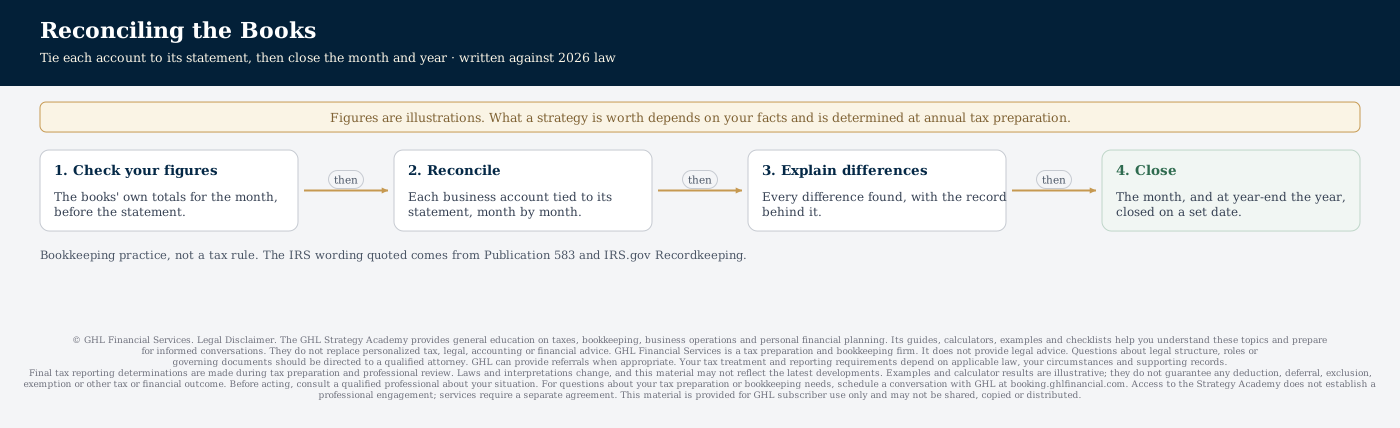
Where to start. Publication 583: “Before you reconcile your monthly bank statement, check your own figures.”
A difference needs its record. Publication 583: “Supporting documents include sales slips, paid bills, invoices, receipts, deposit slips, and canceled checks.” A difference is explained by one of these, by a bank charge not yet entered, or by an entry made twice or in the wrong account.
Closing a month means agreeing that its entries are final once the account is reconciled, so later work does not change figures already checked. Closing the year does the same for the last month and sets the cutoff: what belongs to this year and what to the next.
Books that have fallen behind are brought current the same way, one month at a time from the last month that was reconciled, with each month closed before the next is started.
Who keeps up with it. SBA guidance, not a tax rule: “Ensure that someone can manage the following: Accounts receivable Accounts payable Available cash Bank reconciliation Payroll”
How long to keep them. Publication 583: “You must keep your records as long as they may be needed for the administration of any provision of the Internal Revenue Code.” How Long to Keep Tax Records covers the periods.
Sources
What you would do
- Pick a day each month to reconcile, a few days after the statements arrive.
- Check the books' own totals for the month first.
- Tie each business account and card to its statement, and write a note for every difference.
- Close the month once it reconciles.
- If the books are behind, start with the oldest month not reconciled and work forward.
- At year-end, reconcile the last month, set the cutoff, and close the year.
Usually a week or two — mostly things you can start yourself.
What GHL needs from you
- The year's bank and card statements, every month.
- The reconciled books, with the notes for any differences.
- All of it sent through the Secure Client Portal, not by email.
What usually goes wrong
- Reconciling only at year-end. Twelve months of differences are much harder to trace than one.
- Forcing the books to match the statement with an unexplained adjustment. Each difference has a cause worth finding.
- Leaving a month open after it is reconciled, so later entries change figures that were already checked.
- Catching up behind books all at once. One month at a time, oldest first, keeps every month's balance honest.
Common questions
Our books are six months behind. Where do we start?
With the oldest month that was never reconciled, then forward one month at a time, closing each before the next. GHL's bookkeeping service can do this work if you would rather not.
The statement and the books are off by a small amount. Can we just adjust it?
A small difference usually has a cause: a bank fee not entered, an entry made twice, a deposit in the wrong month. Finding it keeps the next month's balance right too.
Read next
Keeping it alive
A position is not finished when it is set up. This is what it needs each year to still be there when it matters.
- Confirm it still applies — circumstances change more often than the law does.
- Put the date in the calendar. This one closes at the year end and cannot be added at tax preparation.
- Ask GHL what changed for 2027. Figures move every year and rules move most years.