
Does this fit you?
- Your business sells to customers in other states.
- Your business has work, property or people in another state.
What it could be worth
Nothing here lowers a tax bill. It shows where each state explains what activity there can mean.
How it works
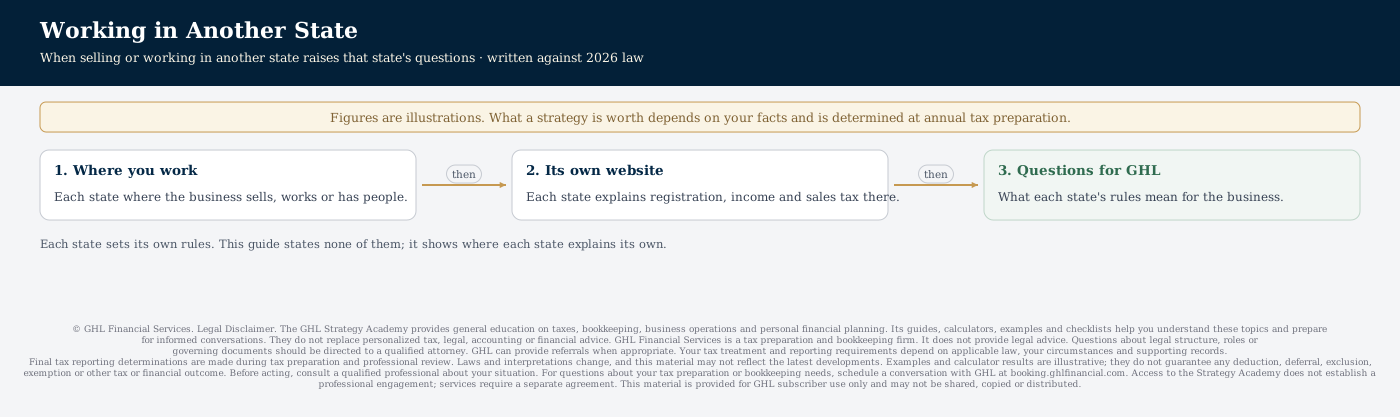
Activity in another state can bring that state's questions: whether the business registers there, whether it files an income or franchise return there, and whether it collects that state's sales tax. Each state answers these for itself.
SBA guidance, not a tax rule: “If your business is a limited liability company (LLC), corporation, partnership, or nonprofit corporation, you’ll probably need to register with any state where you conduct business activities.” On foreign qualification: “If your LLC, corporation, partnership, or nonprofit corporation conducts business activities in more than one state, you might need to form your business in one state and then file for foreign qualification in other states where your business is active.” And: “Check with state offices to find out foreign qualification requirements and fees.”
Where to find each state's answer. IRS.gov, State government websites: “Visit the state websites below and find information on doing business in the state, taxation, links for employers, and more.”
An employee working in another state can bring that state's employer questions too, which its own website covers.
Paying State Tax at the Business Level is a related guide. Registration questions about a contract or a legal entity are for an attorney; GHL can introduce one.
Sources
What you would do
- List each state where the business sells, works, owns property or has people.
- For each, open that state's own website from the IRS page and find its business pages.
- Write down what each state asks about registration, income tax and sales tax.
- Bring the list to GHL.
Allow one to two months. Some of it depends on other people.
What usually goes wrong
- Assuming the home state's rules apply everywhere. Each state sets its own.
- Hiring someone who works from another state without asking what that state requires of an employer.
- Waiting until a state writes. Asking early is easier than catching up.
Common questions
We only ship products into a state. Does that state expect anything?
That depends on the state, and its own website says. Bring the list of states and sales to GHL to talk it through.
An employee moved and now works from another state. What changes?
That state's own website covers what it asks of an employer. GHL can talk through the payroll side once you know what the state requires.
Read next
Keeping it alive
A position is not finished when it is set up. This is what it needs each year to still be there when it matters.
- Confirm it still applies — circumstances change more often than the law does.
- Put the date in the calendar. This one closes at the year end and cannot be added at tax preparation.
- Ask GHL what changed for 2027. Figures move every year and rules move most years.