
When it matters: Premiums count in the year they are paid. Nothing has to be elected, but a January payment lands in the following year.
Does this fit you?
- You are past fifty and paying premiums on a standalone long-term care policy — the cap rises steeply with age and is worth most to the oldest.
- You are self-employed or a partner, so you can take it above the line without the medical floor.
- You own a C corporation, which is the one structure that can deduct the whole premium.
- You have an HSA, which can pay these premiums without the withdrawal being taxed, up to the same age cap.
What it could be worth
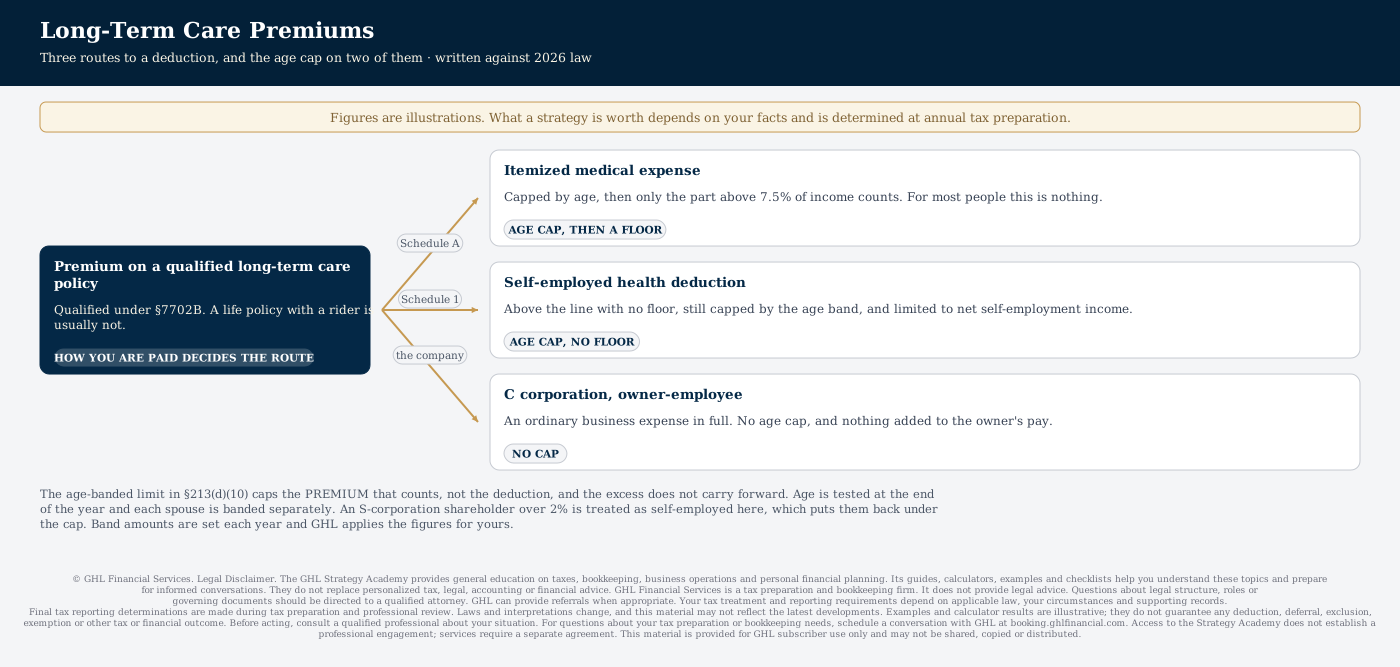
A qualified long-term care premium counts as a medical expense, and there are three quite different routes to using it. Which one is open to you depends on how you are paid, and they are worth very different amounts.
Itemized, it joins everything else medical and only the part above 7.5% of income is deductible. For most people that means nothing.
Self-employed, it goes above the line with no floor at all — but only up to the age-banded limit.
Through a C corporation it is a business expense in full, with no age cap and nothing added to the owner's pay. It is the only route without a ceiling, and it is the reason this question is worth asking before deciding how a business is taxed.
| Itemized medical expense | capped by age, then only the part above 7.5% of income |
|---|---|
| Self-employed health deduction | capped by age, no floor, limited to net self-employment income |
| C corporation, owner-employee | the whole premium, no age cap, not added to the owner's pay |
| Paid from an HSA | an untaxed withdrawal, up to the same age-banded limit |
| The age bands themselves | five of them, from 40 and under to over 70, reset each year |
The structure of §213(d)(10) and the routes to it. The band amounts are indexed annually and GHL applies the figures for your year — they are not reproduced here because a stale limit is worse than no limit. The C-corporation treatment assumes an owner who is a genuine employee of the corporation.
How it works
A contract has to be qualified under §7702B to count at all. That means the insurer cannot decline to renew it, it carries no cash surrender value, and benefits are triggered by an inability to perform at least two of six daily activities for at least ninety days, or by severe cognitive impairment.
§213(d)(10) then caps how much of the premium is treated as a medical expense, in five bands by age. The cap rises sharply with age, which is why the same policy produces a much larger deduction at seventy than at fifty.
Age for the band is tested at the end of the tax year, and each spouse is banded separately on a joint return.
The itemized route adds it to everything else medical, and the 7.5% of income floor applies to the total.
The self-employed route is above the line, so no floor applies, but the age cap still does and the deduction cannot exceed net self-employment income.
A C corporation deducting a premium for an owner-employee is buying a benefit for an employee. That is an ordinary business expense with no §213(d)(10) cap, and it is not added to the employee's pay.
An S corporation shareholder over 2% is treated for this as self-employed: the premium is added to the W-2 and then deducted above the line, back under the age cap.
An HSA can be used to pay these premiums without the withdrawal being taxed, up to the same age-banded amount. That is a use of HSA money many people never make.
Several states allow their own deduction or credit for these premiums, sometimes with no cap and sometimes where the federal route gave nothing.
What you would do
- Find the policy document and check it is a standalone qualified long-term care contract rather than a life policy with a rider.
- Get the annual premium statement, per person, and keep the proof of payment with the year it was paid in.
- Tell GHL both ages at the end of the year — the band is per person.
- If you run a business, raise this before deciding how it is taxed. It is one of the few places the answer genuinely differs by entity.
- If you have an HSA and a policy, ask whether paying the premium from it is better than paying it from cash.
- Ask whether your state gives something the federal return did not.
Usually a week or two — mostly things you can start yourself.
What GHL needs from you
- The policy, or enough of it to confirm it is qualified under §7702B.
- Premium paid in the year, per person, with the payment dates.
- Dates of birth for both spouses.
- How the business is taxed, if the premium is going through one.
- Any 1099-LTC if benefits were received.
What usually goes wrong
- A hybrid life-and-long-term-care policy is usually not deductible at all. Only a separately stated qualified long-term care portion counts, and most contracts do not state one.
- The age-banded limit is a cap on the PREMIUM that counts, not on the deduction. Paying more than the band does not carry the excess forward.
- Age is tested at the end of the tax year, so a birthday in December moves you into the next band for that whole year.
- Taken as an itemized medical expense it has to clear 7.5% of income first, which for most people means it is worth nothing by that route.
- An S-corporation shareholder owning more than 2% does not get a business deduction — the premium goes on the W-2 and comes back as the self-employed health deduction, still capped by age.
- A per-diem policy pays a fixed daily amount, and benefits above a statutory daily limit can be taxable. A reimbursement policy does not have that problem.
Common questions
Why is my deduction so much smaller than my premium?
Because §213(d)(10) caps how much of the premium counts, by age, and the cap is well below what a policy costs at younger ages.
Are the benefits taxable if I claim on the policy?
Benefits from a qualified contract that reimburse actual costs are not treated as income. A policy paying a fixed daily amount has a statutory daily limit above which some of it can be, so a 1099-LTC is worth bringing in.
Is a C corporation worth setting up for this?
Almost never for this alone — how a business is taxed changes a great deal besides. It belongs in that conversation rather than driving it, and it is a conversation to have with a qualified tax professional, or GHL if separately engaged.
Read next
Keeping it alive
A position is not finished when it is set up. This is what it needs each year to still be there when it matters.
- Confirm it still applies — circumstances change more often than the law does.
- Put the date in the calendar. This one closes at the year end and cannot be added at tax preparation.
- Ask GHL what changed for 2027. Figures move every year and rules move most years.