
When it matters: An S election has a filing deadline measured from the start of the tax year it is to take effect in, and late relief exists but is not automatic. Decide early in the year, not late.
Does this fit you?
- You are a sole proprietor whose profit has grown past what the simple form is costing you.
- You own an S-corp and wonder whether it is still worth the payroll and the filings.
- You are being told to incorporate without being told what it costs to run.
What it could be worth
At the right profit level the employment-tax difference between a sole proprietor and an S corporation is the largest recurring saving available to a small business — several thousand a year, every year.
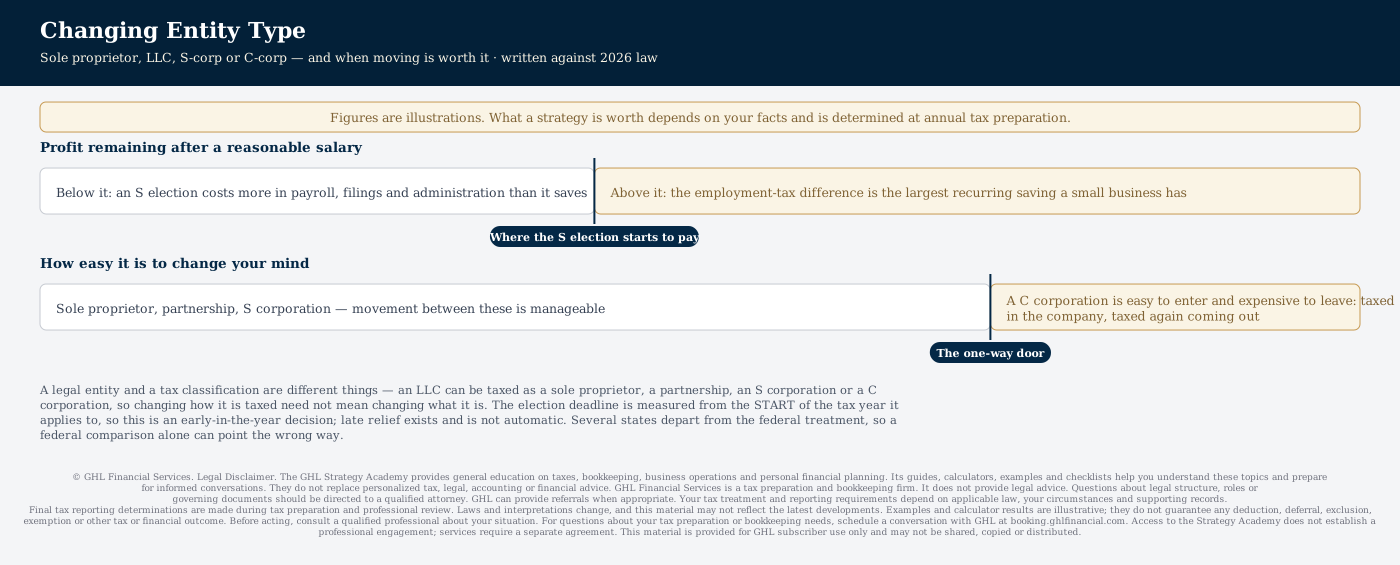
Below that level it runs the other way: payroll, a second return and the administration cost more than the saving, which is why the answer depends on the number rather than the structure.
The bigger money is usually further out. A structure chosen well before a sale is worth more at the sale than anything done during the negotiation, and that decision is made years ahead.
| Sole proprietor / single-member LLC | simplest; all profit carries employment tax |
|---|---|
| Partnership / multi-member LLC | flexible allocations; partners are not employees |
| S corporation | salary plus distributions; the saving is on employment tax |
| C corporation | its own taxpayer; easy to enter, expensive to leave |
| What decides it | profit level, payroll, state, and how it will eventually end |
| What it is not | a change of legal entity — an LLC can be taxed several ways |
What each classification is designed for rather than which is best. The S-corp comparison turns on profit remaining after a reasonable salary, which is specific to the business. Election deadlines are measured from the start of the tax year concerned. Several states depart from the federal treatment.
How it works
A sole proprietor or single-member LLC reports the business on the owner's return, and all of the profit carries employment tax.
A partnership or multi-member LLC allocates profit between partners, with more flexibility about how.
An S corporation pays its owner a reasonable salary and may distribute the rest; only the salary carries employment tax, which is where the saving comes from.
That saving is real only above the point where a reasonable salary still leaves meaningful profit, because the salary has to come first.
A C corporation is its own taxpayer. It pays its own tax and getting money out to shareholders is taxed again.
The classification is elected rather than fixed by the legal form, so an LLC can be taxed several different ways without changing what it legally is.
Elections have deadlines measured from the start of the tax year they are to apply to, and relief for a late one exists but is not automatic.
Moving between classifications can itself be taxable, particularly where assets move into or out of a corporation.
What you would do
- Get the comparison run on your actual numbers before deciding anything. The right answer at $80,000 of profit is often the wrong one at $300,000.
- Include the cost of running it — payroll, a second return, the bookkeeping — not just the tax difference.
- Decide early in the tax year. The election deadline is measured from the start of the year, not the end.
- Ask what the state does. A federal comparison on its own can point the wrong way.
- If a sale is anywhere in view, ask how the classification looks at the exit rather than only this year.
- Use an attorney for the entity documents. The tax election and the legal formation are different jobs.
Allow three to six months. It needs documents, and usually somebody else to draw them.
Worksheets to use
- Entity, ownership and election record (XLSX). What the entity is, how it is taxed, every election behind that, and who has owned it through the year. Record each election with the date it takes effect and the acceptance received. An election you believe was made, with nothing confirming it, is discovered at the worst moment.
What GHL needs from you
- Profit for the last two years and an estimate for this one.
- What the owner does in the business, and what a comparable salary would be.
- Everybody on the payroll.
- The current legal entity and where it is registered.
- Any plan to sell or bring in a partner.
What usually goes wrong
- A legal entity and a tax classification are different things. An LLC can be taxed as a sole proprietor, a partnership, an S corporation or a C corporation — changing the tax treatment does not necessarily mean changing the entity.
- The S-corp saving is on employment taxes, and it only exists above the point where a reasonable salary leaves meaningful profit behind. Below that it costs more in payroll and filings than it saves.
- Electing S status brings obligations that do not go away in a bad year: a payroll, a separate return, and a reasonable salary whether or not the business could afford one.
- Going INTO a C corporation is easy and coming out is not. Earnings taxed in the company and then taxed again on the way out is the classic trap, and it shows up years later at a sale.
- Revoking an S election has consequences of its own, including a period during which it cannot simply be made again.
- Several states treat these classifications differently from the federal rules, and a couple charge the entity regardless. A federal comparison alone can point the wrong way.
- A change of classification is a taxable event in some directions and not others. Assets moving into or out of a corporation are where that bites.
Common questions
Should I be an S corporation?
The saving is on employment tax and only exists above the point where a reasonable salary still leaves meaningful profit behind — below that, the payroll and the second return cost more than it saves. It is worth running on your actual figures.
What about a C corporation? The rate looks low.
The rate is only half the picture. A C corporation pays its own tax and then getting the money out to you is taxed again — and it is much easier to enter than to leave. It suits some situations and it is not a decision to make on the headline rate.
Read next
Keeping it alive
A position is not finished when it is set up. This is what it needs each year to still be there when it matters.
- Confirm it still applies — circumstances change more often than the law does.
- Keep the record current. Filled in as the year happens it is evidence; assembled in March it is a reconstruction.
- Check the documents still say what they said — an agreement that has drifted from practice is the usual failure.
- Ask GHL what changed for 2027. Figures move every year and rules move most years.