
When it matters: Four installments across the year. A payment made late stays late — paying more in December does not repair an underpaid April.
Does this fit you?
- You have income that is not taxed at source: business profit, rent, investment income, a large gain.
- Your income jumped this year, where last year's figure is the cheap way to stay safe.
- You have had a penalty before and do not know why.
What it could be worth
It does not reduce the tax. What it avoids is the penalty for paying it late, which is charged as interest on the shortfall for as long as it is outstanding.
The useful part is that the safe harbor is a fixed target taken from a return you have already filed. You do not have to predict this year's income to be safe from the penalty — you only have to pay a stated proportion of last year's tax.
That matters most in a year when income rises sharply. The tax will still be due at filing, but there is no penalty for having paid on last year's smaller figure through the year.
| Pay at least this and the penalty does not apply | the lower of two figures |
|---|---|
| Figure A — last year's tax | 100% of it, or 110% if last year's income was over the threshold |
| Threshold for the higher multiplier | $150,000 of income ($75,000 filing separately) |
| Figure B — this year's tax | 90% of it |
| No penalty at all if the balance owed is under | $1,000 |
2026, from the engine's own safe-harbor calculation. Figure A needs a prior-year return that covered a full twelve months. The test is applied quarter by quarter, so meeting the annual total late does not clear an earlier shortfall. Farmers and fishermen have their own rules, and states run their own versions of this with different numbers.
How it works
Tax is due as income is earned. For anything not taxed at source, that means paying in four installments across the year.
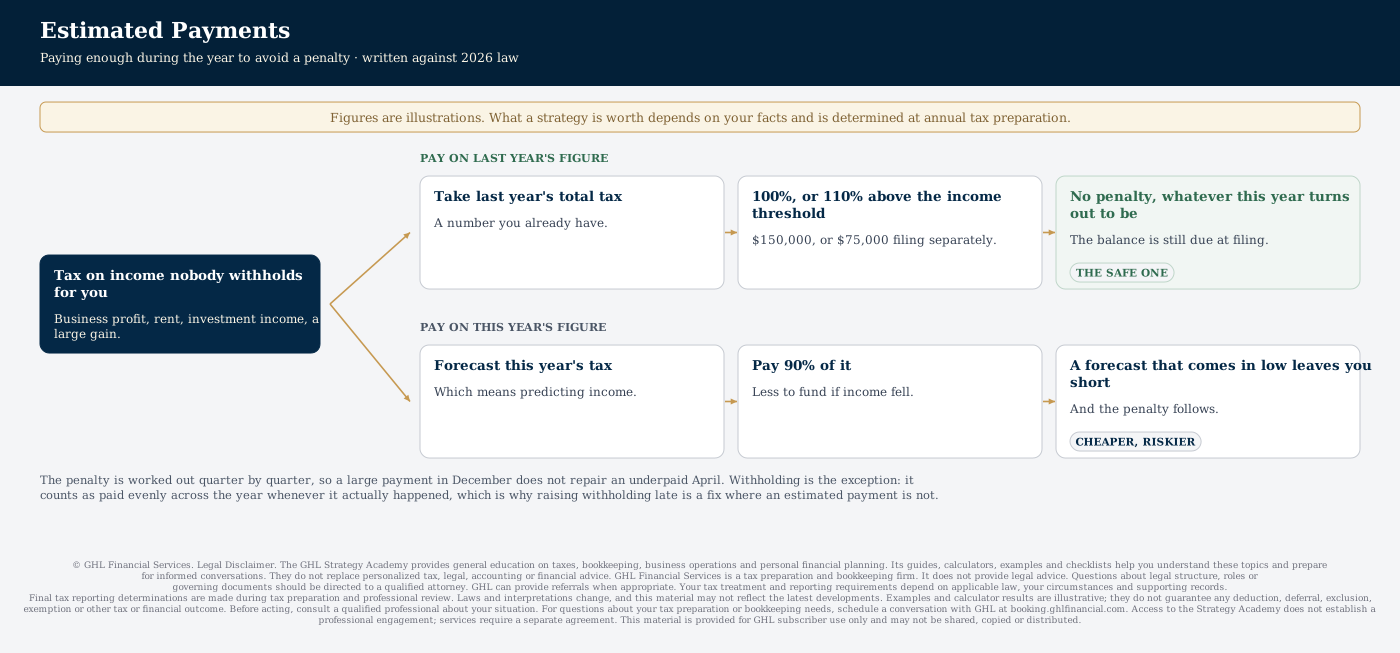
The penalty is avoided by paying at least the safe harbor: the lower of last year's tax — at 100%, or 110% if last year's income was above the threshold — or 90% of this year's.
Last year's figure is usually the one to use, because it is known. This year's is a forecast, and a forecast that comes in low leaves you short.
The calculation is done quarter by quarter, so the timing matters as much as the total.
Withholding from wages or a pension counts as paid evenly through the year whenever it actually happened. An estimated payment counts when it is made.
Owing less than $1,000 at filing avoids the penalty regardless.
States run their own versions with different thresholds and different multipliers.
What you would do
- Find last year's total tax — the tax, not the balance you paid at filing. That single number sets the safe target.
- Divide it by four and diary the dates. The dates are not evenly spaced and that catches people.
- Tell GHL when something large happens — a sale, a conversion, a bonus — in the quarter it happens, not at filing.
- If you are behind and it is late in the year, ask about increasing withholding rather than making a bigger estimated payment. Withholding is treated as spread across the year; a payment is not.
- Keep the confirmations. A payment you cannot evidence is a payment you did not make.
Usually a week or two — mostly things you can start yourself.
Worksheets to use
- Estimated tax payment record (XLSX). Every estimated payment for the year, federal and state, with the date it was made and the confirmation number that proves it. Fill in the header block at the start of the year, then log each payment on the day you make it. The confirmation number is what settles a later question about whether a payment arrived.
What GHL needs from you
- Last year's return, for the tax figure and the income.
- What you have paid this year, with dates.
- Withholding from any wages or pension.
- Anything large and one-time, and which quarter it fell in.
- The states you file in.
What usually goes wrong
- The penalty is worked out quarter by quarter. A large payment in January does not undo a shortfall in April, which is why catching up at year end often does not help.
- Above the income threshold the prior-year safe harbor is 110% of last year's tax, not 100%. Somebody who crossed that line last year and paid 100% is short by a tenth.
- Withholding is treated as paid evenly across the year whenever it was actually deducted. That makes increasing withholding late in the year a genuine fix where an estimated payment is not.
- A big one-time event — a sale, a conversion, a bonus — lands in the quarter it happened, not spread across the year.
Common questions
I paid everything by December 31. Why was there still a penalty?
Because it is charged quarter by quarter. A shortfall in April runs until it is made up, and a December payment does not reach back. This is the most common surprise here.
My income is much higher this year. Do I have to pay on the new figure?
Not to avoid the penalty. Paying on last year's figure, at the right multiplier, is enough — the rest is due at filing. Just be ready for it then.
Does this cover my state as well?
No. States have their own rules, thresholds and dates, and they do not all follow the federal ones.
Read next
Keeping it alive
A position is not finished when it is set up. This is what it needs each year to still be there when it matters.
- Confirm it still applies — circumstances change more often than the law does.
- Keep the record current. Filled in as the year happens it is evidence; assembled in March it is a reconstruction.
- Put the date in the calendar. This one closes at the year end and cannot be added at tax preparation.
- Ask GHL what changed for 2027. Figures move every year and rules move most years.