
When it matters: The installment dates run through the year and the last is in January. The annualized method itself is claimed with the return, but only works if the records were kept by period.
Does this fit you?
- Your revenue is seasonal, and most of the year's profit arrives in one part of it.
- You have a large one-time event — a property sale, a bonus, a business sale, a conversion — late in the year.
- Your income this year is much lower than last, where the prior-year safe harbor is expensive.
- You have been charged an underpayment amount despite paying the full year's tax.
What it could be worth
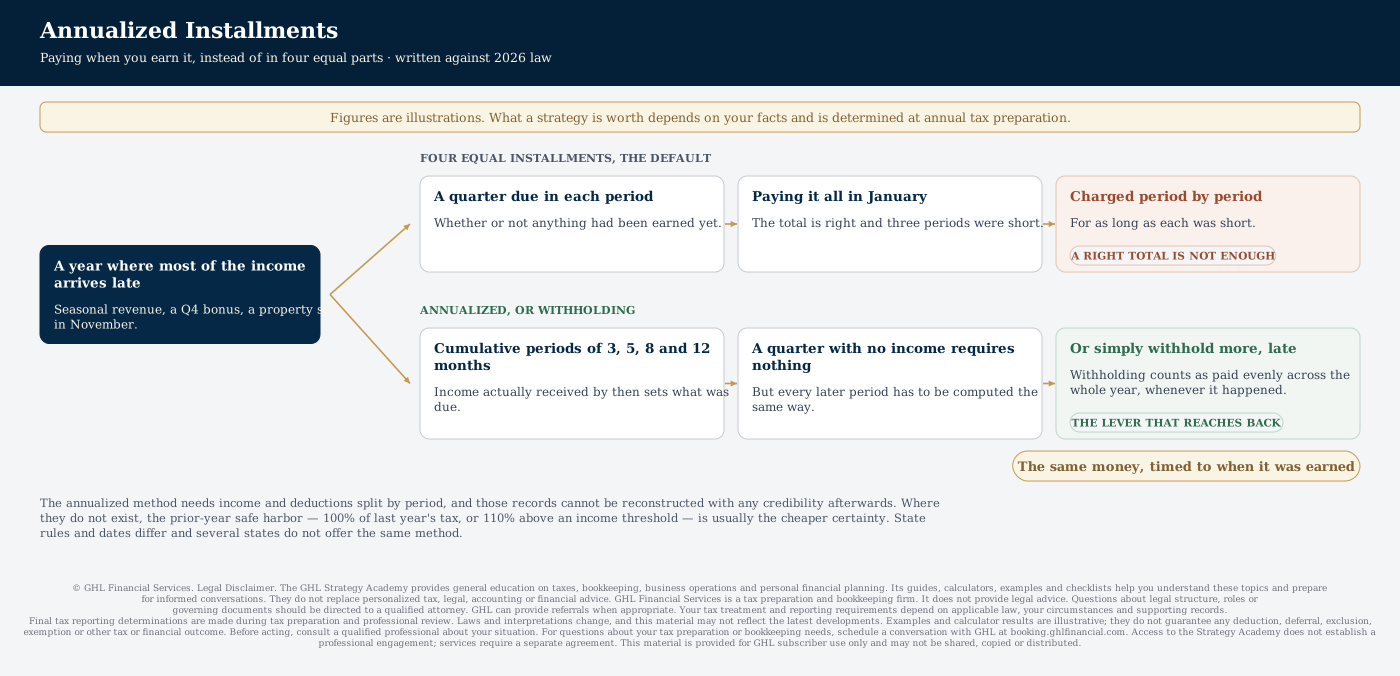
The estimated tax rules assume income arrives in four equal parts, and charge for underpayment period by period. Somebody who earns nothing until October and pays everything in January has paid the right total and still owes a charge for the three periods they were short.
Two ways out. The annualized installment method computes what was actually due in each period from income actually received by then, so a quarter with no income requires no payment. It is precise and it needs records kept by period.
The other is simpler and widely missed: tax withheld is treated as paid evenly across the whole year, whatever month it was actually withheld. So withholding taken in December counts as though a quarter of it was paid in April. For somebody with a wage alongside the lumpy income, raising withholding late in the year can cure an earlier shortfall in a way an estimated payment cannot.
| First period | January to March |
|---|---|
| Second | January to May |
| Third | January to August |
| Fourth | January to December |
| Each one | cumulative income, annualized, tax computed, required installment set |
| The alternative | withholding, counted as paid evenly whenever it happened |
The structure of §6654(d)(2). The periods are cumulative rather than discrete quarters, and each requires income, deductions and credits for the months it covers. GHL computes the required installments from your own figures at preparation.
How it works
The ordinary rule requires a quarter of the year's obligation in each period, and charges interest on whatever was short, for as long as it was short.
The safe harbors sit on top of that: pay 90% of what the year actually costs, or a full 100% of what last year cost — 110% where last year's income was above a threshold — and no charge arises whatever the pattern.
The prior-year safe harbor is the reliable one because last year's figure is already known. It is also the expensive one in a year when income has fallen.
The annualized method instead treats each cumulative period as if the income to date had continued at that rate for the whole year, computes the tax on that, and requires only the share of it attributable to the period.
Because it is cumulative, a large receipt in the third period raises the requirement for the third and fourth but not retrospectively for the first two.
It has to be applied consistently across the year, and it needs income, deductions and credits allocated to periods. Estimated figures will not stand up if they are questioned.
Withholding is treated under §6654(g) as paid in equal parts across the year regardless of when it happened. That is what makes a late increase in withholding able to fix an early shortfall.
For somebody with no wage at all, that route is closed and the answer is either the annualized method or paying to a safe harbor.
What you would do
- Say at the start of the year if the income is going to be uneven, rather than after the first missed period.
- Keep the books current by month. That is the whole requirement for the annualized method, and it cannot be done retrospectively with any credibility.
- If you or your spouse has a wage, consider raising withholding late in the year instead of making a large final estimate.
- Keep last year's total tax to hand — the prior-year safe harbor is often the cheapest certainty available.
- Tell GHL about a one-time event in the year it happens, not at filing.
- Ask about the state separately. The rules and the dates are not the same.
Allow one to two months. Some of it depends on other people.
Worksheets to use
- Estimated tax payment record (XLSX). Every estimated payment for the year, federal and state, with the date it was made and the confirmation number that proves it. Log each payment as it is made. Where income arrives unevenly, the dates matter as much as the amounts — tell GHL before the next quarter rather than after it.
What GHL needs from you
- Income and deductible costs by month, or at least by the four cumulative periods.
- Dates and amounts of every estimated payment made.
- All withholding for the year, from every source.
- Last year's total tax and adjusted gross income, for the safe harbor.
- Details of any one-time event and when it landed.
What usually goes wrong
- The penalty is worked out quarter by quarter, so paying the right total by January does not fix an underpayment in April. People assume a year-end catch-up settles it.
- The annualized method needs income and deductions split by period. Without those records the method is not available, however uneven the year genuinely was.
- The periods are cumulative and of unequal length — three, five, eight and twelve months — which is not how most people think about quarters.
- Choosing it means every subsequent period has to be computed the same way. It is not a one-quarter fix.
- Withholding is treated as paid evenly across the year whatever month it happened in. That is an advantage almost nobody uses deliberately.
- State estimates have their own rules and their own dates, and several do not offer the same method.
Common questions
I paid the whole year's tax in January. Why is there still a charge?
Because the charge is worked out period by period. Money that was due in April and arrived in January was late for nine months, and the total being right does not reach that.
Is the annualized method worth the trouble?
Where the year is genuinely lopsided and the books are current, often yes. Where the records would have to be reconstructed, the prior-year safe harbor is usually the better answer.
Does raising my withholding in December really count as paid in April?
For this purpose, yes — withholding is treated as paid in equal parts across the year. It is the one lever that reaches backwards, and it only exists if there is a wage to withhold from.
My income dropped a lot this year. Do I still have to pay on last year's figure?
No. That safe harbor is an option, not a requirement. Paying 90% of what this year actually costs is the other one, and the annualized method is how it is proved period by period.
Read next
Keeping it alive
A position is not finished when it is set up. This is what it needs each year to still be there when it matters.
- Confirm it still applies — circumstances change more often than the law does.
- Keep the record current. Filled in as the year happens it is evidence; assembled in March it is a reconstruction.
- Put the date in the calendar. This one closes at the year end and cannot be added at tax preparation.
- Ask GHL what changed for 2027. Figures move every year and rules move most years.