
When it matters: December 31. Everything on the list closes with the tax year, which is the whole point of the list.
Does this fit you?
- You have business income, rental property, or a year that looked different from the last one.
- Best worked through in November, while every item on it is still available.
What it could be worth
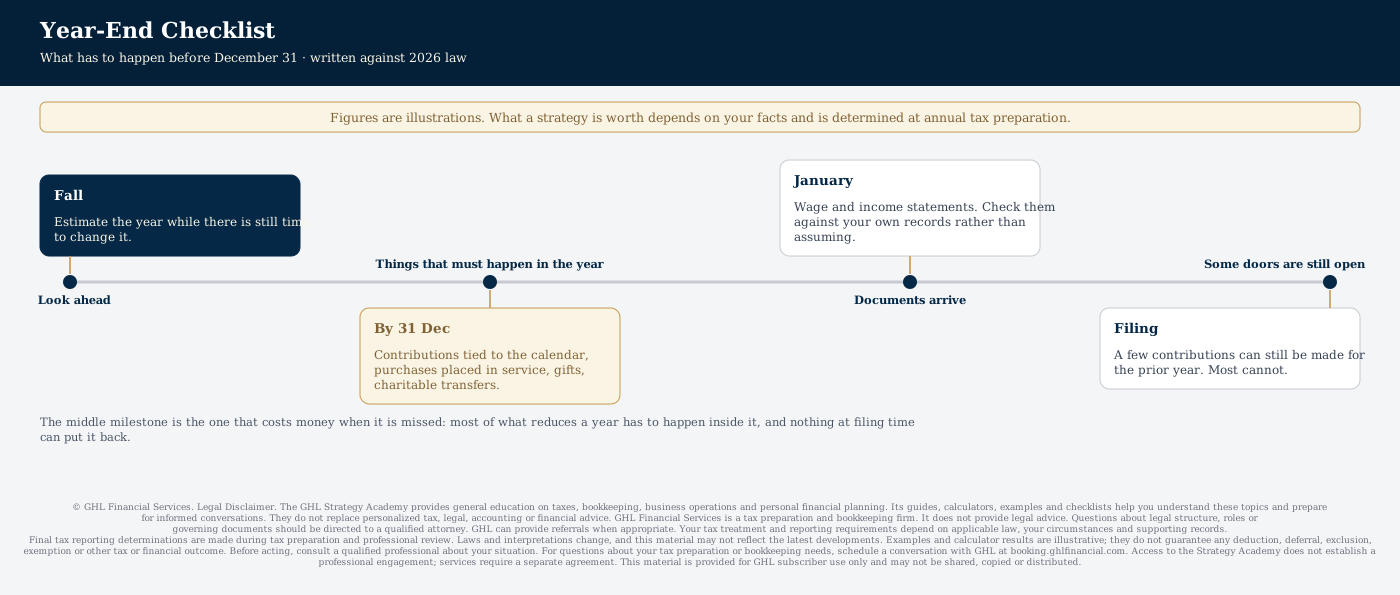
The tax year is a hard edge. A piece of equipment delivered on January 2 belongs to the next year however early it was ordered; a retirement plan that was never established cannot be funded retrospectively; an accountable plan adopted in March does not cover January.
What follows is the shortlist of things that stop being possible at midnight on December 31, separated from the things that can still be done at filing. Most of the value in this whole library is in the first list.
How it works
Before the year ends: equipment has to be delivered and in use, not merely ordered. A retirement plan that needs establishing has to exist. Charitable gifts have to be made, and share transfers take time to settle. Anything with a day count — business use of a home, participation hours — has to have its log complete, because it cannot be honestly reconstructed afterwards.
Also before the year ends: income near a threshold is worth looking at while the levers still move. Retirement contributions, charitable giving and the salary an S-Corp pays all change the figure the thresholds are measured against.
After the year ends, and still fine: totalling premiums, assembling receipts, computing business-use percentages from a log you already kept, choosing between calculation methods where the choice is annual, and funding some retirement contributions where the rules allow it up to the filing date.
The difference between the two lists is whether the thing is a decision or a calculation. Decisions have deadlines. Calculations only need the records.
What you would do
- Work through the checklist in November, not late December — several items need a third party to act.
- Close out every log for the year: mileage, hours, days of business use.
- Confirm anything ordered has actually arrived and been put to use.
- Tell GHL about anything unusual in the year while there is still time to do something about it.
- Book the year-end conversation before the diary fills.
Usually a week or two — mostly things you can start yourself.
Worksheets to use
- Year-end checklist (XLSX). Every item split into what must happen before December 31 and what can wait, with a place to record the date each one was done and who it needs. Work through it in November. Mark items that do not apply rather than leaving them blank — a blank row cannot be told apart from one nobody read.
What GHL needs from you
- The completed checklist, with the items that do not apply marked as such.
- Every log for the year, closed out.
- A note of anything that changed: a new entity, a hire, a property, a state, a marriage.
- Questions you have been saving up — this is the conversation they are for.
What usually goes wrong
- It gets worked in the last week of December, when the people who have to act — a plan provider, a broker, a supplier — have gone home. November is when this list can still be acted on.
- Ordering is treated as doing. Equipment has to be delivered and in use by December 31; a purchase order and a paid invoice are not the same thing as placed in service.
- A calculation is mistaken for a decision, or the other way round. Decisions close with the year and calculations only need records — confusing the two produces either a panic in December or something lost quietly.
Common questions
Can anything be fixed after December 31?
Some things. Decisions with a deadline cannot.
I did not keep a log. Can I write one now?
A log written now is not a contemporaneous record, and it is treated as what it is. Start one today for the year you are in, and talk to GHL about the year that has closed.
When should the year-end conversation happen?
November, if the year had anything unusual in it. December still works for some items; January is a conversation about calculations rather than choices.
Read next
Keeping it alive
A position is not finished when it is set up. This is what it needs each year to still be there when it matters.
- Confirm it still applies — circumstances change more often than the law does.
- Keep the record current. Filled in as the year happens it is evidence; assembled in March it is a reconstruction.
- Put the date in the calendar. This one closes at the year end and cannot be added at tax preparation.
- Ask GHL what changed for 2027. Figures move every year and rules move most years.