
Does this fit you?
- You own residential rental or commercial property, usually where the building value is large enough that a study costs less than it moves.
- Most useful in the year of purchase, though a study can be done later on a property already owned.
- Only worth doing where the resulting deduction can actually be used — see the passive-loss point below.
What it could be worth
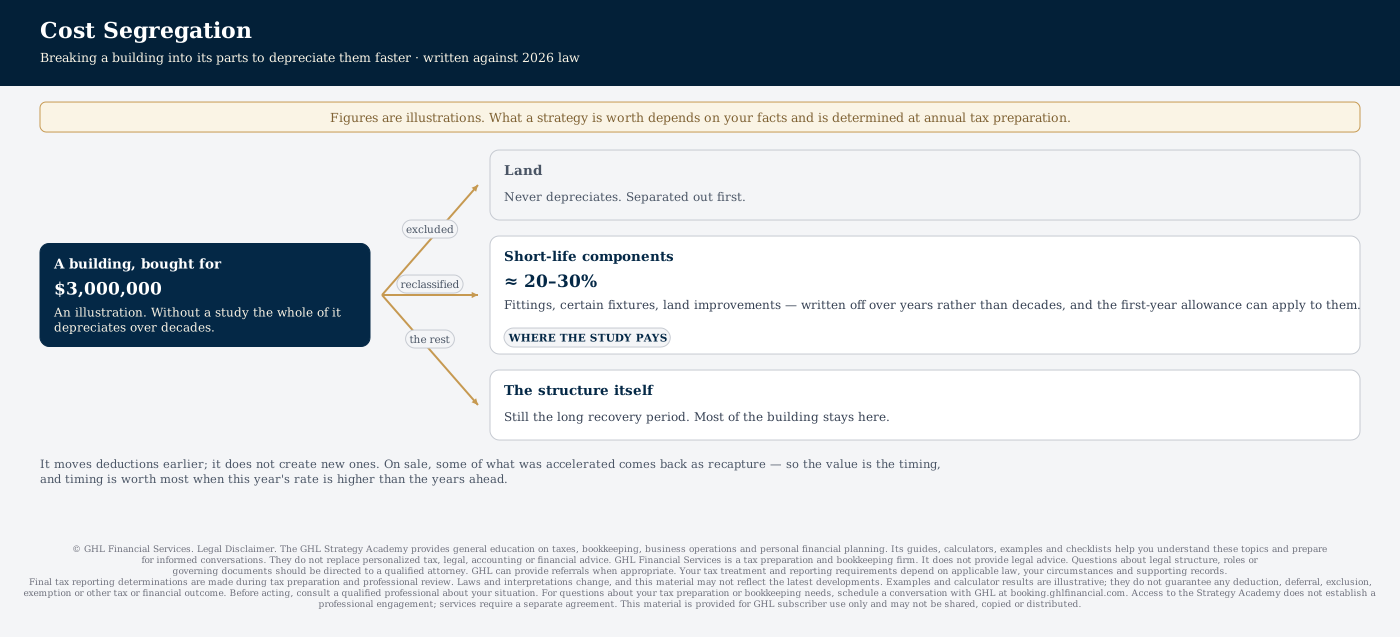
A building is normally recovered over a long period — decades. A cost segregation study is an engineering exercise that identifies the parts of the purchase that are not really the building: carpet, cabinetry, fixtures, paving, landscaping. Those parts have much shorter recovery periods, and accelerated depreciation can apply to them.
Studies commonly reclassify a fifth to two fifths of a purchase price. What that is worth depends on the property, the year's bonus depreciation rate, and — the part people skip — whether the owner can use a loss once it exists.
| Reclassified by the study | 30% ($300,000) |
|---|---|
| First-year allowance on those components, 2026 | 100% |
| Deduction available in year one | $300,000 |
| Federal effect at a 37% rate, if usable | ≈ $111,000 |
2026 law. The reclassified share depends entirely on the building and on a study that supports it; 30% is illustrative, not typical. The first-year percentage is set by the placed-in-service date and has changed more than once. Whether the deduction is usable in the year is a separate question, answered below.
How it works
The study is done by engineers, not by a bookkeeper. It produces a report allocating the purchase price across components, and that report is the support for the position.
The acceleration then comes from the depreciation rules applying to those shorter-life components, so the two work together: the study finds the components, the depreciation rules decide how fast they come off.
The limit that catches people is the passive-loss rule. Where the owner is not a real estate professional and the property is an ordinary long-term rental, the accelerated depreciation often creates a loss that cannot meet wages or business income — it waits instead. Pairing this with the seven-day rental rule or professional status is what makes the loss usable, and those have their own tests.
It can be done on a property already owned: a look-back study picks up the depreciation that was not taken, as an adjustment rather than by amending old returns.
Depreciation taken now is accounted for when the property is sold. That is not a reason to avoid it, but it is a reason to raise a sale with GHL before it happens.
What you would do
- Ask GHL whether the loss would be usable in your situation before commissioning a study — that question, not the study's cost, is usually what decides it.
- Commission the study from an engineering firm that does them properly, and keep the full report.
- Get it done in time for the year you want the deduction in.
- Keep the closing statement and everything that shows what was paid for what.
- Tell GHL before selling the property.
Allow one to two months. Some of it depends on other people.
Worksheets to use
- Property improvement register (XLSX). Every improvement after purchase, with date, cost and what it was — the record a later study or a sale calculation is built from. Add a line whenever work is done on the property, with enough description to tell an improvement from a repair later.
What GHL needs from you
- The full study report, not just its summary.
- The closing statement and purchase documents.
- The date the property was placed in service.
- Where the loss needs to be usable: the hours log supporting professional status or the seven-day rule.
What usually goes wrong
- The study is commissioned before anybody asks whether the loss would be usable. Where the owner is not a real estate professional and the rental is an ordinary long-term one, the deduction often waits — and the study has been paid for either way.
- The property is sold without raising it first. Depreciation taken now is accounted for at sale, and that conversation belongs before the closing rather than after it.
- A summary is filed and the full report is not. The report is the support for the allocation; a one-page summary of it is not.
Common questions
Is the deduction lost if I cannot use it this year?
Generally it waits rather than disappears. Whether waiting is worth the study's cost is the conversation to have first.
Does this affect what I owe when I sell?
Yes — depreciation taken is accounted for at sale. Raise a planned sale with GHL well before it completes.
Read next
Keeping it alive
A position is not finished when it is set up. This is what it needs each year to still be there when it matters.
- Confirm it still applies — circumstances change more often than the law does.
- Keep the record current. Filled in as the year happens it is evidence; assembled in March it is a reconstruction.
- Check the documents still say what they said — an agreement that has drifted from practice is the usual failure.
- Ask GHL what changed for 2027. Figures move every year and rules move most years.