
When it matters: Placed in service by December 31 for the first-year element. The log runs all year.
Does this fit you?
- Your business use is above half, and you drive enough business miles that the arithmetic is worth doing — around 5,000 a year is where it starts to tell.
- Your vehicle cost enough that depreciation alone can exceed what the mileage rate would give.
- You will keep a log as you drive. Without one, neither method is defensible.
What it could be worth
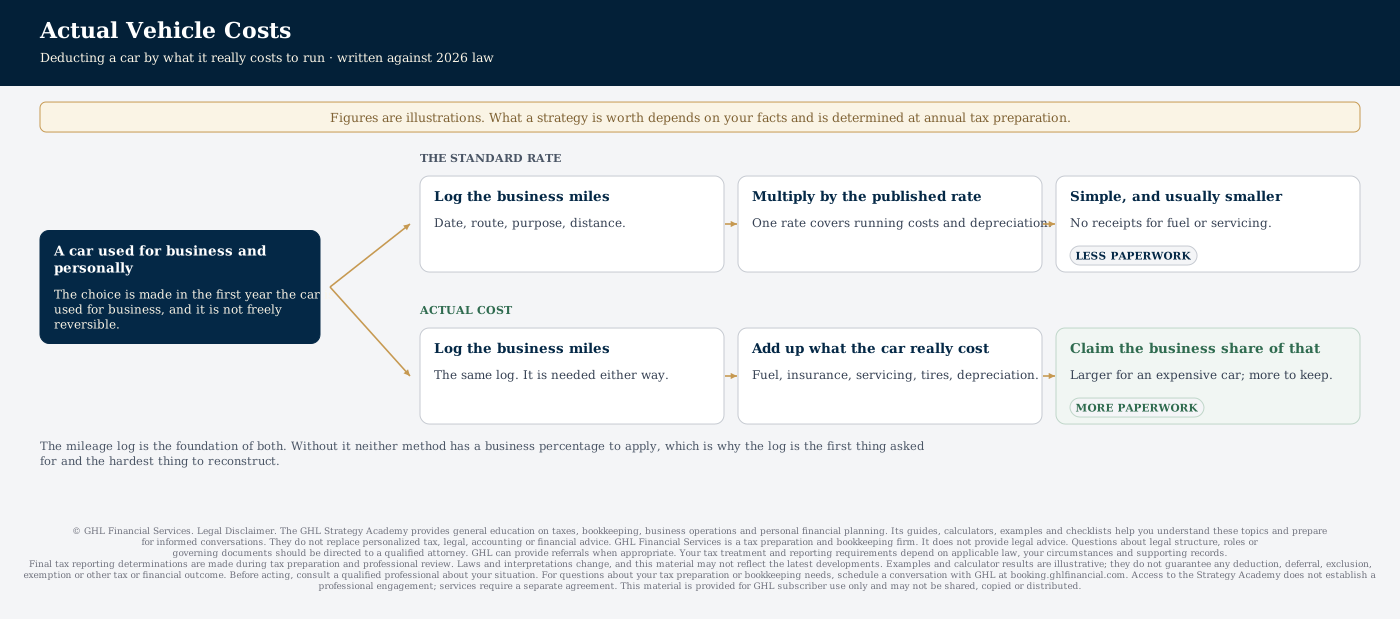
There are two ways to deduct a vehicle: a published rate per business mile, or the actual costs of running it — fuel, insurance, repairs, registration, lease payments and depreciation — multiplied by the share of use that is business.
Which is larger depends on the vehicle and the driving. An inexpensive car driven a great many miles usually does better on the mileage rate; an expensive one driven moderately usually does better on actual costs, particularly in the first year where accelerated depreciation is available.
| Fuel, insurance and maintenance for the year | $7,500 |
|---|---|
| Business share of those costs | $6,000 |
| Depreciation on top | capped by rules that depend on the vehicle's weight and type |
| The alternative | a published rate per business mile, set annually |
2026. The standard mileage rate is published each year and is not quoted here — GHL applies the figure for your year. Assumes a vehicle used more than half for business and a log supporting the 80%. Depreciation caps mean the first-year figure is calculated from your log and your invoice rather than assumed.
How it works
The business-use percentage is business miles divided by total miles, and it comes from the log. Everything else in the calculation is multiplied by it.
The log has to be contemporaneous — written as you drive, whether on paper or in an app. A log reconstructed at year end from a calendar is the weakest evidence there is, and it is what most disallowed vehicle deductions have in common.
Some choices cannot be revisited. A leased vehicle cannot switch from actual costs to the mileage rate after the first year, so the method is chosen at the start rather than whichever turns out larger.
Vehicles over 6,000 lbs gross weight are treated differently from cars for first-year expensing. Whether a particular vehicle qualifies is a fact about the vehicle, not about how it is used.
If business use falls below half in a later year, part of the accelerated deduction comes back. Tell GHL when the pattern of use changes.
What you would do
- Start the log the day the vehicle goes into service — date, miles, and the business purpose of the trip.
- Keep every vehicle receipt: fuel, insurance, repairs, registration, lease statements.
- Record the odometer at the start and end of the year; the total-miles figure depends on it.
- Decide the method with GHL in the first year, especially on a lease, because it may not be changeable later.
Allow one to two months. Some of it depends on other people.
Worksheets to use
- Vehicle mileage and expense log (XLSX). Trip log with a running business-use percentage, and an expense summary by category. Both halves of what the method needs, in one file. Trips go in as you drive; costs go in as bills arrive. Read the odometer on January 1 and December 31.
- Vehicle mileage log (fillable) (PDF). The trip log as a form you can type into or print for the glovebox — for the part of this that happens away from a computer. Print it, keep it in the vehicle, and write each trip as it happens — or type into it if the driving is logged at a desk.
What GHL needs from you
- The mileage log for the year, with business and total miles.
- Odometer readings at both ends of the year.
- All vehicle expense receipts, totalled by category.
- The purchase or lease documents, with the date the vehicle was placed in service.
What usually goes wrong
- A leased vehicle cannot switch from actual cost to the mileage rate after the first year. The method is chosen at the start.
- Business use falling to half or below disqualifies the first-year election and brings earlier deductions back.
- Depreciation on an ordinary car is capped. A vehicle over 6,000 lb rated weight is treated differently — that is its own guide.
Common questions
Can I estimate my business percentage?
An estimate is not a log. The percentage has to come from a contemporaneous record of trips, which is the first thing asked for.
Can I switch methods later?
Sometimes for an owned vehicle, and generally not for a leased one after the first year. Settle it at the start.
Does commuting count as business mileage?
Generally not. Travel between home and a regular place of work is personal, which is one of the reasons the log records purpose and not only distance.
Read next
Keeping it alive
A position is not finished when it is set up. This is what it needs each year to still be there when it matters.
- Confirm it still applies — circumstances change more often than the law does.
- Keep the record current. Filled in as the year happens it is evidence; assembled in March it is a reconstruction.
- Put the date in the calendar. This one closes at the year end and cannot be added at tax preparation.
- Ask GHL what changed for 2027. Figures move every year and rules move most years.