
When it matters: Placed in service by December 31.
Does this fit you?
- Your business is buying an SUV, truck or van whose rated weight is over 6,000 lbs.
- Your business use is comfortably above half, and you have a log to evidence it.
- You are in trades, construction, agriculture or property, or otherwise have a genuine reason for the vehicle.
What it could be worth
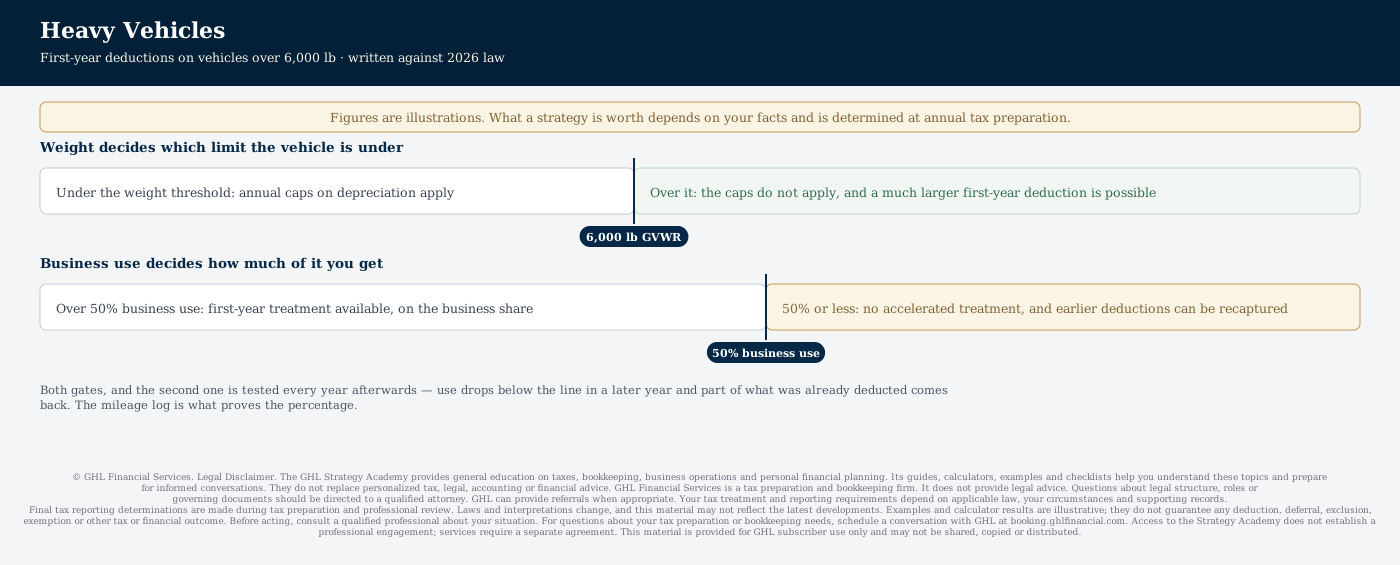
Ordinary cars have annual caps on how fast their cost can be deducted. Vehicles above a rated weight threshold are outside those caps, which is why the first-year deduction on a heavy vehicle can be so much larger than on a car costing the same.
How much larger depends on the year's rules, the price, and the business-use percentage — which multiplies everything. It also depends on keeping business use above half, in this year and in the years that follow.
| Rated weight that lifts the ordinary depreciation caps | over 6,000 lb |
|---|---|
| Immediate expensing element | capped for this category — GHL confirms the figure for the year |
| First-year allowance on the remainder, 2026 | 100% |
| Federal effect at a 24% rate if the whole cost is deducted | ≈ $21,600 |
2026. The cap on the immediate-expensing element for this category of vehicle is indexed and is not quoted here. Assumes 100% business use, a vehicle whose rated weight qualifies, and that it was placed in service in the year. Business use below 100% reduces every line proportionally, and a later drop below half brings earlier deductions back.
How it works
The threshold is the manufacturer's gross vehicle weight rating, which is on the sticker inside the driver's door frame. It is not what the brochure implies and not the vehicle's curb weight — photograph the sticker.
Business use has to be more than half for the accelerated treatment to be available at all, and the percentage then scales the deduction.
Taking it commits you to the actual-expense method for that vehicle; the standard mileage rate cannot be combined with it.
If business use falls below half in a later year, part of what was deducted comes back as income. That is the risk worth understanding before buying — a vehicle bought for a busy year and used personally in a quiet one creates a problem.
This is an examined area, and the mileage log is what decides it.
What you would do
- Photograph the weight rating sticker on the door frame before buying, and keep the photograph.
- Start the mileage log the day it goes into service.
- Keep the purchase invoice and the date it was actually first used for business.
- Tell GHL if your use of the vehicle changes in a later year.
Allow one to two months. Some of it depends on other people.
What GHL needs from you
- The weight rating documentation — the door-frame photograph is enough.
- The mileage log showing business and total miles.
- The purchase invoice and placed-in-service date.
- Confirmation of how the vehicle is used, by whom, and for what.
What usually goes wrong
- 100% business use is rarely defensible, and this is an area that gets looked at closely. Keep a detailed mileage log.
- If business use drops below half in a later year, earlier deductions come back as ordinary income.
- Several states do not follow the federal treatment for these vehicles.
Common questions
How do I know whether a vehicle qualifies?
The rating is on the sticker inside the driver's door frame. Check it on the actual vehicle before buying — trim levels within the same model can differ.
What if I use it personally at weekends?
Personal use reduces the deduction proportionally, and dropping below half business use changes the treatment. The log is what shows where you are.
Can I switch to the mileage rate later?
Not once this treatment has been taken on the vehicle. It is a decision at purchase, not one to revisit.
Read next
Keeping it alive
A position is not finished when it is set up. This is what it needs each year to still be there when it matters.
- Confirm it still applies — circumstances change more often than the law does.
- Put the date in the calendar. This one closes at the year end and cannot be added at tax preparation.
- Ask GHL what changed for 2027. Figures move every year and rules move most years.