
When it matters: For eligible hires who began work by December 31, 2025, Form 8850 pre-screening is completed on or before the offer date and submitted to the state workforce agency within 28 calendar days after work begins.
Does this fit you?
- You have eligible hires who began work by December 31, 2025.
- You have historical payroll and certification records for those hires.
- You can document Form 8850 pre-screening by the offer date and timely submission.
What it could be worth
For eligible hires who began work by December 31, 2025, the historical credit is a share of first-year wages, and the share depends on which targeted group the person belongs to and how many hours they work. Some categories are worth substantially more than others.
Unlike most of this library, the difficulty is not the calculation. It is that the paperwork has a short deadline attached to the hire date, and a claim missed on timing cannot be recovered later.
| Credit, depending on group and hours worked | roughly $2,400 – $9,600 |
|---|---|
| Certification form signed | on or before the employment offer |
| Filed with the state workforce agency within | 28 calendar days after work begins |
An eligible hire who began work on or before December 31, 2025, certified as belonging to a targeted group, enough hours worked in the first year, and the paperwork filed inside the window. Miss the window and the credit is gone for that hire regardless of eligibility.
How it works
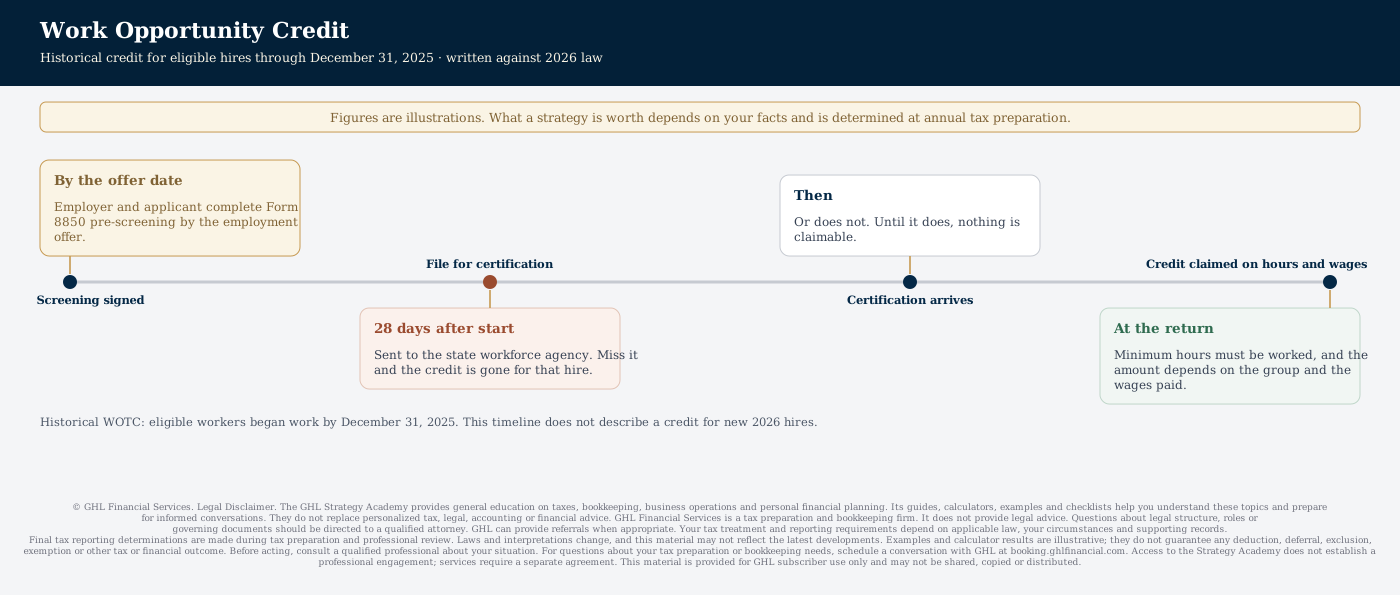
For the historical WOTC, the employer and applicant complete Form 8850 pre-screening on or before the employment offer. The guide does not describe a credit for new 2026 hires.
It is then filed with the state workforce agency, with its companion form, inside 28 calendar days after work begins. That deadline is the whole game.
Certification comes back from the agency. Only then is the credit claimed, on the return for the year.
The amount depends on the category and on hours worked, so a short-tenure hire may certify but produce little.
Historical certification records include Form 8850 pre-screening completed by the employer and applicant on or before the offer date.
What you would do
- For eligible historical hires, retain Form 8850 showing pre-screening completed on or before the employment offer.
- Check historical submission records against the deadline: 28 calendar days after work began.
- Keep the state workforce agency submission confirmation.
- Keep the certification when it comes back, and tell GHL which hires were certified.
- Track hours worked for certified hires; the credit depends on them.
Allow one to two months. Some of it depends on other people.
Worksheets to use
- Hiring credit tracker (XLSX). Each eligible historical hire with their start date, the filing deadline calculated from it, whether the form went in, and the certification outcome. Record eligible hires who began work by December 31, 2025. Use the start-date deadline column to check historical submissions, and keep pre-screening records showing completion by the offer date.
What GHL needs from you
- Certifications received, by employee.
- First-year wages and hours for each certified hire.
- Submission confirmations showing the filing was inside the window.
- The hire dates, so the timing can be evidenced.
What usually goes wrong
- The 28-day deadline is unforgiving. A late filing disqualifies that hire entirely.
- The authorization covers eligible workers who began work by December 31, 2025. This guide does not describe a credit for new 2026 hires.
- A tax-exempt employer can claim only the veteran portion, and against payroll tax rather than income tax.
Common questions
What if we find out someone qualified after they started?
For eligible historical hires, Form 8850 pre-screening had to be completed on or before the employment offer. A later discovery generally does not satisfy that requirement.
Can a later return still include first-year wages for an eligible historical hire?
First-year wages for an eligible worker who began work by December 31, 2025 may extend into a later year. The certification, hours, wages and applicable category still determine the claim; this is not authorization for a new 2026 hire.
Read next
Keeping it alive
A position is not finished when it is set up. This is what it needs each year to still be there when it matters.
- Confirm it still applies — circumstances change more often than the law does.
- Keep the record current. Filled in as the year happens it is evidence; assembled in March it is a reconstruction.
- Put the date in the calendar. This one closes at the year end and cannot be added at tax preparation.
- Ask GHL what changed for 2027. Figures move every year and rules move most years.