
When it matters: Claimed with the return, including extensions. The records are made while the work happens.
Does this fit you?
- Your business is developing or materially improving a product, process or software — not only laboratories.
- Your work had an outcome that was genuinely uncertain at the start and was resolved by trying things.
- Your business is young with little or no tax liability, and may still be able to use it against payroll tax rather than income tax.
What it could be worth
This is a credit, which reduces tax directly, rather than a deduction that reduces the income tax is calculated on. A dollar of credit is worth more than a dollar of deduction, which is why it is worth the record-keeping it demands.
It is calculated from qualifying wages, supplies and contracted research above a base. What it comes to depends on how much of the payroll is genuinely doing qualifying work — and on being able to show which people, on which projects, for how long.
| Credit, depending on method and base | roughly $50,000 – $100,000 |
|---|---|
| Nature of the benefit | a credit against tax, not a deduction |
| For a young business with no income tax to offset | part of it may be applied against payroll tax, to a statutory ceiling |
| What decides the size | the qualifying share of payroll, established from records |
The payroll-offset ceiling and the age and receipts limits that go with it are set in statute and have been amended — GHL confirms what applies for your year. Qualifying wages are identified project by project and a calculation method is chosen between the two available. The qualifying share is established from records rather than estimated.
How it works
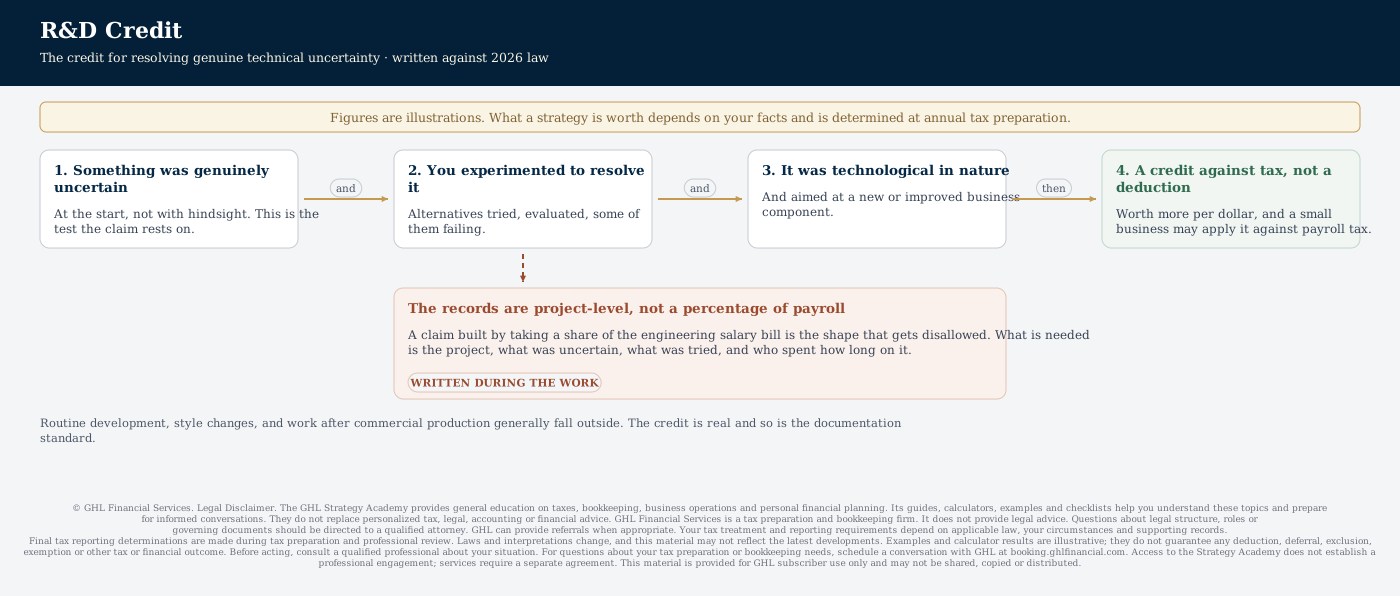
Qualifying work has to meet four tests together: it is for a new or improved business component, it is technological in nature, there was uncertainty at the outset, and it was resolved through a process of experimentation.
The last two are where most claims are won or lost. Work that was routine, or that followed a known path, does not qualify however difficult it was.
What is claimed is wages for people doing or directly supporting that work, supplies consumed in it, and contracted research. Allocating a person's time between qualifying and routine work is the exercise, and it is far easier done monthly than reconstructed.
There are two calculation methods with different bases, and which produces more depends on the business's history.
This is an examined area. The strength of a claim is the contemporaneous record of what was attempted, what was uncertain, and what was learned — not a description written afterwards.
What you would do
- Tell GHL what you are building before the year ends, not at filing.
- Keep project notes as the work happens: what was uncertain, what was tried, what the result was.
- Track time against projects monthly, even roughly, rather than estimating in March.
- Keep contracts with any outside developers or engineers — what they did and under whose direction matters.
- If the business is young and not yet paying income tax, say so; the payroll route has its own requirements.
Allow one to two months. Some of it depends on other people.
Worksheets to use
- Research project log (XLSX). A project, what was uncertain about it, what was tried, and the people and hours against it — the four-part test answered as the work happens. Open a row per project when it starts, and add to the notes monthly. Time goes in at the same time as it is recorded for payroll, which is the only way it stays honest.
What GHL needs from you
- A project list with what each was trying to achieve and what was uncertain.
- Payroll by person with the share of time on qualifying projects.
- Supplies consumed in the work, and contracts for any outside research.
- Prior years' figures, because the base is calculated from history.
What usually goes wrong
- Without records made at the time, the claim is fragile. This is the pressure point, not the arithmetic.
- Routine engineering and work after commercial production do not qualify. There has to have been real technical uncertainty.
- Separately, research costs have to be capitalized and written off over several years, which changes the cash picture even when the credit is allowed.
Common questions
We are not a laboratory. Can we still qualify?
Possibly. Software development, manufacturing process improvement and engineering iteration are the common cases. The test is about uncertainty and experimentation, not lab coats.
Can a business with no profit use it?
A young business inside the age and receipts limits may be able to apply it against payroll tax instead. It has its own conditions — raise it early.
Is a description written at year-end enough?
It is the weakest version of the claim. Notes written while the work happened are what make it defensible.
Read next
Keeping it alive
A position is not finished when it is set up. This is what it needs each year to still be there when it matters.
- Confirm it still applies — circumstances change more often than the law does.
- Keep the record current. Filled in as the year happens it is evidence; assembled in March it is a reconstruction.
- Put the date in the calendar. This one closes at the year end and cannot be added at tax preparation.
- Ask GHL what changed for 2027. Figures move every year and rules move most years.