
Does this fit you?
- You are about to hire your first employee.
- You pay contractors for work that is growing into a job.
- You want a list of what to have on file before the first paycheck.
What it could be worth
Nothing here lowers a tax bill. It lists the forms and records the first hire brings, so they are in place before the first paycheck rather than gathered after.
What it is worth is a file that answers the questions an employer is asked later, about withholding, eligibility to work and the state's report.
How it works
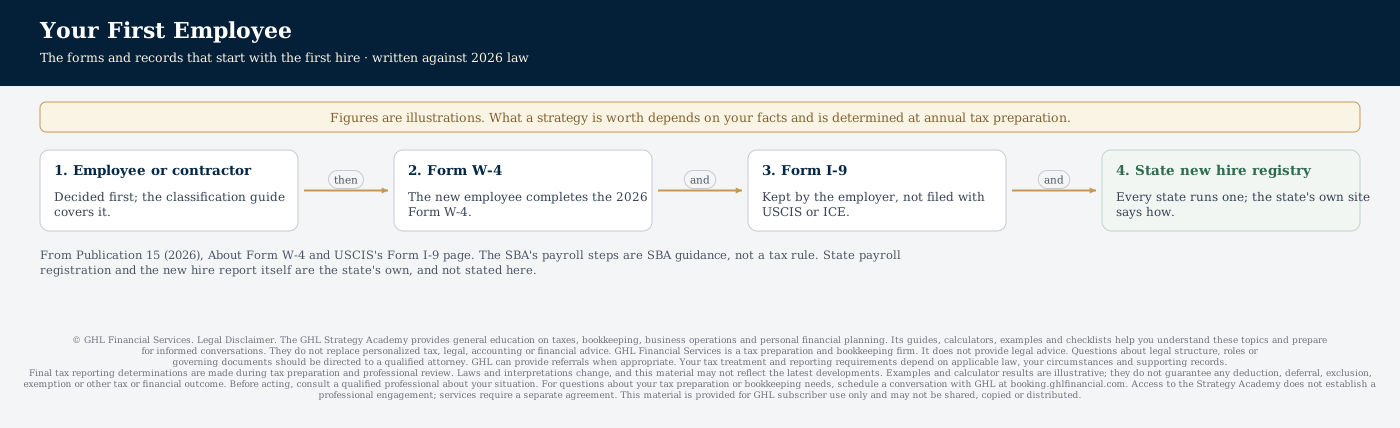
Employee or contractor comes first, and the Worker Classification guide covers how it is decided. SBA guidance, not a tax rule: “If your contractor is discovered to meet the legal definition of employee, you may need to pay back taxes and penalties, provide benefits, and reimburse for wages stipulated under the Fair Labor Standards Act.”
Form W-4. Publication 15 (2026): “Ask each new employee to complete the 2026 Form W-4.” About Form W-4 says what it is for, from the employee's side: “Complete Form W-4 so that your employer can withhold the correct federal income tax from your pay. Consider completing a new Form W-4 each year and when your personal or financial situation changes.”
The name and SSN. Publication 15: “Record each new employee's name and SSN from their social security card if it is available.”
Form I-9. Publication 15: “You must verify that each new employee is legally eligible to work in the United States… This includes completing the U.S. Citizenship and Immigration Services (USCIS) Form I-9, Employment Eligibility Verification.” USCIS: “All U.S. employers must properly complete Form I-9 for every individual they hire for employment in the United States.”
Where the I-9 goes. USCIS: “Do not file Form I-9 with U.S. Citizenship and Immigration Services (USCIS) or U.S. Immigrations and Customs Enforcement (ICE).” And how long it is kept: “Retain and store Form I-9 for three years after the date of hire, or for one year after employment is terminated, whichever is later”.
New hire reporting is run by the states. Publication 15: “All 50 states, and most of the territories, have a new hire registry. You're required to report any new employee to a designated state new hire registry.” What the report asks for, and when, is on the state's own site.
The SBA's payroll steps, as SBA guidance rather than a tax rule: “Before finding the right person for the job, you'll need to create a plan for paying employees. Follow these steps to set up payroll: Get an Employer Identification Number (EIN) Find out whether you need state or local tax IDs Decide if you want an independent contractor or an employee Ensure new employees return a completed W-4 form Schedule pay periods to coordinate tax withholding for IRS Create a compensation plan for holiday, vacation and leave Choose an in-house or external service for administering payroll Decide who will manage your payroll system Know which records must stay on file and for how long Report payroll taxes as needed on quarterly and annual basis”
Not covered here, because the wording has not been checked: registering for the state's payroll accounts, the federal deposit schedule, and which documents an employee may show for the I-9.
Sources
What you would do
- Settle whether the role is an employee's or a contractor's before the offer.
- Have the EIN in hand, and find out from the state which payroll accounts it requires.
- On the first day, collect the 2026 Form W-4 and complete the Form I-9.
- Record the employee's name and SSN, and keep the I-9 in the business's own files.
- Report the hire to the state's new hire registry, and keep the confirmation.
- Decide who runs payroll, in-house or a service, before the first pay date.
Allow one to two months. Some of it depends on other people.
What GHL needs from you
- The date of the first payroll, and who runs it.
- The payroll summary for the year once it closes.
- The business's EIN and the state payroll account numbers.
- All of it sent through the Secure Client Portal, not by email. The I-9 itself stays in the business's files.
What usually goes wrong
- Paying somebody as a contractor who is in fact an employee. The SBA lists back taxes, penalties and benefits as what can follow.
- Sending the I-9 to a government office. USCIS says it is not filed with USCIS or ICE; the employer keeps it.
- Throwing out an I-9 when the person leaves. USCIS gives a retention period that can run past the last day.
- Missing the state new hire report, because it is the state's process and not the IRS's.
Common questions
Do I send the I-9 to the government?
No. USCIS says not to file it with USCIS or ICE. The employer completes it and keeps it, for three years after the date of hire or one year after employment ends, whichever is later.
Who do I report a new hire to?
A state new hire registry. Publication 15 says every state has one; the state's own site says what it needs and when.
Which W-4 does a new employee complete?
Publication 15 (2026) says to ask each new employee to complete the 2026 Form W-4.
Read next
Keeping it alive
A position is not finished when it is set up. This is what it needs each year to still be there when it matters.
- Confirm it still applies — circumstances change more often than the law does.
- Check the documents still say what they said — an agreement that has drifted from practice is the usual failure.
- Ask GHL what changed for 2027. Figures move every year and rules move most years.