
When it matters: Decided when the work starts, from how it is actually done. A contract signed afterwards does not change what happened.
Does this fit you?
- Your business pays somebody who is not on the payroll.
- You are considering converting an employee to a contractor.
- Your contractors work set hours, use the business's equipment, or work only for you.
What it could be worth
A genuine contractor costs less than an employee — no employer payroll tax, no benefits, no unemployment coverage. That saving is the reason the question gets answered optimistically.
The exposure runs the other way and it is larger: back tax that should have been withheld, the employer's own share, interest and penalties, across every affected worker and every open year.
So what this is worth is not a saving but a position that holds. A business that classifies carefully, documents why, and treats similar workers consistently is in a very different place from one that did not think about it.
| Behavioral control | who decides when, where and how the work is done |
|---|---|
| Financial control | who provides tools, who can make a loss, whether they work for others |
| The relationship | written terms, benefits, permanence, and whether the work is central to the business |
| What does NOT decide it | what the contract calls them, or how they are paid |
| If it is wrong | the business owes the tax, its own share, and penalties |
The federal factors, weighed together rather than counted. Relief is available in some circumstances where a business had a reasonable basis and was consistent, which is one of the reasons consistency matters. Several states apply stricter tests of their own, so a worker can be a contractor federally and an employee for the state.
How it works
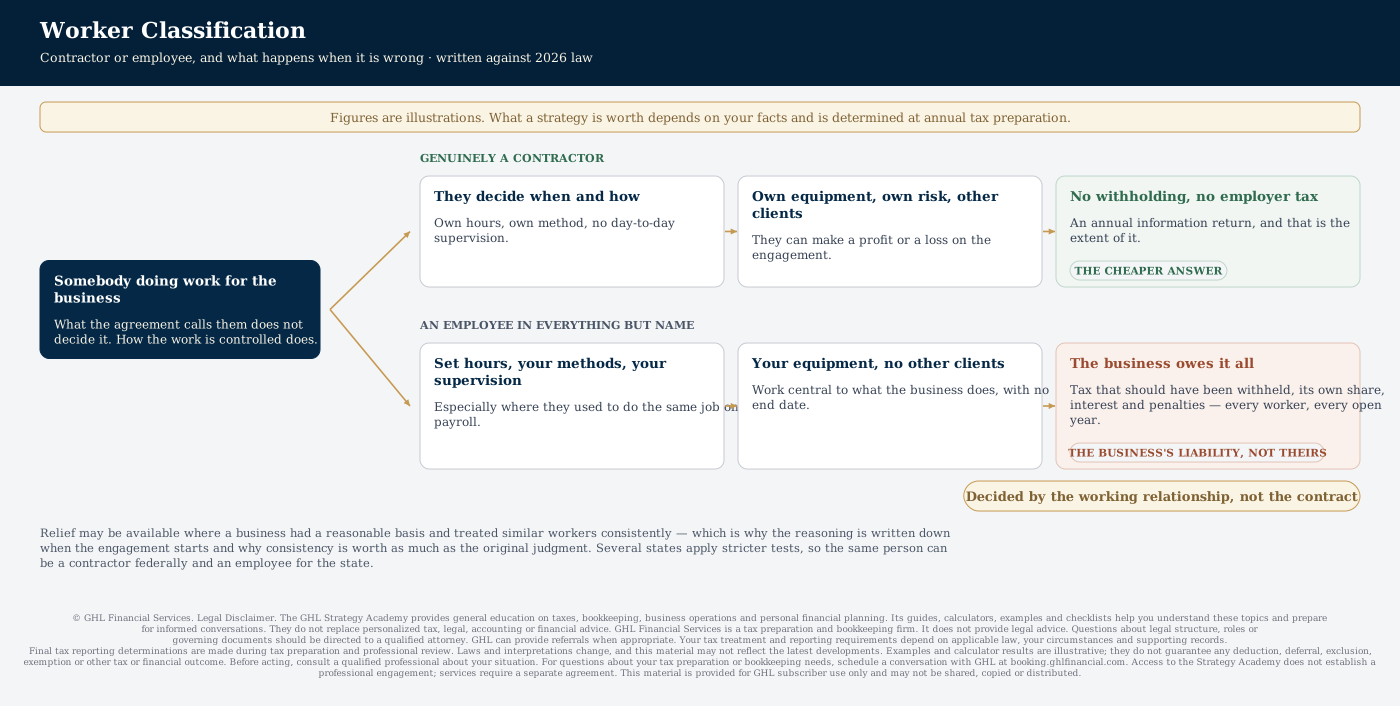
The question is whether the business has the right to control how the work is done, not merely what the result should be.
Three groups of factors are weighed: behavioral control, financial control, and the nature of the relationship.
A contractor typically sets their own hours and methods, supplies their own tools, can make a profit or a loss, and works for others.
An employee typically works when and how they are told, with the business's equipment, on work that is central to what the business does.
What the contract calls the arrangement does not decide it, though written terms are evidence.
Where a business got it wrong but had a reasonable basis and treated similar workers consistently, relief may be available — which is why consistency is worth as much as the original judgment.
States apply their own tests and several are stricter.
What you would do
- Decide before the work starts, and write down why — the factors you weighed, not just the conclusion.
- Treat similar workers the same way. Inconsistency is what removes the relief that would otherwise be available.
- Get a proper agreement, but do not rely on it: make sure the working relationship actually matches it.
- Collect the contractor's details and issue the annual information return. Failing to is its own penalty and it invites the question.
- Ask GHL before converting an employee to a contractor. That is the pattern examined most closely.
Allow one to two months. Some of it depends on other people.
Worksheets to use
- Worker classification record (XLSX). One line per worker, with the factors weighed and the conclusion — written when the engagement starts. Complete it before the first payment, not after a question. Relief where a classification turns out to be wrong depends on having had a reasonable basis and on treating similar workers consistently, and this record is the evidence of both.
- Contractor payment and W-9 register (XLSX). Who was paid outside payroll, how much, and whether the W-9 behind each 1099 is actually on file. Add a line the day somebody is engaged and collect the W-9 before the first payment leaves. Check the W-9 column in November, while a January problem is still a November one.
What GHL needs from you
- What each worker does, and who decides how and when.
- Written agreements and any changes to them.
- Whether they work for others, and whose equipment they use.
- How similar workers are treated.
- The states the work is performed in.
What usually goes wrong
- A signed agreement calling somebody a contractor does not make them one. The test is the working relationship, and the paperwork is only evidence of it.
- Getting it wrong makes the business liable for the tax it should have withheld, plus the employer's own share, plus penalties — and that is the employer's liability, not the worker's.
- The same person cannot usually be a contractor for the same work they used to do as an employee. Converting somebody is the pattern that gets looked at hardest.
- A worker can ask for a determination, and often does after a dispute. The question is then answered without the business choosing the moment.
- States run their own tests, several of them stricter than the federal one, so the two answers can differ for the same person.
Common questions
We have a signed contractor agreement. Is that enough?
No. The agreement is evidence, not the answer. If the working relationship looks like employment, the agreement does not change it — which is why it is worth checking that practice matches the paperwork.
Can I make my employee a contractor doing the same job?
It is the pattern that attracts the most attention, and usually the same work under the same control is still employment. Raise it before doing it rather than after.
Who bears the cost if it is wrong?
The business.
Read next
Keeping it alive
A position is not finished when it is set up. This is what it needs each year to still be there when it matters.
- Confirm it still applies — circumstances change more often than the law does.
- Keep the record current. Filled in as the year happens it is evidence; assembled in March it is a reconstruction.
- Check the documents still say what they said — an agreement that has drifted from practice is the usual failure.
- Ask GHL what changed for 2027. Figures move every year and rules move most years.