
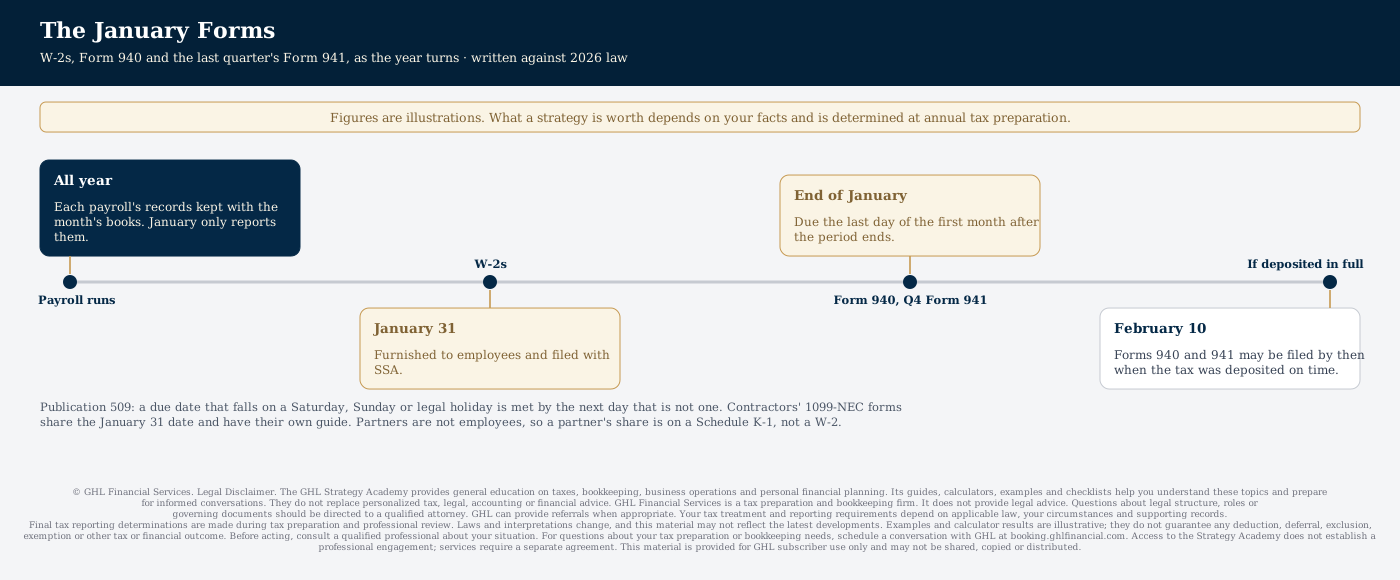
When it matters: W-2s by January 31. Form 940 and the fourth quarter's Form 941 by the last day of January, or by February 10 where the tax was deposited on time and in full.
Does this fit you?
- You have employees, or you are on your own corporation's payroll.
- Your business uses a payroll service.
- You are moving to an S corporation and will be paid through payroll for the first time.
What it could be worth
Nothing here lowers a tax bill. What it is worth is a January without late forms: the W-2s, Form 940 and the fourth quarter's Form 941 all fall due within weeks of the year's end.
Each one reports what payroll already did during the year. A business whose payroll records are current finds January routine; one reconstructing the year finds it the hardest month.
How it works
W-2s. IRS.gov: “Forms W-2 are required to be furnished to employees and filed with SSA by January 31.” The employee's copy and the filing with the Social Security Administration share that one date.
Who gets one. Every employee, and that includes an owner paid wages through an S corporation's or a C corporation's payroll. An S corporation pays a shareholder-employee reasonable compensation before non-wage distributions, which the S-Corp Salary guide covers, so the owner's salary is on a W-2 like anyone else's.
A partner is different. Partners are not employees of the partnership, so a partner's pay is not on a W-2; each partner's share is shown on the Schedule K-1 the partnership sends.
Form 940. Publication 509: “This form is due the last day of the first calendar month after the calendar year ends. Use it to report the FUTA tax on wages you paid.” FUTA is the federal unemployment tax, and IRS.gov says who bears it: “Only employers pay FUTA tax.”
The fourth quarter's Form 941. Publication 509: “This form is due the last day of the first calendar month after the calendar quarter ends. Use it to report social security and Medicare taxes and withheld income taxes on wages” paid in the quarter. So the October to December return falls due at the end of January, beside the W-2s and Form 940.
The later date. Publication 509: “If you timely deposit in full the tax you're required to report on Form 940, 941, 943, 944, or 945, you may file the return by the 10th day of the 2nd month that follows the end of the return period.” For Form 940 and the fourth quarter's Form 941, that is February 10. The sentence names those returns; it does not move the W-2 date.
Weekends and holidays. Publication 509: “if a due date for performing any act for tax purposes falls on a Saturday, Sunday, or legal holiday, the act is considered to be performed timely if it is performed no later than the next day that isn't a Saturday, Sunday, or legal holiday.” For the 2025 forms, Publication 509 gave February 2, 2026 as the W-2 date, because January 31, 2026 was a Saturday.
Contractors are not on this list. Their form is the 1099-NEC, which shares the January 31 date and has its own guide.
Not covered here, because the wording has not been checked against IRS.gov: Form W-3, electronic filing, extensions, how an S corporation owner's health insurance is shown on the W-2, and which employers file Form 940 at all.
Sources
What you would do
- Before the year ends, confirm each employee's name, address and Social Security number on the payroll records.
- Record who files each form: the business itself, or a payroll service it pays to do it.
- Put January 31, the end of January, and the February date that depends on full and timely deposits on the business calendar.
- In January, compare the W-2 totals with the four quarterly Forms 941 before anything is filed.
- Keep each form and its filing confirmation with the year's payroll records.
Allow one to two months. Some of it depends on other people.
What GHL needs from you
- The year's W-2s, and the payroll service's year-end summary if one is used.
- The four quarterly Forms 941 and the Form 940.
- Which owners were paid wages through payroll, and how much.
- All of it sent through the Secure Client Portal, not by email.
What usually goes wrong
- Leaving the owner off. An owner paid wages through an S corporation's or a C corporation's payroll gets a W-2 for those wages, on the same date as everyone else's.
- Putting a partner on a W-2. Partners are not employees of the partnership; a partner's share is reported on a Schedule K-1.
- Counting on the February date without checking the deposits. Publication 509 gives the later date only where the tax was deposited on time and in full, and it names Forms 940 and 941, not the W-2s.
- Treating January as the return's season. These forms come weeks before the business's own return and do not wait for it.
- Finding in January that the payroll records are incomplete. The forms report what payroll already did; they cannot be built from memory.
Common questions
I am the only employee of my own S corporation. Do I still get a W-2?
Yes, for the wages the corporation pays you through payroll. W-2s are furnished to employees by January 31, and a shareholder-employee is paid as one.
Is February 10 the date for everything?
No. Publication 509 gives the later date for returns such as Form 940 and Form 941, and only where the tax on them was deposited on time and in full. The W-2 date stays January 31.
Do my partners get W-2s?
No. Partners are not employees of the partnership. Each partner's share appears on the Schedule K-1 the partnership sends.
Our payroll service files these. What is left for us?
Knowing that it did. Record which forms the service files and which the business files itself, and keep each confirmation with the year's records.
Read next
Keeping it alive
A position is not finished when it is set up. This is what it needs each year to still be there when it matters.
- Confirm it still applies — circumstances change more often than the law does.
- Put the date in the calendar. This one closes at the year end and cannot be added at tax preparation.
- Ask GHL what changed for 2027. Figures move every year and rules move most years.