
Does this fit you?
- You are self-employed, or your business has no other fixed location.
- You have a room or clearly defined area used for work and not for anything else.
- You have records of your home's running costs for the year.
What it could be worth
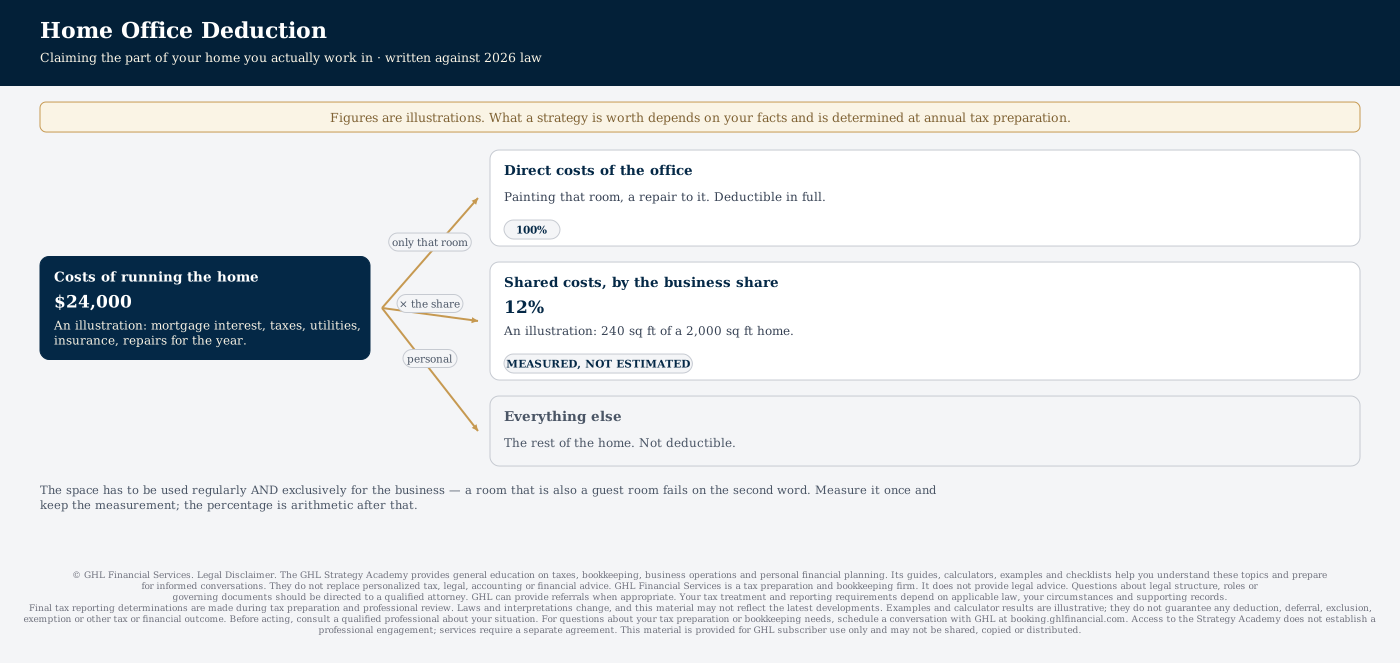
Where part of a home is used regularly and exclusively for business, a proportional share of the home's costs can be treated as a business expense — a share of utilities, insurance, repairs and, for an owner, depreciation.
The amount turns on the share of the home involved and on which of the two calculation methods produces the better result for that year. The simplified method is quicker; the actual-cost method is usually larger for a home with real running costs, and requires the records to support it.
| Business share of the home | 15% |
|---|---|
| Actual cost method — 15% of $24,000 of home costs | $3,600 |
| Simplified method | a published rate per square foot, to a 300 sq ft ceiling |
| Which applies | whichever you choose for the year; it can change year to year |
2026. The simplified method uses $5 per square foot for up to 300 square feet, subject to the method’s eligibility and income limits. Home costs assumed to be mortgage interest, taxes, utilities, insurance and maintenance for the full year. Which method is better is decided on your own figures at preparation.
How it works
Exclusive use is the requirement people most often miss. A desk in a spare room used only for work qualifies; the same desk in a room that is also a guest bedroom does not.
Regular use means what it sounds like — occasional use of a room does not make it an office.
The two methods are a choice, not a preference: the simplified method multiplies the square footage by a published rate up to a ceiling, while the actual method applies the business percentage to the home's real costs.
Employees generally cannot deduct a home office at all under current law. Where the business is an S-Corp and the owner is its employee, the usual route is an accountable plan — the company reimburses the documented cost, which is deductible to the company and not income to the owner.
What you would do
- Measure the space, and the home, and keep the figures.
- Photograph the room as it is actually used, once a year.
- Keep the year's utility, insurance and maintenance bills — the actual method cannot be reconstructed without them.
- If the business is an S-Corp, ask GHL about an accountable plan before paying anything personally.
Usually a week or two — mostly things you can start yourself.
Worksheets to use
- Home office worksheet (XLSX). Measurements and the year's home costs, with the business share calculated, so both methods can be compared at tax preparation. Measure once, then add costs through the year as bills arrive. Bring it to tax preparation with the bills behind it.
What GHL needs from you
- Square footage of the office and of the home.
- The year's home running costs, by category.
- Confirmation the space was used regularly and exclusively for the business.
- For an S-Corp: the accountable plan and the reimbursement records under it.
What usually goes wrong
- Exclusive use quietly stops being true. A room that worked in January is the spare bedroom at Christmas, and the test is applied to the year rather than to the month it was set up in.
- The actual method is chosen and the bills are not kept. Utilities, insurance and maintenance cannot be reconstructed from memory in March, and what is left is the simplified method — usually for less.
- An S-Corp owner pays the household costs personally all year and raises it at filing. Without an accountable plan already in place, there is often no clean route left to get that money out of the company.
Common questions
Does claiming it cause problems when the home is sold?
Depreciation taken on the business portion is accounted for at sale. It is a known consequence, not a surprise, and it is worked through at the time — raise it with GHL before selling.
Can both spouses claim an office in the same house?
Only where each has a separate qualifying space and a business that needs it. Two people sharing one desk is one office.
What if the business also rents commercial space?
Then the home office generally does not qualify, because the home is not the principal place of business. There are narrow exceptions; bring the facts.
Read next
Keeping it alive
A position is not finished when it is set up. This is what it needs each year to still be there when it matters.
- Confirm it still applies — circumstances change more often than the law does.
- Keep the record current. Filled in as the year happens it is evidence; assembled in March it is a reconstruction.
- Put the date in the calendar. This one closes at the year end and cannot be added at tax preparation.
- Ask GHL what changed for 2027. Figures move every year and rules move most years.