
When it matters: The plan has to exist before the first reimbursement of the year. Claims are substantiated within the period the plan sets.
Does this fit you?
- You own an S-Corp or C-Corp and pay business costs out of a personal account.
- Your closely held company has employee-shareholders who incur real business expenses.
- You are a solo S-Corp owner: since the 2018 changes you can no longer deduct a home office as an employee expense, and reimbursement is the route that remains.
What it could be worth
Under a written plan meeting the requirements, a company can reimburse an employee for documented business expenses without the payment becoming wages. The company deducts the cost; the employee receives the money without it appearing on the W-2 and without payroll tax on those dollars.
Without a written plan the same payment is wages by default. That is the whole of the difference — the money moves either way, and the paperwork decides how it is treated.
| Reimbursed under a plan, deductible to the company | $15,000 |
|---|---|
| Added to the owner's W-2 | nothing |
| Combined federal effect at a 24% bracket | ≈ $5,750 |
A 24% bracket, expenses that are genuinely the company's, reimbursement made outside payroll, and a written plan in place before the first payment. The figure moves with the bracket and with what the expenses actually are.
How it works
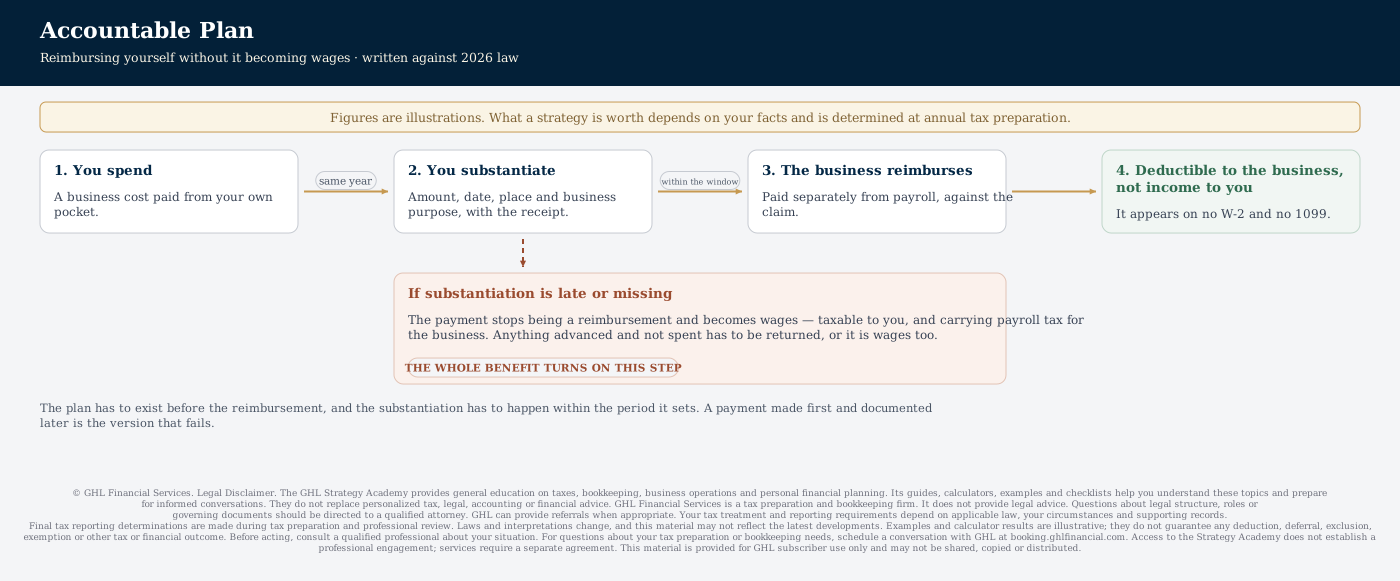
Three requirements sit behind the treatment: the expense has a business connection, it is substantiated within a reasonable time, and anything advanced in excess of the documented cost is returned — the usual benchmark being 120 days.
The reimbursement is paid as its own transaction, not folded into a payroll run, so it does not become part of wages by accident.
The plan is a written company policy, adopted before the first reimbursement for the year. A verbal understanding does not qualify, and a plan adopted in March does not cover January.
GHL does not draft the plan document or the resolution adopting it. Those are company legal documents and come from an attorney; what GHL does is make sure the reimbursements are recorded and reported correctly once the plan exists.
What you would do
- Have an attorney prepare the plan document, and adopt it before the first reimbursement of the year.
- Submit expenses on a regular cadence — monthly is usual — with receipts and the business purpose written at the time.
- Have the company pay reimbursements separately from payroll.
- Return anything advanced above the documented cost, inside the window the plan sets.
Allow one to two months. Some of it depends on other people.
Worksheets to use
- Expense reimbursement report (XLSX). One month of expenses with date, amount, business purpose and receipt reference, totalled for signature. The record the plan requires — not the plan itself, which comes from an attorney. One per month. Fill it in as expenses happen, attach the receipts, and submit it to the company on the same cadence every month.
What GHL needs from you
- The signed plan document and the resolution adopting it, for the file.
- The expense reports for the year, with receipts and business purpose.
- Bank records showing the reimbursements paid outside payroll.
- Payroll reports showing the reimbursements were not included in W-2 wages.
What usually goes wrong
- A verbal policy is not a plan. Reimbursements paid without a written one are wages by default.
- Anything advanced and not spent has to be returned within the period the plan sets, or it becomes wages too.
- The business purpose is written down at the time, not reconstructed. A claim with a receipt and no purpose is the one that gets questioned.
Common questions
Can GHL give me the accountable plan document?
No. A plan document and the resolution adopting it are company legal documents, and drafting them is an attorney's work. GHL will tell you what the reimbursements need to show once it exists.
What happens if there is no written plan?
The reimbursements are wages. They go on the W-2 and carry payroll tax, which is the outcome the plan exists to avoid.
Can I reimburse expenses from earlier years?
A plan covers the period from its adoption. Older costs are a conversation to have with GHL rather than something to run through a current-year report.
Read next
Keeping it alive
A position is not finished when it is set up. This is what it needs each year to still be there when it matters.
- Confirm it still applies — circumstances change more often than the law does.
- Keep the record current. Filled in as the year happens it is evidence; assembled in March it is a reconstruction.
- Check the documents still say what they said — an agreement that has drifted from practice is the usual failure.
- Ask GHL what changed for 2027. Figures move every year and rules move most years.