
Does this fit you?
- Your business genuinely needs a place to meet — a board meeting, a planning day, a recorded training session.
- Your home is not otherwise being rented out.
- You are prepared to document each use at the time it happens, not in March.
What it could be worth
There is a long-standing rule that a residence rented for fourteen days or fewer in a year is treated differently from a rental property: the owner does not report the rent as income, while the business that paid it may treat a genuine business rental as an expense.
That combination is why the strategy is attractive, and also why it draws attention. Its value depends on a real business use, a rate that reflects what a comparable venue would charge, and paperwork created when the meeting happened. Without those three, the payment is a transfer from one pocket to another and is reviewed as such.
| Comparable local venue rate, per day | $750 |
|---|---|
| Documented business uses in the year | 12 |
| Rent paid by the business | $9,000 |
A rate taken from written quotes for comparable local space, each date supported by an agenda and minutes, and a written rental agreement between the owner and the business. The defensible rate for your home and area is a fact question, settled before the first payment, not at filing.
How it works
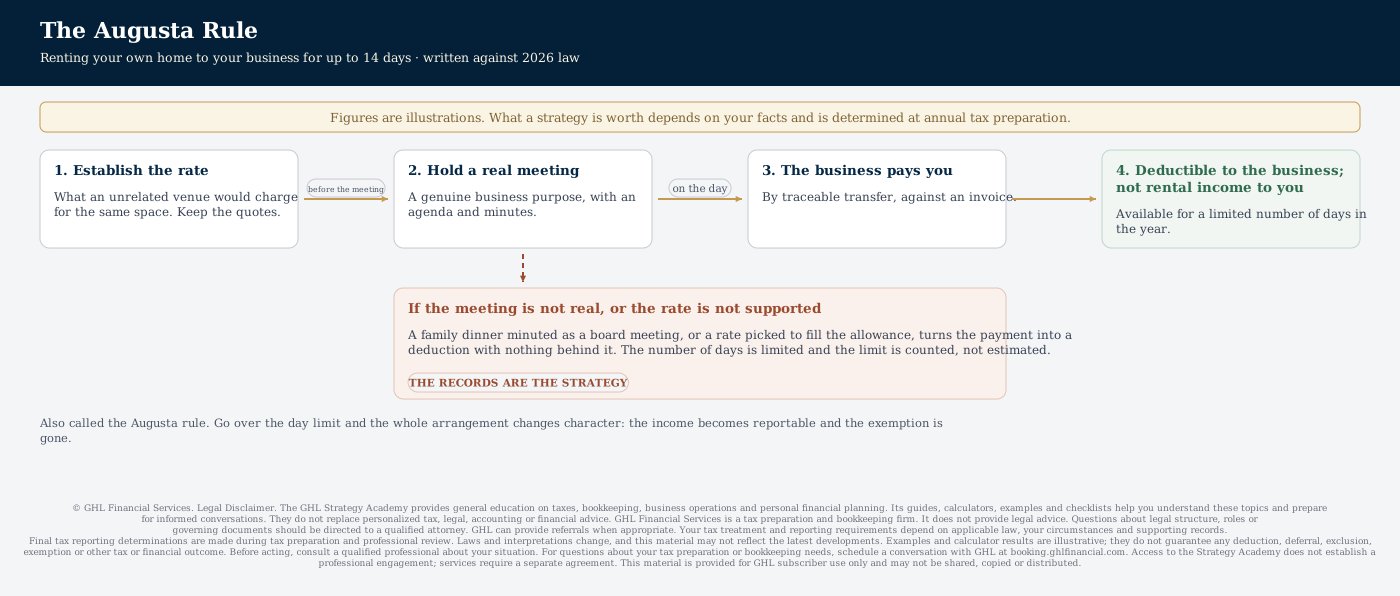
The business rents space from the owner for a specific business purpose on a specific day, at a rate it could have paid an unrelated venue, and pays it like any other bill.
Fourteen days is a ceiling for the year, not a target. Using all fourteen with thin documentation is weaker than using four with strong documentation.
The rate is the part that moves. It should come from what comparable space actually costs near you — written quotes from venues, kept in the file — rather than from a number chosen because it produces a convenient total.
What you would do
- Decide before the year starts whether the business genuinely meets at your home, and for what.
- Get written quotes from two or three comparable local venues, and keep them.
- Put a short written rental agreement in place between you and the business.
- For each use: an agenda before, minutes or notes after, and the date recorded.
- Pay by business check or transfer — never cash, never a journal entry with no money moving.
Allow one to two months. Some of it depends on other people.
Worksheets to use
- Business use of home — day log (XLSX). One line per use, with the rate basis at the top and a running day count, so the ceiling is visible before it is reached. Complete the rate basis before the first use of the year. Add a line on the day of each use, while the agenda and attendees are still in front of you.
- Business meeting record (DOCX). Agenda, attendees and decisions for a single meeting. Completed on the day; a reconstruction in March is what this avoids. One copy per meeting, completed on the day. Print a few and keep them where the meetings happen.
What GHL needs from you
- The rental agreement.
- The comparable-rate evidence the rate was set from.
- For each date claimed: agenda, minutes or notes, and proof of payment.
- The count of days used, so the fourteen-day ceiling can be confirmed.
What usually goes wrong
- The rate is decided first and the evidence gathered in the spring, when somebody asks for it. Quotes obtained a year after the meeting carry very little weight, and the rate is the part of this that gets tested.
- No money moves. A journal entry between the owner and the business, or a check written and never banked, leaves a deduction with no transaction underneath it.
- All fourteen days get claimed because fourteen is the number in the rule. A day with no agenda and no minutes is the one that costs the days that had both.
Common questions
Can this be done for a home office as well?
They are different things and are documented differently. A home office is about regular and exclusive use of space; this is about occasional business use of the whole home. Bring both to tax preparation and they will be treated separately.
What if the rate is high because the house is large?
Size is part of the comparison, but the evidence still has to be what comparable space rents for. A rate nobody else in the area charges is the first thing questioned.
Does a family gathering count if business is discussed?
No. The use has to be a business use — a meeting that would have happened somewhere, with an agenda and a record of what was decided.
Read next
Keeping it alive
A position is not finished when it is set up. This is what it needs each year to still be there when it matters.
- Confirm it still applies — circumstances change more often than the law does.
- Keep the record current. Filled in as the year happens it is evidence; assembled in March it is a reconstruction.
- Put the date in the calendar. This one closes at the year end and cannot be added at tax preparation.
- Ask GHL what changed for 2027. Figures move every year and rules move most years.