
When it matters: Settled with the return, but the decisions that drive it — expensing, bonus depreciation, an S-corp election — are made during the year and often for federal reasons alone.
Does this fit you?
- You live in California with business income, where the pass-through add-back is the largest single number.
- You are buying equipment or property, where the expensing rules diverge sharply.
- You own an S corporation, because of the franchise tax.
What it could be worth
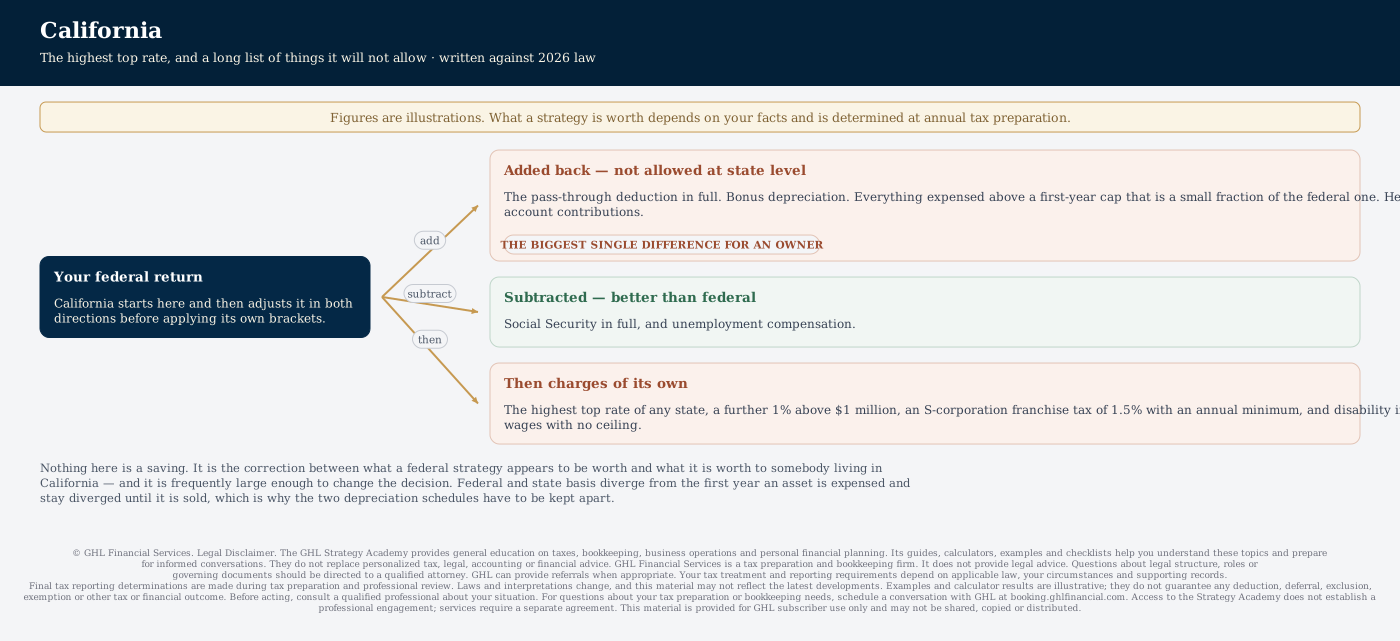
Nothing here is a saving. It is the correction between what a federal strategy appears to be worth and what it is worth to somebody living in California.
That correction is frequently large enough to change the decision. A pass-through deduction worth tens of thousands federally is worth nothing at state level, and an asset expensed in full federally still produces a California deduction spread over years.
Where it does go the other way — Social Security excluded, unemployment excluded — it is worth saying so, because a retiree's California bill is often lower than the headline rate suggests.
| Pass-through deduction | not allowed — added back in full |
|---|---|
| Bonus depreciation | not allowed — regular depreciation instead |
| First-year expensing | capped far below the federal figure |
| Health savings account | no state deduction |
| Social Security | fully excluded — better than federal |
| Income above $1 million | an extra 1% on top of the top bracket |
| S corporation | 1.5% franchise tax, with an annual minimum |
Bracket figures come from the engine's model for 2026 and are for a single filer; joint brackets are roughly doubled at the lower end. Disability insurance is charged on wages with no ceiling. These are planning estimates — an actual return needs the full state schedule.
How it works
California starts from federal adjusted gross income and then adjusts it, in both directions, before applying its own brackets.
Added back: the pass-through deduction, bonus depreciation, the excess of federal first-year expensing over the much lower state cap, and health savings account contributions.
Subtracted: taxable Social Security, which California excludes entirely, and unemployment compensation.
The adjusted figure runs through a graduated scale that reaches the highest top rate of any state.
Income above $1 million carries a further 1%.
An S corporation pays 1.5% of net income as a franchise tax, subject to an annual minimum that applies whether or not it made money.
Disability insurance is charged on all wages, with no upper limit, so it acts as a further percentage on salary.
What you would do
- Ask for the California number alongside the federal one before making any expensing or depreciation decision. The two answers are routinely far apart.
- If you are weighing an S-corporation election, put the franchise tax and its minimum into the comparison.
- Keep the state depreciation schedule separately. Federal and state basis diverge from the first year and stay diverged until the asset is sold.
- Do not count a health savings account deduction at state level.
- If your income is near $1 million, say so — the extra percentage point applies above that line.
What GHL needs from you
- Federal depreciation and expensing elections, with the asset detail behind them.
- Whether an S corporation is in the picture, and its net income.
- Wages, separately from other income, for the disability charge.
- Health savings account contributions.
- Social Security and unemployment received.
What usually goes wrong
- California does not allow the pass-through deduction at all. A federal deduction worth 20% of business income is added straight back for state purposes, which is the single largest difference for most owners.
- It does not follow federal bonus depreciation, and its first-year expensing cap is a small fraction of the federal one. An asset written off entirely in year one federally is depreciated over years in California.
- Health savings account contributions are deductible federally and not in California, so the account is untaxed at one end rather than both for a California resident.
- An extra 1% applies to income above $1 million, on top of the top bracket.
- An S corporation pays a state franchise tax of 1.5% of its net income, with a minimum charge every year even in a loss year. The federal reason for electing S status does not carry that cost; California does.
- State disability insurance is charged on wages with no ceiling, so it behaves like an additional rate on every dollar of salary rather than a capped payroll item.
- Social Security and unemployment compensation are fully excluded, which is one of the few places California is more generous than the federal rules.
Common questions
I got a large pass-through deduction federally. Does California follow?
No. It is added back in full, so a deduction worth a great deal federally is worth nothing at state level. For most California business owners that is the biggest single difference between the two returns.
I expensed a machine in full this year. What happens at state level?
The state cap is a small fraction of the federal one, so most of it is depreciated over years instead. Federal and state basis diverge from that point, which is why the two schedules have to be kept separately.
Does electing S-corporation status still make sense here?
Often, but the comparison has to include the 1.5% franchise tax and its annual minimum, which is charged even in a loss year. The federal arithmetic on its own overstates the benefit for a California business.