
Does this fit you?
- You own a pass-through business — sole proprietor, partnership, S-Corp, or an LLC taxed as any of those.
- Your rental activity rises to a trade or business; a triple-net lease generally does not.
- Worth the most attention where your taxable income is near a threshold, because that is where the arithmetic changes shape.
What it could be worth
Owners of pass-through businesses may deduct up to 20% of qualified business income. Below the taxable-income thresholds that is close to automatic, subject to a cap at 20% of taxable income. Above them it becomes a calculation rather than a percentage.
Which side of the threshold a return lands on is itself movable — retirement contributions, charitable giving and the salary an S-Corp pays all change taxable income. That is why this is discussed before year end rather than at filing, when the levers have stopped moving.
| Full deduction available below (married filing jointly) | $403,500 |
|---|---|
| Full deduction available below (single) | $201,750 |
| The range it phases across | $150,000 joint / $75,000 single |
| Above that, a non-service business is limited to the greater of | 50% of W-2 wages, or 25% of wages + 2.5% of qualified property |
| Above the upper threshold, a service business | phases out entirely |
2026 thresholds and phase-in range from Rev. Proc. 2025-32 §4.26, the same figures as the deductions and limits page; the wider range is from the 2025 law. They move annually and your own figures are applied at tax preparation. The wages-and-property test is why a salary decision changes this answer.
How it works
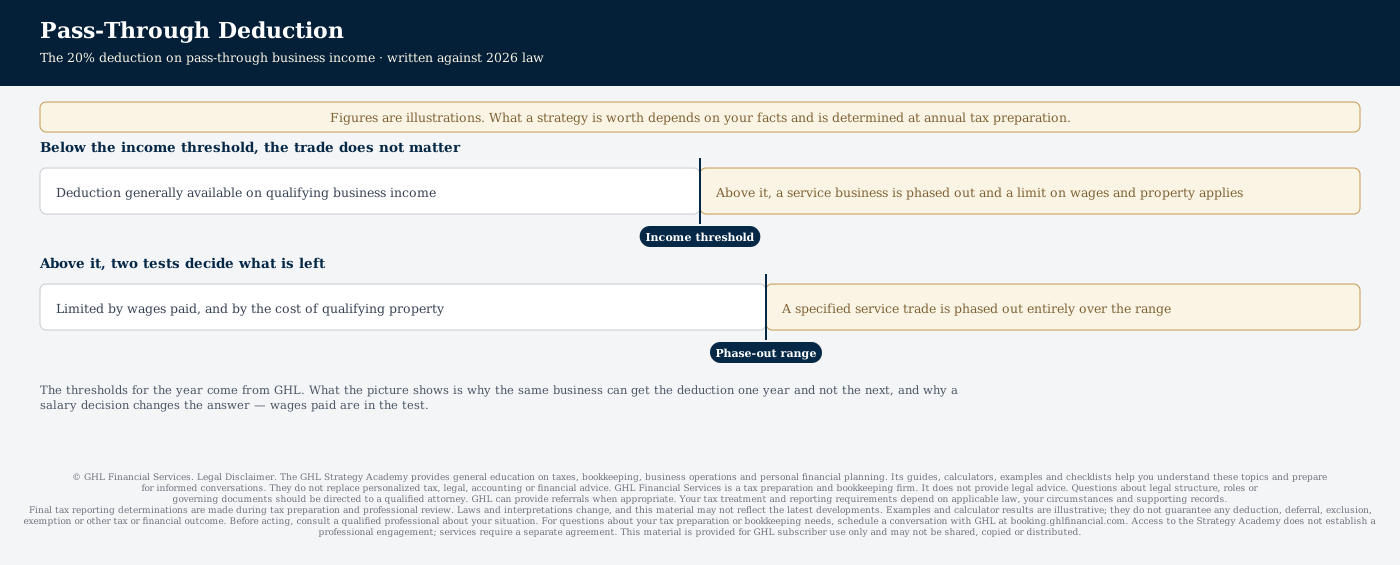
Below the threshold the deduction is 20% of qualified business income, capped at 20% of taxable income. Most owners never meet the complications.
Above the threshold a non-service business is limited by what it pays in W-2 wages and what it holds in qualified property. A business with employees and equipment keeps more of the deduction than one with neither.
A specified service trade or business — health, law, consulting, athletics, performing arts, financial services, brokerage, investment management, and anything whose principal asset is the skill or reputation of its people — phases out completely above the upper threshold.
Whether a particular business is a service business is the question that produces the most argument. The regulations work through boundary cases; it is a facts question, not a label you pick.
What you would do
- Tell GHL before year end if income is close to a threshold — after December 31 most of the levers are gone.
- Keep the W-2 wage total and a fixed-asset list for the business; above the threshold both feed the limit directly.
- If you run more than one activity, keep their books separate — the deduction is computed per business.
- Raise any change in what the business does; it can change whether it counts as a service business.
What GHL needs from you
- Business income by activity, with separate books where there is more than one.
- Total W-2 wages paid by the business for the year.
- A fixed-asset list with dates and cost, for the qualified-property part of the limit.
- A description of what the business actually does, in enough detail to test the service-business question.
What usually goes wrong
- Income lands just over a threshold and nobody knew until the return was prepared. Most of what moves it — a retirement contribution, the salary, the timing of an invoice — closed on December 31.
- Two activities run through one set of books. The deduction is computed per business, and separating them after the year has closed is reconstruction rather than accounting.
- The business is described by its label rather than by what it does. Whether it counts as a service business turns on the facts, and the boundary is where the argument actually happens.
Common questions
Is my consulting business a service business?
If the principal asset of the business is your skill or reputation, generally yes. There is real judgment at the boundary and the regulations give examples — bring the facts rather than the label.
Does rental income qualify?
Only where the rental activity rises to a trade or business. There is a safe harbor built around hours of activity, and triple-net leases generally fall outside it.
Can hiring someone increase the deduction?
Above the threshold, wages paid by the business feed the limit, so it can. Whether that is worth doing depends on whether you needed the employee — the wage is a real cost either way.