
When it matters: Notice to employees before the plan year starts, which means setting it up in the fall before.
Does this fit you?
- You are a small employer who wants to offer health benefits without the cost and rigidity of a group plan.
- Your people are spread across places where one plan does not suit everybody.
- You would rather commit a fixed amount per person than underwrite a plan's increases.
What it could be worth
The arrangement lets a business reimburse employees for individual health insurance premiums and qualifying medical costs. The reimbursement is deductible to the business and is not treated as wages, so payroll tax does not apply to those dollars on either side.
The other half of the value is predictability: the employer sets the amount rather than inheriting a group plan's renewal.
| Reimbursed in the year | $60,000 |
|---|---|
| Treatment to the business | deductible |
| Treatment to the employee | not wages |
| Combined effect at an assumed 30% rate | ≈ $18,000 |
A written arrangement in place before the plan year, the required notice given, employees holding qualifying individual coverage, and reimbursements made against substantiated premiums. The rate assumed here stands in for a real calculation done on the business's own figures.
How it works
Amounts can differ between defined classes of employee — full time against part time, salaried against hourly, by location — but not between individuals within a class. The class rules are specific and are where most design problems arise.
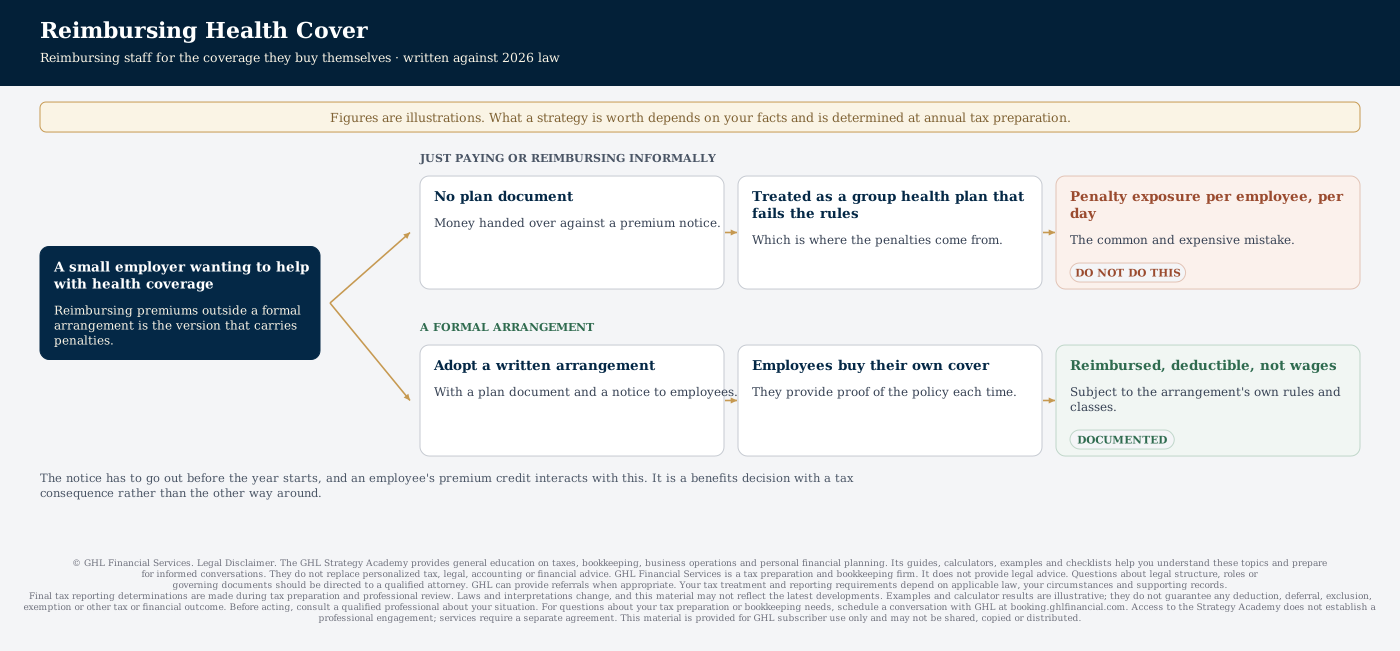
There is a written plan document, and a notice that has to reach employees a set period before the plan year starts. Both are requirements rather than good practice.
Employees buy their own individual coverage and submit evidence of what they paid. The business reimburses against that evidence.
It interacts with marketplace subsidies: an offer of this kind can affect an employee's eligibility for a premium tax credit, and employees need to understand that before deciding.
GHL does not draft the plan document or the employee notice. Those are legal documents and come from an attorney or a specialist administrator; what GHL does is make sure the reimbursements are recorded and reported correctly.
What you would do
- Start the design conversation well before the plan year — the notice period alone rules out a late start.
- Have the plan document and notice prepared by an attorney or an administrator who does these.
- Decide the classes and the amounts deliberately, and write down why.
- Collect premium evidence from employees before reimbursing, every month.
- Tell employees the arrangement may affect their marketplace subsidy, and let them take advice.
Allow one to two months. Some of it depends on other people.
What GHL needs from you
- The plan document and the notice that was given, with dates.
- The classes and amounts, and any changes during the year.
- Monthly reimbursement records with the premium evidence behind them.
- Payroll reports showing the reimbursements were not treated as wages.
What usually goes wrong
- An employee on this arrangement generally cannot also take a premium credit on the exchange. Some are better off opting out.
- The same employees cannot be offered both this and a traditional group plan.
- Classes of employee have to be genuine ones. A class built around a single named person is not allowed.
Common questions
Can we pay different amounts to different people?
Between defined classes, yes. Within a class the amount has to be consistent, apart from variation the rules specifically allow.
Does this affect an employee's marketplace subsidy?
It can. Employees should be told that when the offer is made, and should take their own advice on it.
Read next
Keeping it alive
A position is not finished when it is set up. This is what it needs each year to still be there when it matters.
- Confirm it still applies — circumstances change more often than the law does.
- Check the documents still say what they said — an agreement that has drifted from practice is the usual failure.
- Ask GHL what changed for 2027. Figures move every year and rules move most years.