
When it matters: A change takes effect from the next pay run, so December is late but not useless — withholding still counts as paid across the whole year.
Does this fit you?
- You have two incomes in the household, where the default is a shortfall.
- You have had a large balance or a large refund two years running.
- You have just married, divorced, had a child or started a second job.
- You are retiring, where the withholding forms change entirely.
What it could be worth
Withholding is meant to land close to the tax. Where it does not, the two failures are unequal: a large balance can carry a charge and a large refund simply costs the use of the money, for months.
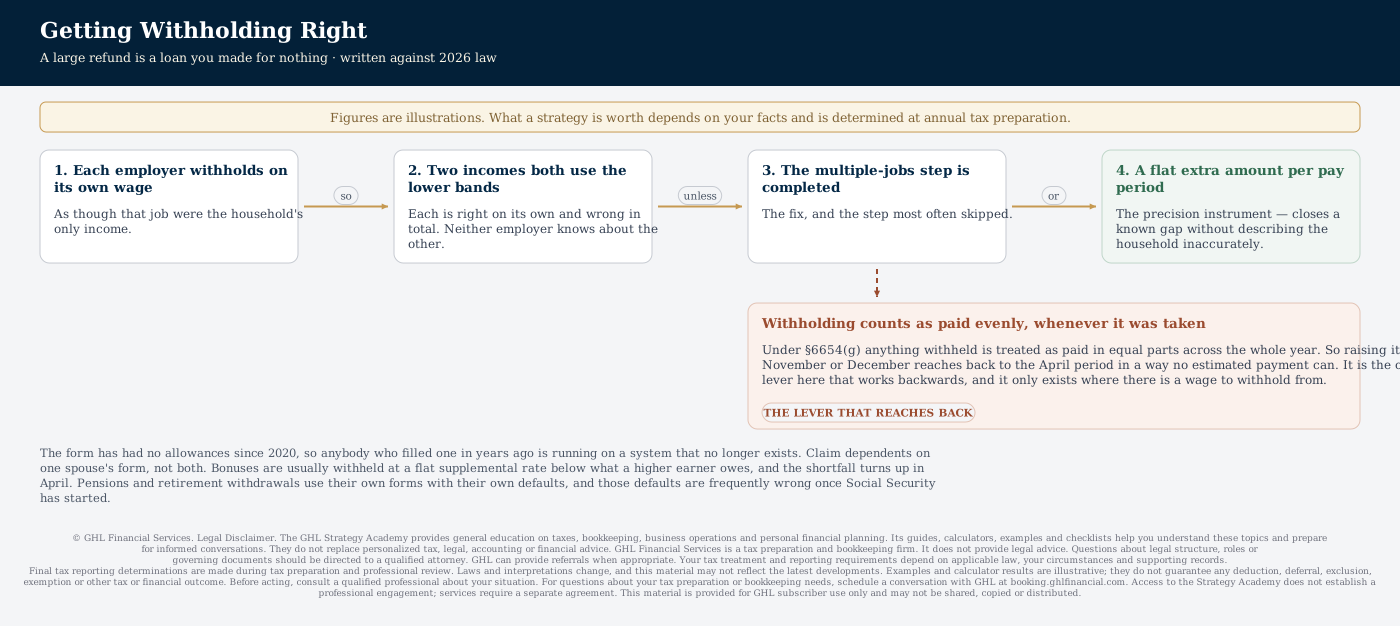
The mechanism people trip over is that every employer withholds as though its wage were the household's only income. Two jobs, or two working spouses, therefore withhold correctly on each and incorrectly in total, because both have applied the same lower bands.
The form has a step specifically for that, and it is the one most often skipped. Below it sits a line for a flat extra amount per pay period, which is the precision instrument — the honest way to correct a known shortfall without pretending the household looks like something it does not.
And withholding has a property nothing else has: it is treated as paid evenly across the year, whatever month it was actually taken. That makes raising it in November or December able to fix a shortfall from April, which no estimated payment can do.
| Filing status | sets which bands the employer applies |
|---|---|
| The multiple-jobs step | the fix for two incomes; most often skipped |
| Dependents | reduces withholding by the credits expected |
| Other income and deductions | for income with no withholding, and for itemizing |
| Extra withholding per period | a flat amount — the precision instrument |
| Anything withheld, whenever | treated as paid evenly across the whole year |
The structure of the current form. Pensions and retirement distributions use their own forms with their own defaults. GHL works the actual figures from your own return and tells you what to put where.
How it works
An employer withholds using the filing status and the adjustments on the form, applied to that job's wages as though nothing else existed.
Where a household has two incomes, both employers apply the lower bands to their own wage. The combined income belongs in higher bands, and neither employer knows.
The multiple-jobs step corrects that, either through a checkbox where two jobs pay similarly, or through a worksheet, or through an online estimator.
The dependents step reduces withholding by the credits expected. Claiming it on both spouses' forms double-counts and is a common cause of a balance.
The other-income line brings in amounts with no withholding at all — interest, dividends, a side business — so the tax on them is collected through the payroll rather than through estimates.
The extra-withholding line adds a flat amount per pay period. It is the simplest and most reliable way to close a known gap, and it does not require the rest of the form to describe the household inaccurately.
Bonuses and other supplemental pay are usually withheld at a flat rate. For somebody whose marginal rate is higher than that, every bonus arrives under-withheld.
Retirement income uses different forms: one for periodic pension payments and another for withdrawals from accounts, each with its own default. The defaults are frequently wrong once Social Security has started and other income has changed.
Because withholding is treated as paid rateably across the year under §6654(g), increasing it late still counts as though part of it had been paid in each earlier period. That is the one lever that reaches backwards.
A change takes effect from the next pay run. Nothing is backdated, but the rateable treatment means the effect is spread anyway.
What you would do
- Look at your last return: a balance or a refund over a few hundred dollars means the form is wrong.
- If there are two incomes, complete the multiple-jobs step. It is the single most common omission.
- Claim dependents on one form, not both.
- Use the extra-withholding line to close a known gap rather than inventing a filing status.
- Redo it after a marriage, a divorce, a birth, a job change or a spouse starting work.
- On retiring, complete the new forms deliberately rather than accepting the defaults.
- If the year is nearly over and you are short, raise withholding rather than making a large estimated payment.
Usually a week or two — mostly things you can start yourself.
What GHL needs from you
- Last year's return, for the comparison.
- Current pay stubs for every job in the household, with year-to-date withholding.
- Expected income with no withholding on it.
- Any bonus expected, and how it will be paid.
- Pension and retirement withdrawal amounts, and what is being withheld on them.
What usually goes wrong
- Each employer withholds as though its job were your only one. Two incomes in a household therefore under-withhold by design, and the return arrives with a balance nobody did anything wrong to create.
- The form has had no allowances since 2020. Somebody who filled one in years ago is running on a system that no longer exists.
- A bonus is usually withheld at a flat supplemental rate, which is below what a higher earner actually owes on it. The shortfall turns up in April.
- A large refund is not a win. It is money lent for nothing for up to sixteen months, at a moment when it could have been earning or paying down debt.
- Pensions and retirement withdrawals have their own forms and their own defaults, and the defaults are frequently wrong once Social Security starts.
- Life changes do not update the form. A marriage, a divorce, a child, a spouse starting work and a second job each change the answer and none of them prompts anybody.
- Under-withholding by enough brings a charge on top of the tax, worked out period by period rather than on the annual total.
Common questions
We both had tax withheld and still owe. How?
Because each employer withheld as though its job were the only income in the household, so both applied the lower bands.
Is a big refund not a good thing?
It is your money returned without interest, sometimes more than a year after it was taken. Landing close to zero is the target in both directions.
It is November and I am short. Is it too late?
No, and this is the one place timing works in your favor. Withholding counts as paid evenly across the whole year, so raising it now reaches back to the earlier periods in a way an estimated payment cannot.
Read next
Keeping it alive
A position is not finished when it is set up. This is what it needs each year to still be there when it matters.
- Confirm it still applies — circumstances change more often than the law does.
- Put the date in the calendar. This one closes at the year end and cannot be added at tax preparation.
- Ask GHL what changed for 2027. Figures move every year and rules move most years.